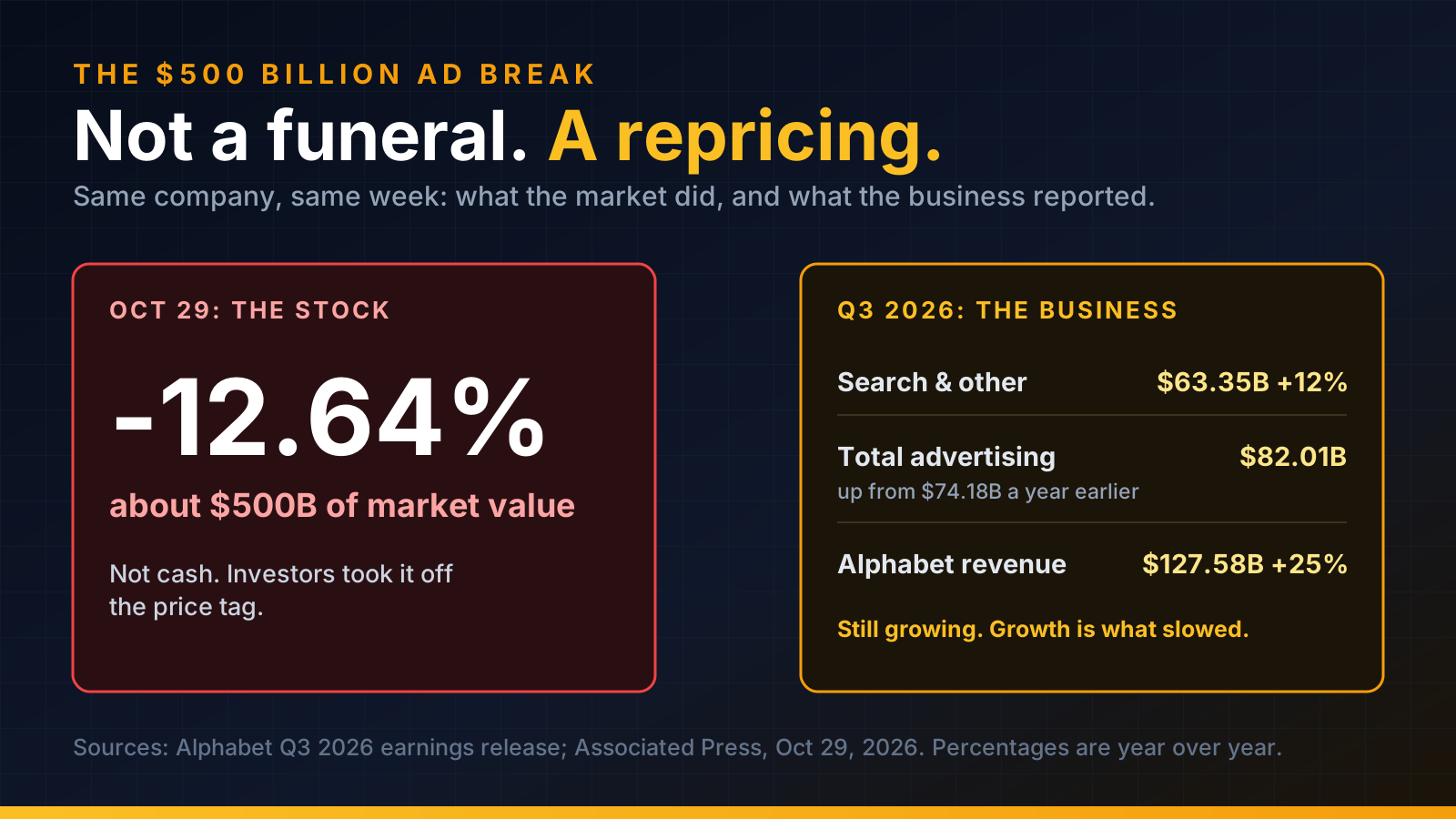
On Thursday, October 29, Alphabet lost roughly $500 billion in market value.
Not cash. Nobody opened a drawer at Google headquarters and discovered half a trillion dollars missing between the stapler and the spare ethernet cables. The stock fell 12.64%, and the market repriced what investors think the company is worth.
Still, when a business can lose the approximate economic output of a small country in a single trading session, I'm inclined to look beyond whether someone used the wrong font on the earnings presentation.
Here's the irony.
Google spent decades making the internet dependent on asking it questions. It created one of the greatest advertising machines in history by helping us find answers, with a few conveniently placed sponsors along the way.
Now artificial intelligence is changing the transaction. The computer doesn't just point toward the answer. Increasingly, it delivers the answer itself.
That's wonderful for the person asking. It is considerably more complicated for the company that used to get paid when the person clicked.
And if the answer requires an enormous amount of computing infrastructure to produce, the economics get even more interesting.
Imagine operating a restaurant that has trained everyone in town to cook at home. Great customer service. Slight problem with the dinner rush. Oh, and you've just committed to buying an industrial kitchen the size of Connecticut.
First, Let's Cancel Google's Funeral
There is one minor complication with the popular story that artificial intelligence has killed Google's advertising business:
The business is still growing.
In Alphabet's third-quarter 2026 earnings release, Google Search & other generated $63.35 billion, up 12% year over year. Google's total advertising revenue reached $82.01 billion, up from $74.18 billion a year earlier. Alphabet's overall quarterly revenue rose 25% to $127.58 billion.
If that's a dying business, I hope somebody invites me to the funeral. I want to see the catering budget.
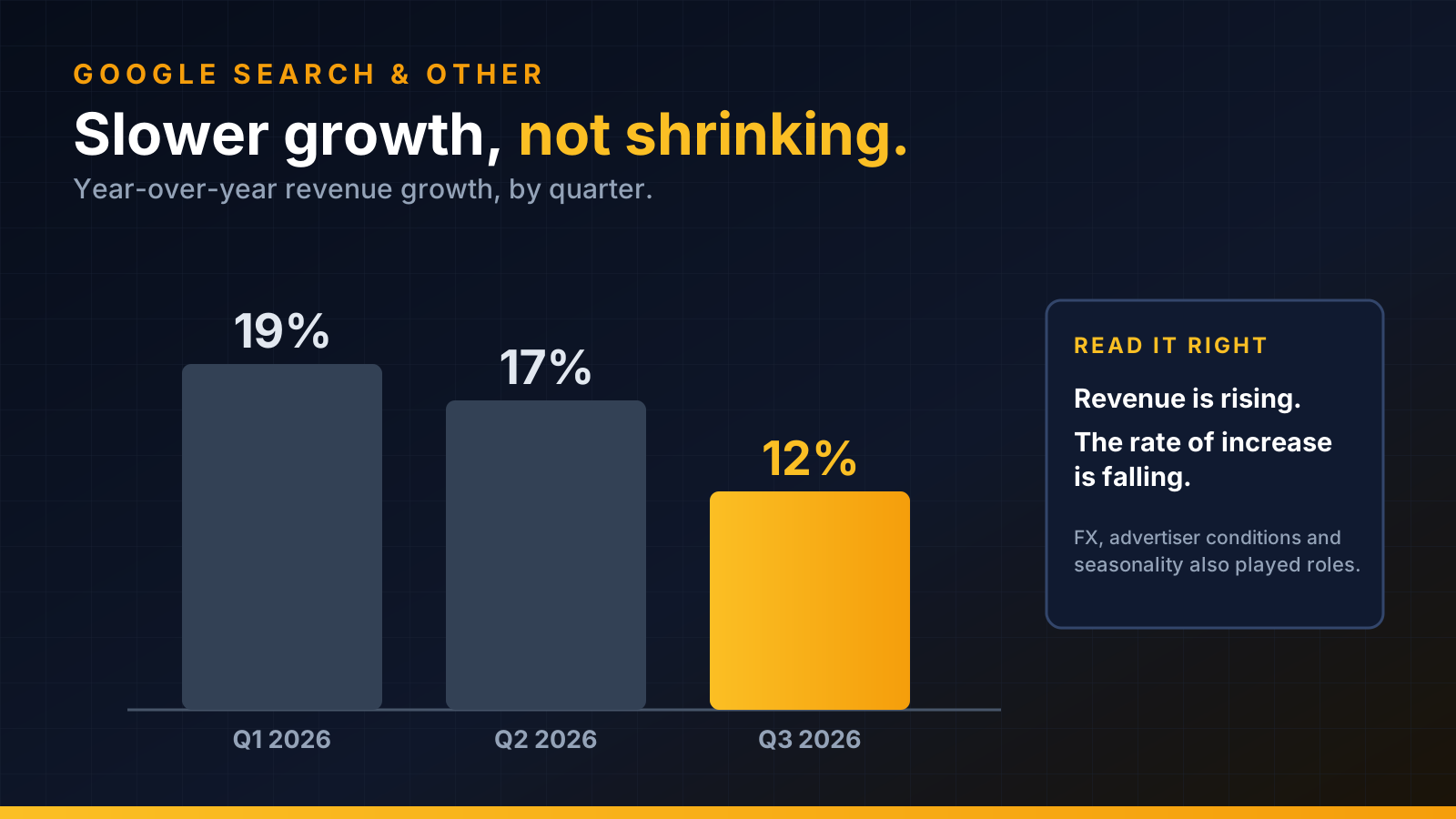
But the rate of search revenue growth tells a different story:
- Q1 2026: 19% year-over-year growth.
- Q2 2026: 17%.
- Q3 2026: 12%.
That is slower growth, not declining revenue. A very important distinction. The patient isn't dead. The doctor just noticed that the marathon runner is breathing a little harder while carrying a much bigger backpack.
Google also says people are searching more. In his October 28 earnings remarks, CEO Sundar Pichai said the year-over-year growth rate in search queries was its highest in five years.
So the simplistic theory—everybody stopped searching Google, therefore Google lost half a trillion dollars—doesn't match the evidence.
The more interesting question is why growth in queries isn't translating into the advertising growth investors expected.
On the earnings call, Google's chief business officer, Philipp Schindler, acknowledged that queries in AI Mode currently have lower monetization than conventional search. In the same discussion, he identified foreign-exchange effects as the largest driver of the quarter-to-quarter search growth slowdown, with advertiser-specific conditions and seasonal spending also playing roles.
That matters. AI isn't the only explanation for the slowdown, and Google is actively expanding its AI advertising formats.
But for a business accustomed to turning intent into advertising revenue with extraordinary efficiency, a growing type of query that earns less is not a trivial design detail.
It's a financial question wearing a chatbot interface.
The Internet Used to Have a Very Convenient Toll Booth
The traditional search model was beautifully simple.
You needed something. You searched. Google provided a page of possibilities. Some businesses paid to get noticed. You clicked a result, and the advertiser or publisher had a chance to turn your visit into something valuable.
The search engine collected money for helping people navigate. Advertisers bought attention. Publishers received visitors. Everyone had a reason to keep the machinery running.
Not everybody got a fair share, obviously. This is the internet, not a charitable bake sale.
But the structure was understandable. A query led to a page, a page led to a click, and a click could lead to a sale.
Now ask an AI system how to replace your garbage disposal.
It can explain the parts, compare the options, walk through the installation, tell you what tools you need, and potentially help arrange the purchase or appointment.
For the consumer, this is excellent. For the old advertising structure, it's an awkward moment.
Where exactly do you put the sponsored link when the customer already got the answer?
Between 'turn off the breaker' and 'check for a leak'?
I would hope not.
AI can make discovery more useful. It can also compress what used to be ten opportunities to visit other sites into one conversation.
That's the real disruption: the destination can disappear even while the demand remains.
The Click Is Going Missing. The Question Isn't.
The shift toward fewer outbound clicks didn't start with generative AI. Search engines have long provided answers directly through maps, weather panels, calculators, featured snippets, and knowledge boxes.
AI accelerates one part of a much larger trend.
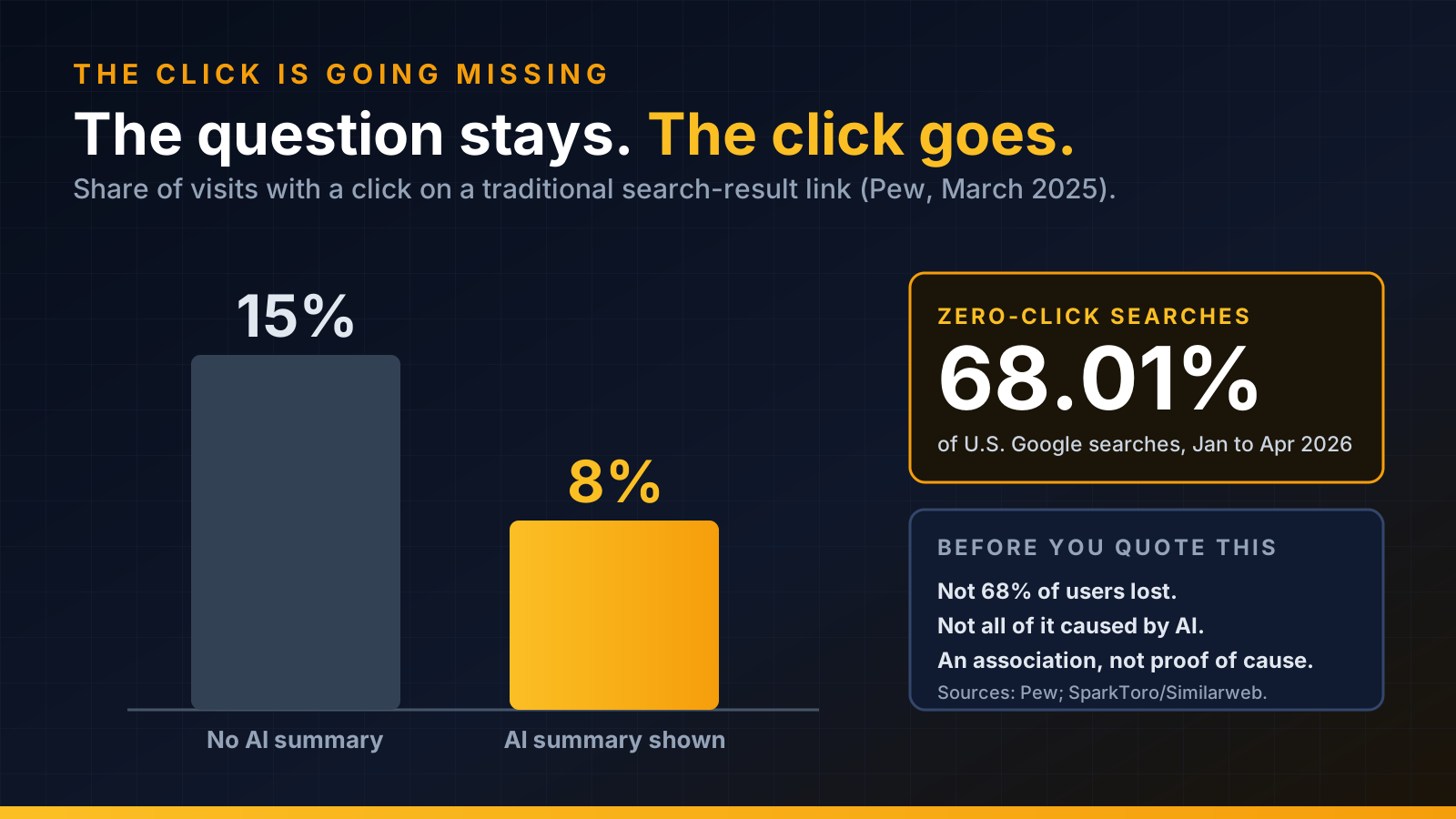
SparkToro's June 2026 analysis, based on Similarweb clickstream data, estimated that 68.01% of U.S. Google searches in the first four months of 2026 ended without a click. A 2024 study reported 60.45%, although the studies used different data panels, so their comparison is not a perfectly controlled before-and-after experiment.
Read the 68% Carefully
That 68% figure is about post-search clicking. It does not mean Google lost 68% of its users or that AI caused every no-click search.
Now look at what happens when an AI summary actually appears.
Pew Research Center found that users clicked a traditional search-result link in 8% of visits with an AI summary, versus 15% without one, in its March 2025 browsing sample. That's an observed association, not proof that introducing a summary alone caused the entire gap.
For publishers, the impact is no longer theoretical. In its 2026 Publisher Playbook, Chartbeat reported that Google Search's share of pageviews across its publisher network went from roughly 9% in July 2024 to 5% in July 2026. That describes participating publishers, not all traffic across the web.
Think about the economics.
A publisher pays writers, editors, researchers, photographers, developers, hosting providers, and the occasional person whose entire job is making sure a pop-up doesn't cover the article you came to read.
Then an answer engine summarizes the material, and the reader never arrives.
The information still has value. The work still has a cost. But the old mechanism that sent a visitor to the original source is less dependable.
That creates a question bigger than Google's quarterly earnings: who pays for the creation and maintenance of the information the AI economy consumes?
Because 'exposure' has never been accepted as payment by my electric company.
Unfortunately, the Robots Have an Electric Bill
There was a time when a website needed a server, a database, and somebody willing to spend a Saturday arguing with a configuration file.
Modern AI adds a much more capital-intensive layer: accelerators, specialized networking, data centers, cooling, energy contracts, model training, inference capacity, and a seemingly endless race to produce the next system before a competitor does.
Alphabet reported approximately $51.4 billion in capital expenditures in Q3 2026. It also reported approximately negative $9.1 billion in quarterly free cash flow. Management projected $195 billion to $205 billion in capital expenditures for the full year and said investment would rise significantly in 2027. The free-cash-flow result also reflected working-capital and other cash factors; it would be misleading to present the entire shortfall as the cost of generating AI answers.
Those figures come from Alphabet's earnings materials and Reuters' October 28 reporting.
What the Numbers Can't Tell Us
Now the critical distinction: those expenditures support much more than consumer search, and the company has not published a simple, universal 'cost per AI answer versus cost per classic search' number that allows us to calculate its profitability from these figures.
So I am not going to invent one.
But the strategic challenge is obvious enough: a company can deliver more usage, improve the customer experience, and still face pressure if the new usage is harder to monetize while the infrastructure behind it requires more capital.
That's not an argument against AI. It's an argument for remembering that even very intelligent machines eventually meet accountants.
And the accountant doesn't care how impressive the demo was.
The accountant wants to know whether this thing pays for itself.
Ads Aren't Dead. They're Just Not a Complete Business Plan.
For some perspective, the Interactive Advertising Bureau's September 2026 forecast projected 8.1% growth in U.S. paid-search advertising spending for the year. Social, connected television, and commerce media were expected to grow faster.
That's a forecast, not a final spending tally, but it is hardly evidence that advertisers have collectively thrown their wallets into the ocean.
Advertising remains valuable because businesses still need customers and customers still need to discover things.
What changes is the nature of the transaction.
A search results page sells visibility near a question. An AI assistant increasingly promises to resolve the question, perhaps by making a comparison, completing a form, buying something, or coordinating a service.
You can sell an ad beside a result. You might sell a subscription for an assistant. You could charge for a completed transaction, an enterprise workflow, or the infrastructure required to perform the work.
These models are not interchangeable. They involve different margins, risks, incentives, and customer relationships.
And that is why I don't expect the next generation of technology giants to survive on advertising alone, even if they continue to sell plenty of it.
The winners will need multiple ways to collect value from actual work performed, not just from interrupting the person trying to do it.
There is a limit to how many sponsored messages you can squeeze into a conversation before your digital assistant starts sounding like an uncle selling timeshares.
So What Actually Pays the Bills Next?
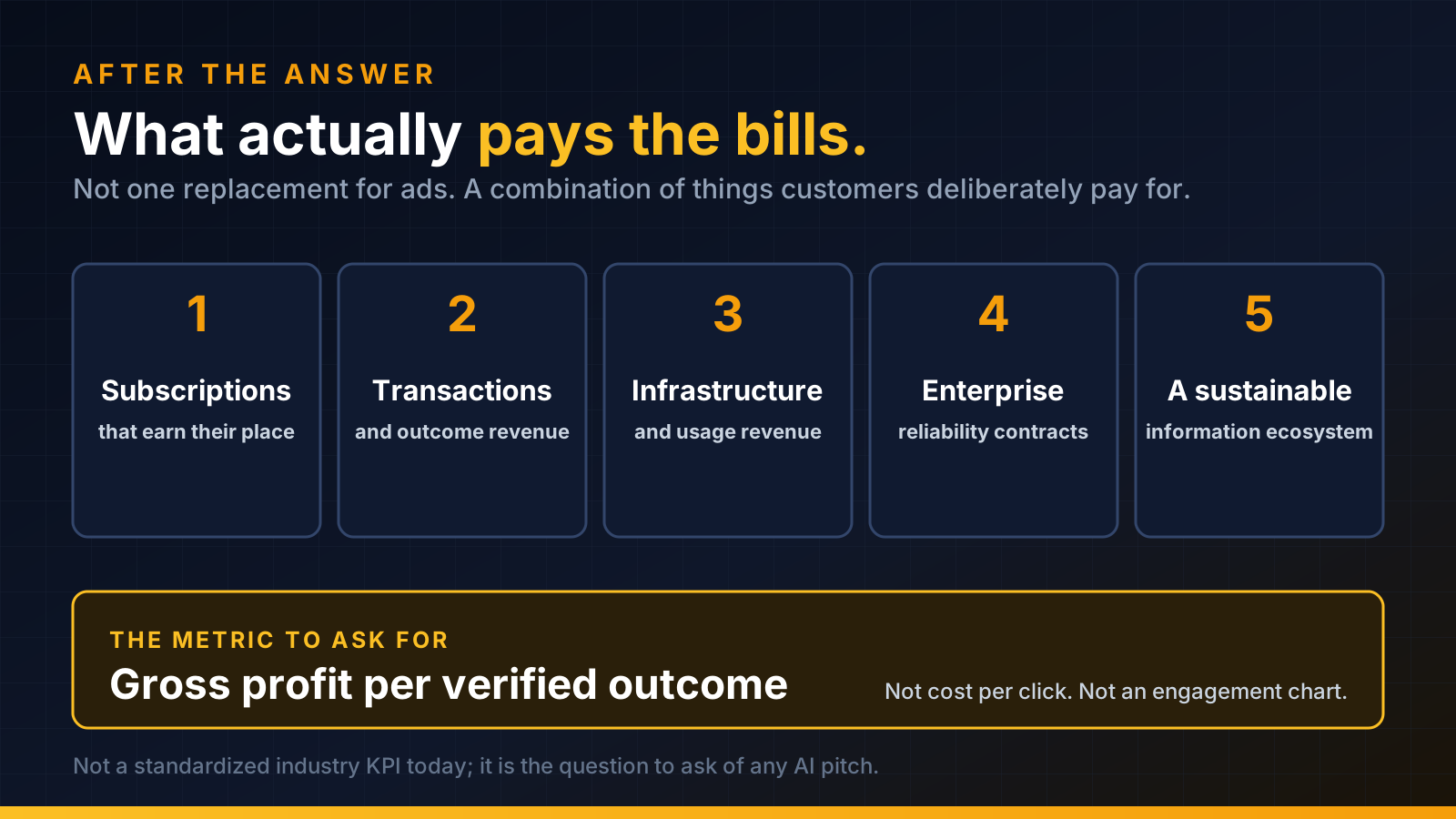
I don't think there is one magic replacement for ads. I think the durable businesses will build a combination of revenue streams around services customers are willing to pay for directly.
1. Subscriptions that earn their place. Not a monthly fee to ask what time the sun sets. I mean assistants that remember work within the user's controls, organize real projects, save measurable time, and help complete tasks reliably. If a service becomes indispensable, the customer has a reason to keep paying beyond novelty.
2. Transaction and outcome revenue. Booking, purchasing, qualified leads, fulfillment, and completed business processes can create value worth paying for. But commissions need to be disclosed, recommendations must not quietly become auctions, and 'completed' has to mean something verifiable. The assistant should not recommend the more expensive toaster simply because the toaster has a better affiliate program.
3. Infrastructure and usage revenue. Cloud platforms, APIs, specialized inference, storage, and enterprise integration can charge based on actual consumption. Alphabet is already demonstrating the appeal of diversification: Google Cloud revenue grew 103% to $30.7 billion in Q3. Cloud is not a speculative future product. It is a large existing business with its own customers and economics.
4. Enterprise contracts built around reliability. A business doesn't just need a clever answer. It needs permissions, audit trails, privacy protections, predictable costs, support, controls, and someone accountable when a system makes a consequential mistake. Those are real products with real procurement budgets. Selling a controlled service is different from trying to slip another banner ad into the conversation.
5. A sustainable information ecosystem. Licensing, attribution, referrals, and fair commercial arrangements matter if AI platforms depend on material created elsewhere. A system that absorbs the web while starving the people who maintain it is not an especially clever long-term supply-chain strategy.
Some of these revenue models already exist. The hard part is doing them profitably, transparently, and at scale.
There is also a danger here: we could replace one imperfect advertising ecosystem with a more opaque marketplace in which an AI's 'best answer' is simply whichever vendor paid the most.
If that happens, congratulations. We reinvented the sponsored search result, except now it's wearing a lab coat and speaking with confidence.
The Metric I Want to See Isn't Another Engagement Chart
I have spent enough time around product, infrastructure, and business operations to become suspicious of numbers that measure everything except whether the work created value.
Pageviews are useful. Query growth is useful. Monthly active users are useful.
None of them, standing alone, tells you whether an AI business is sustainable.
I'd rather see what happens per successfully completed task.
How much revenue does the service earn? What are its real costs, including inference, supporting infrastructure, customer acquisition, support, and the operational effort needed to keep it reliable? How often did it finish the job correctly? How often did a human need to step in? How often did the interaction deliver actual value to the customer, rather than merely produce more interaction?
If an assistant can handle a thousand conversations but completes only fifty useful tasks, the conversation counter is going to be a very handsome liar.
If it can complete the work reliably, keep its costs under control, and charge a fair price for the outcome, that is a business.
The next big operating metric may not be cost per click.
It may be gross profit per verified outcome.
A Metric Worth Asking For
That isn't a standardized industry KPI today. It's the question I would ask if somebody showed up with a billion-dollar AI pitch deck, a hockey-stick usage chart, and no explanation of who actually pays for what.
If the answer is 'we'll monetize the engagement later,' I'd start checking whether the exits are clearly marked.
And Now the $500 Billion Question
Alphabet's October 29 selloff wasn't proof that Google Search is collapsing. Search revenue rose. Total advertising revenue rose. Google Cloud expanded rapidly. Nor can we isolate a single cause for the market's reaction: earnings expectations, slower search growth, spending, cash flow, and broader investment concerns all matter.
But investors received a reminder that the way a technology company makes money matters just as much as the technology itself.
Google's traditional search engine is one of the most successful commercial inventions ever built. There is no reason to pretend it disappears overnight. The company has significant distribution, infrastructure, talent, and a fast-growing cloud operation.
The real risk is subtler.
A business can keep growing while the economics of its next generation of products become less favorable than the ones it is replacing.
It can attract more questions without earning proportionately more money. It can answer those questions so well that publishers lose referrals. It can invest enormously in computing power while experimenting with what customers, advertisers, and enterprises will ultimately pay for.
And it can do all of that while still reporting numbers that would make almost any other company jealous.
What comes next isn't necessarily the death of advertising. It is the end of assuming advertising can fund every new technological experience simply because it funded the last one.
The next generation of giants will need products people deliberately choose to pay for, infrastructure businesses with disciplined economics, transaction models that reward real outcomes, and enough trust that customers invite them to do more than display information.
Because the future isn't just about who can answer the question.
It's about who can finish the work, prove it was done correctly, and build a sustainable business around it.
The computers are getting smarter.
At some point, the business models are going to have to catch up.
And the power company still wants actual money.
— Thesecretchief
Sources and scope
This is technology and business-model analysis, not investment advice. Alphabet's reported figures describe Q3 2026 and the stock movement on October 29, 2026. The consumer-behavior studies use their own samples and periods, and do not establish that AI alone caused every change.
- Associated Press — October 29, 2026 Alphabet selloff
- Alphabet — Q3 2026 earnings release
- Alphabet — Q3 earnings call and AI Mode monetization discussion
- Google CEO — Q3 2026 earnings remarks
- SparkToro/Similarweb — 2026 zero-click search study
- Pew Research Center — AI summaries and search-result clicks
- Chartbeat — 2026 Publisher Playbook
- IAB — September 2026 advertising outlook
- Reuters — Alphabet earnings, free cash flow and capital spending