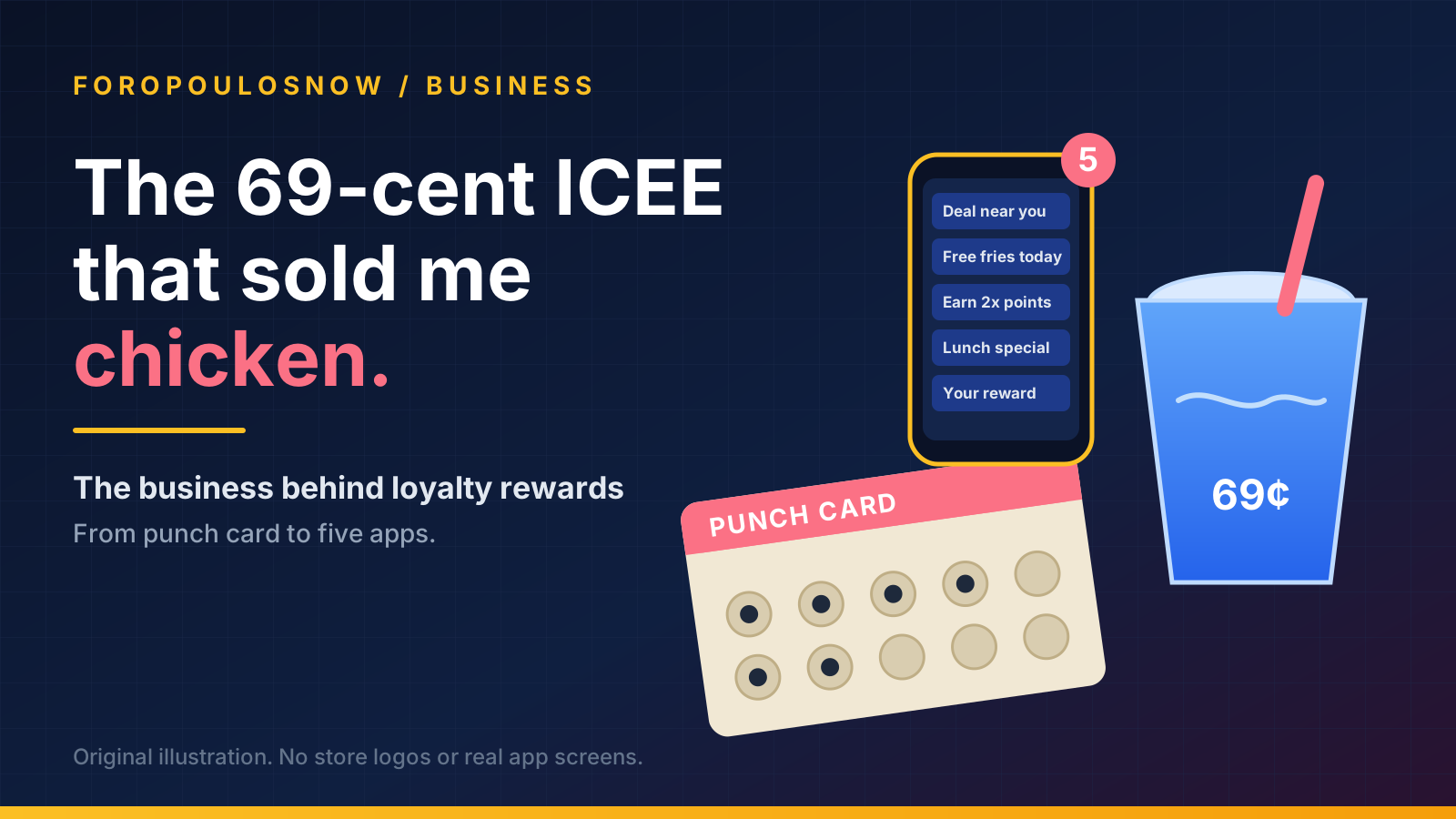

I used to have a punch card for Dodge's for my 69-cent ICEEs. Then one day, I left with some free chicken and fries.
But here's the part I left out.
That was the day they had me sign up for their app and ditch the punch card.
One minute I had a little piece of cardboard with holes in it. The next I had chicken, fries, and a convenience-store app on my phone.
I didn't walk into that store looking for a lesson in business strategy. I wasn't studying customer lifetime value, inventory margins, or behavioral economics. I wanted a cold drink that cost less than the change I could find in the couch.
The punch card had already done its job. It brought me back for those cheap ICEEs. The chicken and fries helped move the relationship from my wallet to my phone.
And here's where it gets funny: I now have apps for five different convenience stores, pushing deals at me almost daily.
Five stores. Five apps. Enough offers to make you think my phone has been appointed regional manager of the snack aisle.
What started as a reward for returning to one store became a direct line through which multiple stores could invite me back—again, and again, and again. They didn't just change the way I collected rewards. They changed the way they could reach me.
I felt like I'd won some free food.
The stores found a new way to compete for my next visit.
I couldn't tell you the economics of that specific promotion, and I'm certainly not claiming to have audited Dodge's chicken operation. But the sequence is a wonderful little case study in retail marketing: give someone a reason to return, offer something worth signing up for, and keep the relationship going after they've walked out the door.
And underneath all of it sits one of retail's oldest and most useful ideas:
The thing that gets you through the door isn't always the thing that makes the trip profitable.
That principle explains why a gas station wants you to buy lunch, why a restaurant discounts your favorite appetizer, why a game retailer becomes interested in trading cards, and why the future of customer rewards has as much to do with attention and data as with free stuff.
It started, for me, with a surprisingly inexpensive piece of cardboard.
The Punch Card Was a Contract Nobody Had to Sign
Think about the elegance of a simple punch card.
Buy a drink. Get a punch. Come back. Get another. Eventually, collect a reward.
No passwords. No push notifications. No terms of service that require a law degree and a spare weekend to read.
It worked because it gave customers an immediate, understandable reason to return. The next visit felt like progress. Changing stores meant walking away from that progress.
That small sense of momentum is a powerful thing. But the real value to the business wasn't just that I might buy nine drinks instead of eight. It was that I had begun making a familiar stop part of my routine.
If I'd already decided to pull into Dodge's, the store had another opportunity to sell me whatever happened to look good that day.
A drink became a visit. A visit became a habit. A habit opened the door to another category.
This is why loyalty programs exist in supermarkets, coffee shops, fast-food restaurants, pharmacies, convenience stores, entertainment venues, and increasingly just about any business capable of recognizing a repeat customer.
Not every program succeeds. A 2026 meta-analysis published in the Journal of Retailing examined 434 effect sizes from 78 independent samples and found that loyalty-program effects vary by customer-journey stage, program design, and product type. The strongest overall relationship appeared at the purchase stage.
In plain English: rewards can influence buying behavior, but stapling a points system onto a bad business is not a magical cure.
A free sandwich isn't going to rescue a restaurant nobody wants to visit twice.
The Day the Punch Card Became an App
My ICEE card wasn't just replaced by a prettier punch card displayed on a screen.
It was replaced by a completely different kind of relationship.
A paper card rewards behavior after I walk into the store. The business has to wait until I come back before it can do anything with that card.
An app can create an opportunity to communicate between visits—assuming I've enabled notifications and the business uses the platform that way. It can show a deal on coffee before the morning commute, a lunch special around noon, or a new product I might not otherwise have noticed.
And it can bring together transactions that used to live on separate pieces of paper: a drink purchase today, a prepared-food reward next week, perhaps fuel savings after that.
This is why the chicken-and-fries part of my story matters more than it first appears. It wasn't simply a free meal at the end of a punch-card journey. It was part of the transition into an app-based program.
That transition creates new potential value for the retailer:
- A more convenient path back: an offer can remind a customer to return, rather than relying on the customer to remember the store.
- A chance to connect categories: the customer who started with frozen drinks can discover foodservice, fuel rewards, or other purchases.
- A measurable relationship: subject to the app's actual capabilities and privacy permissions, a retailer can connect offers to redemptions and purchases more effectively than with anonymous cardboard.
- An ongoing marketing channel: the store can communicate with opted-in customers without purchasing a fresh ad impression for every message, although maintaining apps and messaging systems certainly isn't free.
The catch? If every store gains that ability, the customer's phone becomes a battleground.
Five convenience-store apps sending me deals almost every day is both a remarkable achievement in direct marketing and a fantastic argument for turning off notifications.
Permission Is the Product
An app can reach me between visits only if I've opted in and left notifications on. The channel exists because the customer allows it, and it can be taken back with one tap.
The next competitive advantage won't be the ability to send another offer.
It'll be knowing whether an offer is useful enough that I actually want to receive it.
Nobody's Giving Away Chicken for the Joy of Accounting
When consumers see a free item, they naturally think about its retail price.
If a meal sells for $8, a free meal feels like an $8 gift. But $8 is not necessarily what it costs the restaurant or convenience store to provide it.
The operator is thinking about food ingredients, packaging, spoilage, labor, processing fees, and the opportunity cost of what might otherwise have been sold. Some of those costs are fixed in the short run; others rise directly with the promotion.
The full economic question is more interesting than the sticker price:
Did the promotion generate enough additional contribution profit to pay for itself?
In the particular case of my chicken and fries, the promotion also came with an app sign-up. That makes the business question broader than the cost of a meal: was acquiring a customer for the app, and potentially getting more return visits afterward, worth the incentive? We can't answer that without the store's actual numbers, but it's precisely the question a serious operator should ask.
Suppose a frozen drink earns only a modest contribution after its variable costs. It can still be a terrific reason to visit if customers also buy prepared food, snacks, bottled drinks, or other higher-contribution items.
Or perhaps the promotion introduces someone to a product they later purchase at full price.
Or maybe it brings a customer back on a quiet Tuesday when employees, electricity, and a kitchen are already on the clock.
The store can create value without winning on every item in every transaction.
Conversely, a free reward can absolutely lose money. If customers would have come anyway, redeem the free product, and buy nothing additional, the promotion may simply be an expensive thank-you note.
Sometimes that thank-you note is worth sending. Customer goodwill matters.
But goodwill and profitable growth are not the same line on a financial statement.
Goodwill Isn't Profit
A free reward can lose money outright if customers would have come anyway, redeem it, and buy nothing extra. Sometimes that thank-you note is worth sending. Just know which one you're writing.
The Gas Station That Isn't Just Selling Gas
Here's one of my favorite retail contradictions.
We call them gas stations. We identify them by the pumps. We compare them by the giant numbers on signs facing the road.
And yet the fuel is only part of the story.
According to the National Association of Convenience Stores' 2025 industry data, published in April 2026, fuel represented 65.0% of total convenience-store sales dollars but only 38.8% of gross profit dollars. In-store foodservice and merchandise generated $341.2 billion in sales, and foodservice alone accounted for 38.9% of in-store gross profit dollars.
Notice the distinction. Fuel is an enormous source of revenue and gross profit in absolute terms. Saying gas stations 'don't make money selling gas' would be nonsense.
But the share of sales that comes from fuel is considerably larger than its share of gross profit. Meanwhile, prepared food and dispensed beverages punch well above their share of inside-store revenue.
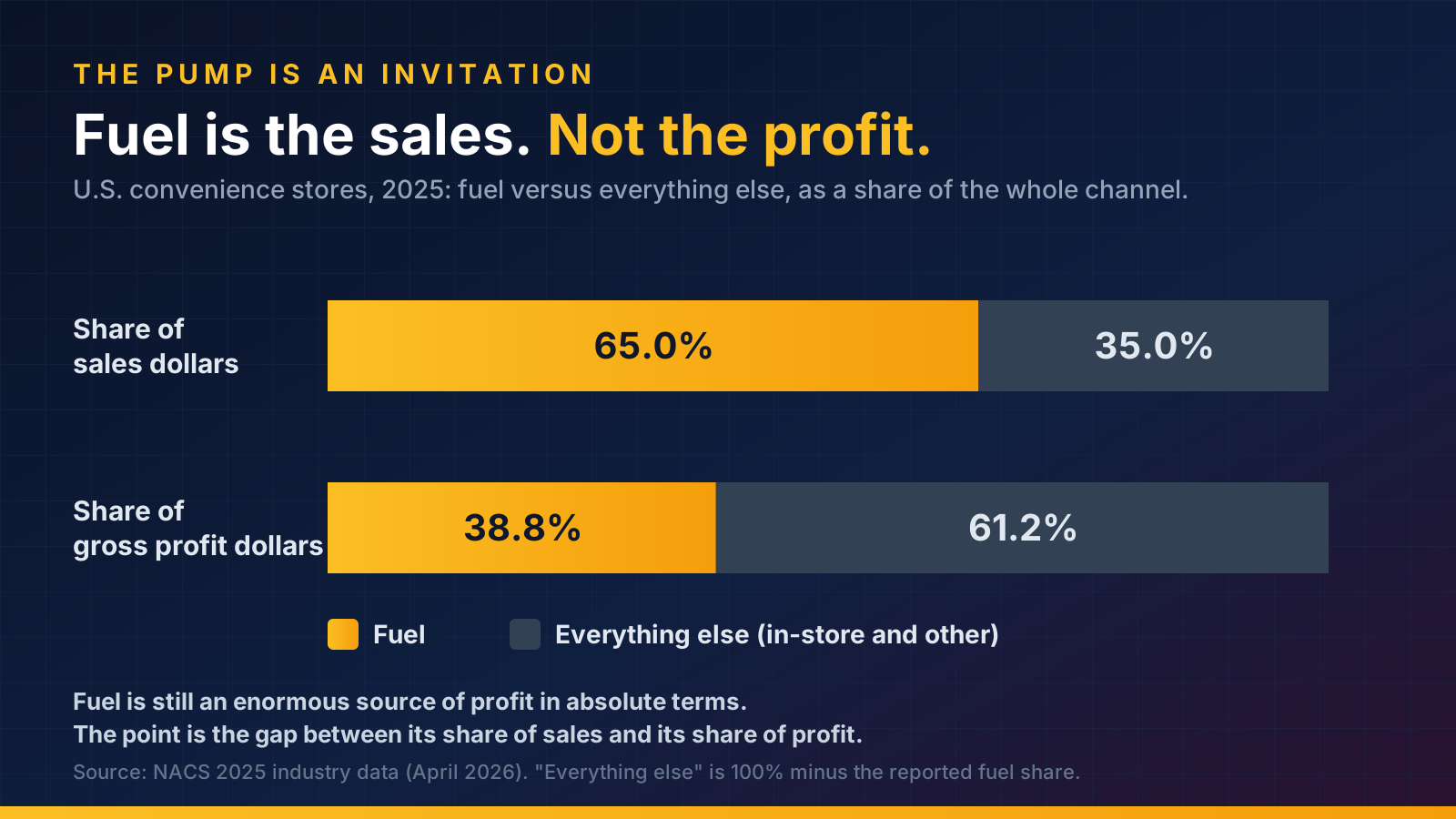
That's why the pump is more than a pump. It's also an invitation.
You need fuel. The retailer hopes you also need coffee. A sandwich. An ICEE. Maybe fried chicken that wasn't remotely part of your plan five minutes ago.
The relationship works in the opposite direction, too.
Refuel's rewards program offers a fuel discount after members spend $25 on qualifying in-store merchandise. In that design, buying inside the store earns savings at the pump.
The product categories are recruiting customers for one another.
A fuel discount can bring someone inside. A sandwich can generate a future fuel discount. A reward can connect two shopping occasions that might otherwise have occurred at different businesses.
And it's not just theory. In October 2026, NACS reported traffic analysis suggesting that food-forward convenience chains with strong lunch visitation were outperforming less lunch-oriented peers on traffic trends during the studied period. That observation doesn't prove food caused all the growth, but it shows why convenience retailers take their lunch business seriously.
The lesson isn't to abandon fuel. It's to understand the economics of the entire visit.
GameStop: The Store With 'Game' in Its Name
Here's another good example of why the business sign doesn't always describe where the money is moving.
Walk into GameStop and you'd reasonably expect video games to be the center of the universe.
For years, that's been the obvious story: new releases, consoles, trade-ins, controllers, and a steady supply of people trying to remember whether they already own a game.
But look at the company's second-quarter 2026 filing.
In the quarter ended August 1, 2026:
- Collectibles: $356.3 million, or 45.1% of net sales.
- Video Games: $263.2 million, or 33.3%.
- Pre-Owned and Refurbished: $170.7 million, or 21.6%.
Those are GameStop's reported categories. Pre-owned and refurbished includes used games, hardware, accessories, and electronics, so don't interpret 33.3% as the total amount of anything related to video games.
Still, the headline is striking: collectibles had become the largest reported sales category.
Trading cards and collector products weren't some decorative shelf near the checkout anymore.
The company also reported that its first-half gross margin had risen from 31.4% to 42.2%, primarily because of a shift toward higher-margin categories, including collectibles.
That doesn't mean every collectible is wildly profitable. Nor does it mean that GameStop's loyalty program caused the shift. The company's actual results reflect many strategic and market forces.
It means the economics of the merchandise mix matter.
A new game release might give a customer a reason to visit. A trade-in program can bring inventory and customers back through the door. Collectibles can expand what that customer purchases, and, in the right circumstances, improve the store's gross margin.
If you're running retail, you should be asking which product category starts the relationship and which ones make that relationship economically durable.
The answer might surprise you.
And if a business can change its sales mix while keeping the customers who recognize its name, that's a pretty powerful trick.
Dave & Buster's: Come for the Games, Stay for the Entire Tab
Now let's visit a business where the entire environment is engineered to keep people entertained.
You go to Dave & Buster's to play games. Maybe it's a date, maybe your friends, maybe you've somehow convinced yourself you're about to break the all-time basketball score while holding a basket of fries.
And yes, the food and drinks matter. Food and beverage promotions are excellent ways to make a gaming visit become dinner, or turn a short stop into a longer night.
But let's avoid another easy myth: Dave & Buster's doesn't primarily derive its revenue from drinks.
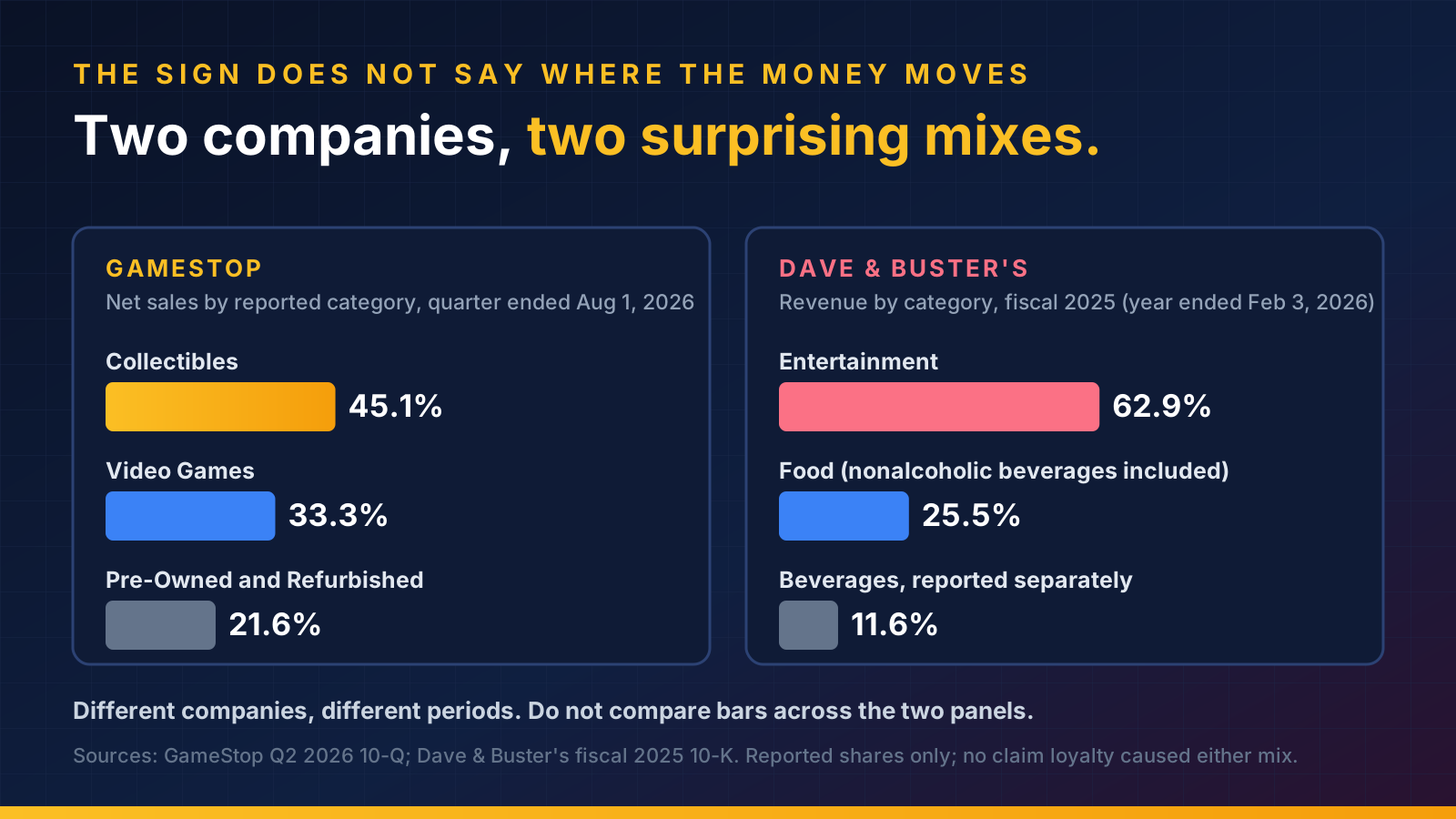
Its fiscal 2025 annual report, for the year ended February 3, 2026, shows:
- Entertainment: 62.9% of revenue.
- Food, with nonalcoholic beverages included: 25.5%.
- Separately reported beverages, principally alcoholic drinks: 11.6%.
The entertainment business is the biggest revenue engine.
There is another useful clue in the numbers. The company reported $1.3235 billion in entertainment revenue and $107.1 million in the direct cost of entertainment products. But don't mistake that difference for net profit. Payroll, occupancy, depreciation, maintenance, and other operating expenses still have to be paid, and they are substantial.
In other words, arcade economics aren't as simple as counting the quarters that used to go into machines.
The interesting opportunity is attachment.
A gaming customer who also eats dinner can produce a more valuable visit. A food customer who buys game credits becomes an entertainment customer. A well-structured bundle can make the whole evening feel like a bargain while increasing the number of things purchased.
Dave & Buster's has specifically discussed food-and-entertainment attachment through its Eat & Play Combo strategy in its annual reporting.
This is the same structural idea as my ICEE and chicken, just with flashing lights, giant televisions, and a lot more people taking air hockey personally.
Nobody needs to lose money on the featured item. The incentive needs to improve the economics of the overall experience.
Restaurants Have Been Teaching This Lesson for Years
A coffee shop might give away the tenth drink. A fast-food restaurant might offer a discounted side if you add a meal. A pizza business might send a customer a weekday coupon rather than another Saturday promotion.
Those offers appear to be about price.
They're often about when, how often, and what else the customer buys.
An operator might want to fill a slow hour, introduce a new menu item, increase order frequency, or encourage a pickup order that avoids delivery-platform fees. Different objectives demand different incentives.
The National Restaurant Association reported in 2025 that 70% of surveyed restaurant operators with loyalty programs said the programs helped increase customer traffic. That is an operator-reported assessment, not a controlled experiment proving every program generates incremental profit. It's still a useful indication of why the industry keeps investing in them.
A well-designed restaurant offer can change an order rather than merely lower its total.
Consider a customer who normally buys a sandwich, then encounters an offer for a discounted drink when paired with the sandwich. If the drink's additional contribution exceeds the discount and related costs, the business has improved the transaction.
But if the customer already buys both every day, the coupon may do nothing but make an existing sale cheaper.
Same coupon. Opposite business outcomes.
Same Coupon, Opposite Outcomes
Whether a discount helps depends on whether it changes the order. A coupon on something the customer already buys every day just makes an existing sale cheaper.
That difference should bother anyone who measures marketing success by the number of discounts redeemed.
The Grocery Store's Old Trick, With a New Dashboard
Grocery stores have always understood that a shopping trip is more than an isolated product.
You may choose a supermarket because eggs, milk, or a weekly special look attractive. You leave with a cart containing produce, snacks, laundry detergent, ingredients for dinner, and some completely unnecessary bakery item that somehow made an extremely convincing argument.
A heavily promoted item can attract traffic even when its own margin is thin. The opportunity is in the basket.
Now add a loyalty account.
The retailer can learn whether a promotion brought a shopper in, whether they bought something from a different department, whether they returned the following week, and whether the discount merely shifted a purchase that would have happened anyway.
It can also test offers by store, by shopping occasion, by household preference, or by inventory that needs to move before it becomes waste.
This is where the old punch card gets interesting.
The old punch card could record how many times I showed up with an ICEE. It couldn't send me another offer tomorrow.
An app connected to checkout data can potentially reveal which combinations of products make a visit valuable, how often a participating customer shops, and which rewards change behavior—depending on what the business collects, what the customer permits, and how the system is set up.
Used responsibly, that can mean fewer pointless coupons and more relevant benefits.
Used badly, it can become a sophisticated machine for pestering people who only wanted a gallon of milk.
The Discount That Makes You Spend More: Let's Do the Math
Enough storytelling. Here's the part that should matter to any business owner.
Suppose a local store tests a reward with 100 customers. The reward costs the business $1 each time it's redeemed.
Forty customers redeem it.
That's $40 in reward cost.
Now assume a properly designed comparison against similar customers who did not receive the offer shows the promotion caused 18 additional visits. Those visits average $12 in sales, and the store earns a 40% contribution margin before the reward after the relevant variable costs.
Here's the illustrative calculation:
| Item | Amount |
|---|---|
| Incremental visits attributed to the offer | 18 |
| Average incremental basket | $12.00 |
| Incremental revenue | $216.00 |
| Contribution before reward at 40% | $86.40 |
| Reward cost: 40 redemptions × $1 | −$40.00 |
| Additional campaign expense | −$15.00 |
| Illustrative incremental contribution | $31.40 |
This isn't a Dodge's, GameStop, or Dave & Buster's result. It's a hypothetical example that assumes the margin already accounts for relevant variable costs other than the reward and campaign expense.
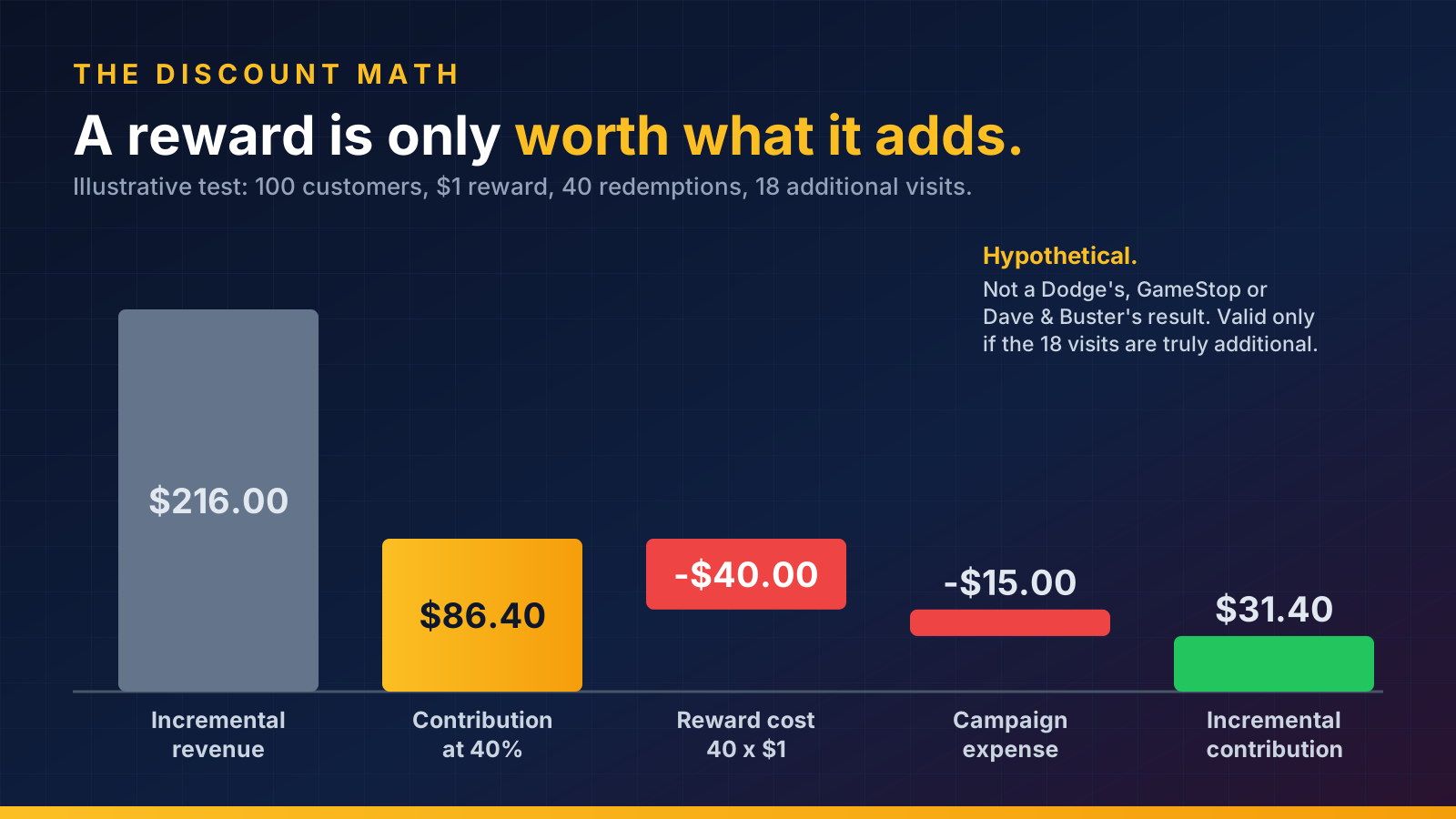
The crucial phrase is additional visits.
Forty redemptions are not forty new purchases. Some customers would have visited without the offer. A few may have purchased more than normal, while others may have simply used the coupon on what they always buy.
Without a holdout group, a reliable baseline, or another credible way to estimate the counterfactual, you can't confidently call the resulting sales incremental.
And this is where businesses make expensive mistakes: they celebrate redemption rates while ignoring whether the reward created any new profit.
A reward can have a huge response rate and a terrible return.
It can also have a modest response rate and be extremely valuable if it reaches customers whose behavior actually changes.
The Next Generation: The Punch Card Gets a Brain
The next generation of loyalty programs won't simply be more points, bigger apps, and increasingly desperate emails congratulating you on your 400th purchase of dish soap.
The interesting shift is from fixed rewards to adaptive rewards.
My five convenience-store apps are already a pretty good illustration of why this matters. They can all send me deals. That doesn't mean all five are telling me something useful. There is a very real difference between earning permission to reach a customer and earning the customer's attention every day.
Imagine a business that can recognize three different situations.
A regular customer buys coffee every weekday but has never tried breakfast. Another shopper buys lunch at the store but fuels up elsewhere. A third hasn't returned in a month.
Sending all three the same five-percent-off coupon isn't particularly intelligent.
One might respond to a breakfast pairing. Another might value fuel savings earned on lunch purchases. The third might need a genuinely useful reason to return—or might not need another marketing message at all.
The possible inputs expand beyond purchase history: time of day, store-level inventory, product availability, expiration risk, staffing capacity, and whether a promotion would divert demand from something the customer already buys.
This isn't science fiction. A September 2026 NACS Magazine report describes convenience chains developing more personalized, transaction-informed loyalty operations. Refuel's program already connects in-store purchases to pump savings and offers targeted promotions.
The next step is better decision-making, not just better targeting.
A store doesn't need to give a customer a free sandwich if the customer was already going to buy it. It might be better off providing a meaningful incentive to try something new, visit at a different time, or buy a complementary product.
Or it might be best to offer nothing.
That last option rarely appears in the glossy advertisements for marketing technology, but it belongs in the mathematics.
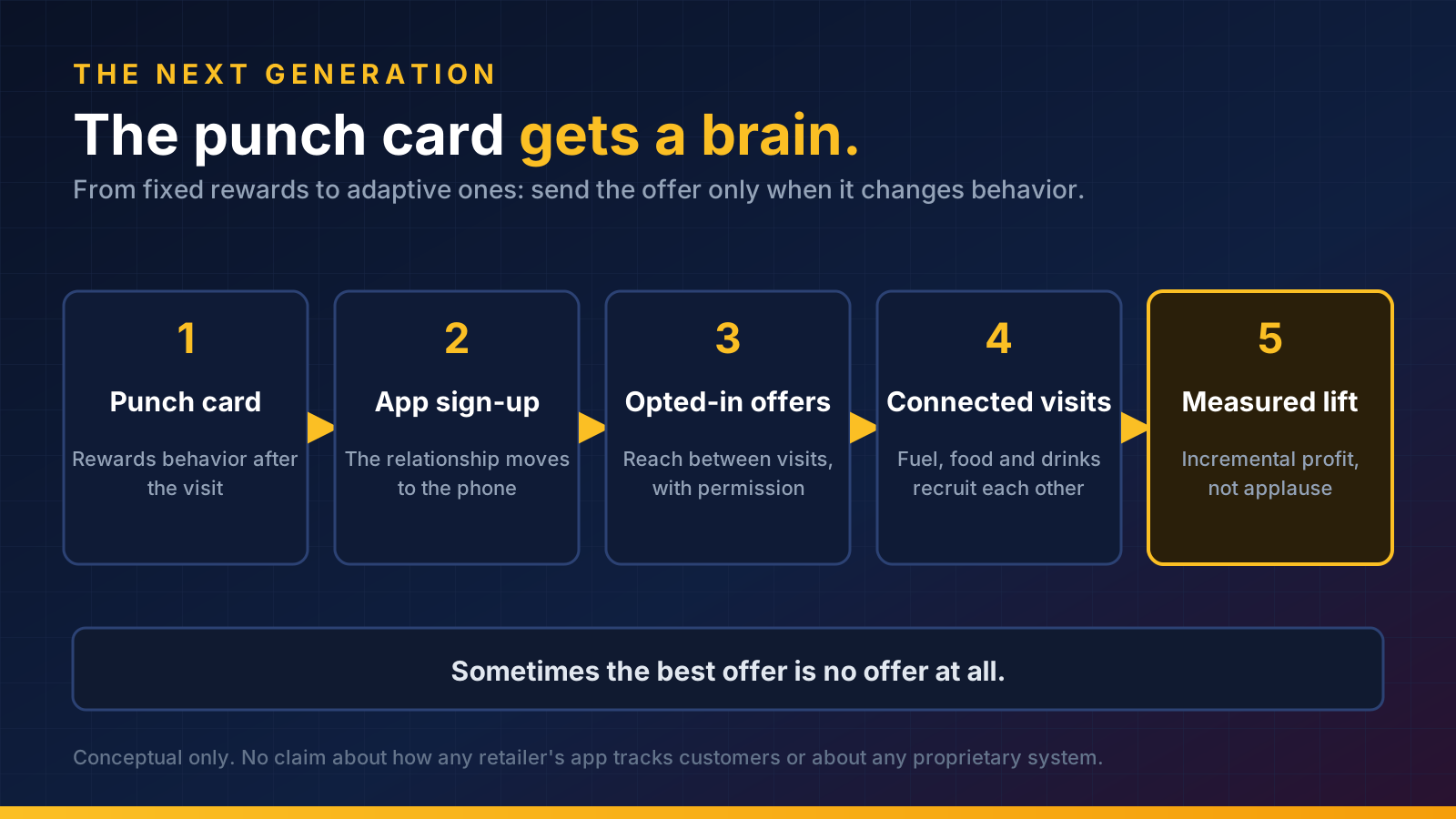
Five changes I'm watching
First, rewards become situational. Instead of the same Tuesday coupon for everyone, the offer can reflect the shopping occasion, store inventory, and what the business can actually fulfill.
Second, categories become connected. Fuel savings can reward lunch purchases. Entertainment credits can accompany food bundles. A retailer can introduce customers to departments beyond the product they first came in for.
Third, loyalty becomes part of operations. A promotion that creates a rush when a kitchen is understaffed can damage service. A promotion that helps move inventory before it expires may help both customers and the store.
Fourth, businesses begin measuring incremental profit instead of applause. A dashboard full of members, points, and redemptions looks nice. A verified lift in contribution margin is better.
Fifth, customers demand something in return for their data. The convenience of an app is not a free pass to collect information nobody needs.
A 2026 convenience-store consumer survey summarized by NACS found interest in personalized offers, especially when based on purchase history, but also a clear desire for transparency and easy access to real employees.
Which brings us to the problem nobody should ignore.
A Better Deal, or a Better Way to Watch You?
There's a difference between a store remembering that you like frozen drinks and a marketplace trying to calculate the maximum amount you're personally willing to pay for one.
The first can produce useful service. The second raises obvious questions about fairness, consent, and price discrimination.
The Federal Trade Commission's January 2025 surveillance-pricing study described how intermediaries can use granular consumer data to tailor prices and promotions. It did not establish that every loyalty program engages in such practices.
That distinction matters.
Read the Terms
The FTC study didn't find that every loyalty program sets individualized prices. But the ability to tailor offers from personal data is exactly why customers should be able to see the terms and control what's collected.
Personalized rewards can be a genuinely good bargain. They can also become confusing, invasive, or manipulative if customers don't understand the data involved or can't decline participation.
My preferred future is one where customers can understand the offer, see the terms, control their data, and still get a reasonable price without surrendering their entire digital life to a bag of potato chips.
I already have five convenience-store apps. That's five opportunities for a good deal—and five opportunities to interrupt a perfectly good afternoon with an offer for something I wasn't planning to buy.
Not everyone wants a separate app for every business they enter. Having the technology to push an offer doesn't mean the customer has volunteered to pay attention.
Sometimes an old-fashioned punch card is still a pretty beautiful technology.
What Smart Businesses Should Actually Do Next
Before buying the latest AI loyalty platform, a business owner should answer a few less glamorous questions.
What brings customers in the door? Which products generate the greatest contribution dollars after variable costs? Which purchases naturally travel together? At what times do we have unused capacity? What is the cost of a reward, and what would the customer have done without it?
Then make the program simple enough that the customer understands the value.
Start with a small, measurable hypothesis: 'If we offer a fuel reward for qualifying lunch purchases, will incremental lunch contribution cover the fuel discount?' Or: 'Will a weekday bundle increase new visits without discounting customers who already come every day?'
Run the test. Compare similar groups. Account for labor, waste, fulfillment, fraud, and promotion costs. Watch whether customers return after the discount ends.
Make sure the point-of-sale system, inventory records, and customer permissions can support the promise. A reward for an item that's out of stock is not loyalty. It's an excellent way to teach people to shop somewhere else.
And don't confuse a customer who uses a coupon with a customer who loves your business. One is a transaction. The other is something you earn through repeated good experiences.
Technology can improve the precision. It can't replace the fundamentals.
The Last Punch on the Card
I still like the idea of a punch card.
It was wonderfully honest about its bargain: come back enough times and we'll give you something.
Then came the day the chicken and fries arrived—and Dodge's had me trade that card for an app.
Now I have five convenience-store apps offering me deals almost daily.
Somewhere along the way, a reward I carried in my wallet became a series of invitations arriving in my pocket. And that change tells you nearly everything about where loyalty programs are heading.
Give customers a reason to return.
Make the experience worth repeating.
Introduce them to something else you do well.
Understand where the profit is, not merely where the sales are.
And respect the customer's attention as much as you value their business.
The next generation of rewards will give businesses more ways than ever to understand purchases, connect products, and decide which offers actually work.
But it will also have to answer a very old question: is the reward worth the interruption?
I thought I was getting free chicken.
The store was getting a place on my phone.
Five convenience-store apps later, I'd say the chicken worked.
— Thesecretchief
Sources & Further Reading
- National Association of Convenience Stores: U.S. convenience in-store sales and 2025 profit mix (April 15, 2026).
- GameStop: Q2 2026 Form 10-Q, category revenue and margin mix.
- Dave & Buster's: Fiscal 2025 Form 10-K, revenue categories and operating costs.
- Refuel Market: Rewards and fuel-savings terms.
- National Restaurant Association: 2025 operator and consumer loyalty findings.
- Chen, Evanschitzky & Blut: Loyalty program effectiveness meta-analysis, Journal of Retailing (2026).
- NACS Magazine: The Value Is in the Data (September 2026).
- NACS: Convenience-store lunch and customer traffic trends (October 23, 2026).
- NACS: Consumer attitudes to AI checkout and personalized rewards (October 5, 2026).
- Federal Trade Commission: Initial findings from its surveillance-pricing study (January 17, 2025).