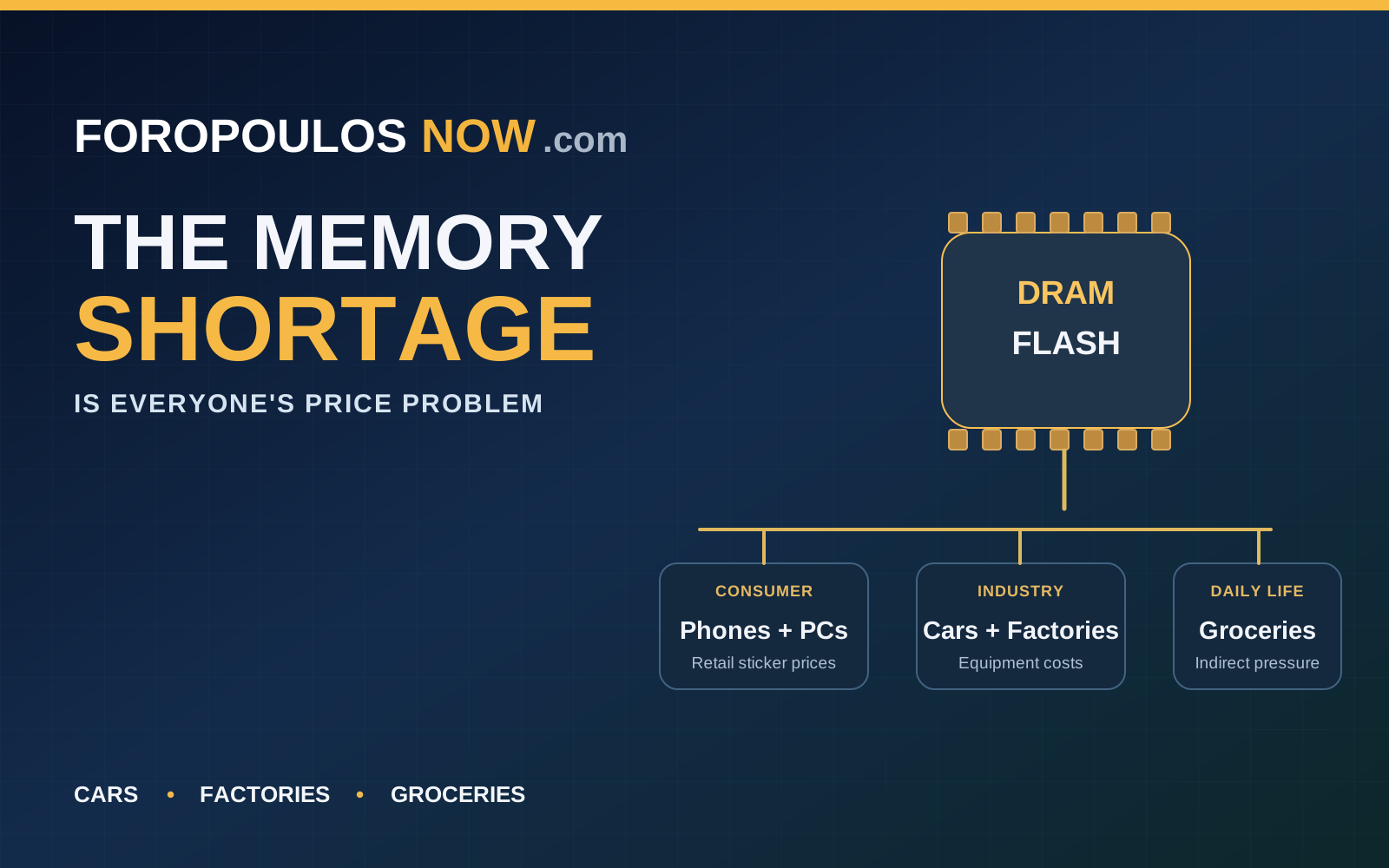

Nobody walks into a grocery store looking for a memory chip.
They walk in for milk, bread, chicken, maybe something that doesn't require a second mortgage. And yet the machinery that packs the bread, the equipment that keeps the milk cold, the trucks that deliver the chicken, and the systems that ring it all up increasingly rely on electronics.
Which raises a question that sounds ridiculous until you trace the supply chain: could a global shortage of computer memory make everyday life more expensive, even for people who never buy a new computer?
The direct damage to phones, laptops, and other electronics is already documented. The risks to vehicle production, industrial equipment, telecommunications, and medical devices are serious enough that major American industry associations jointly warned the federal government. The possible spillover into groceries is more indirect. And that's what makes it worth examining carefully rather than turning a legitimate supply shock into a convenient explanation for every price tag.
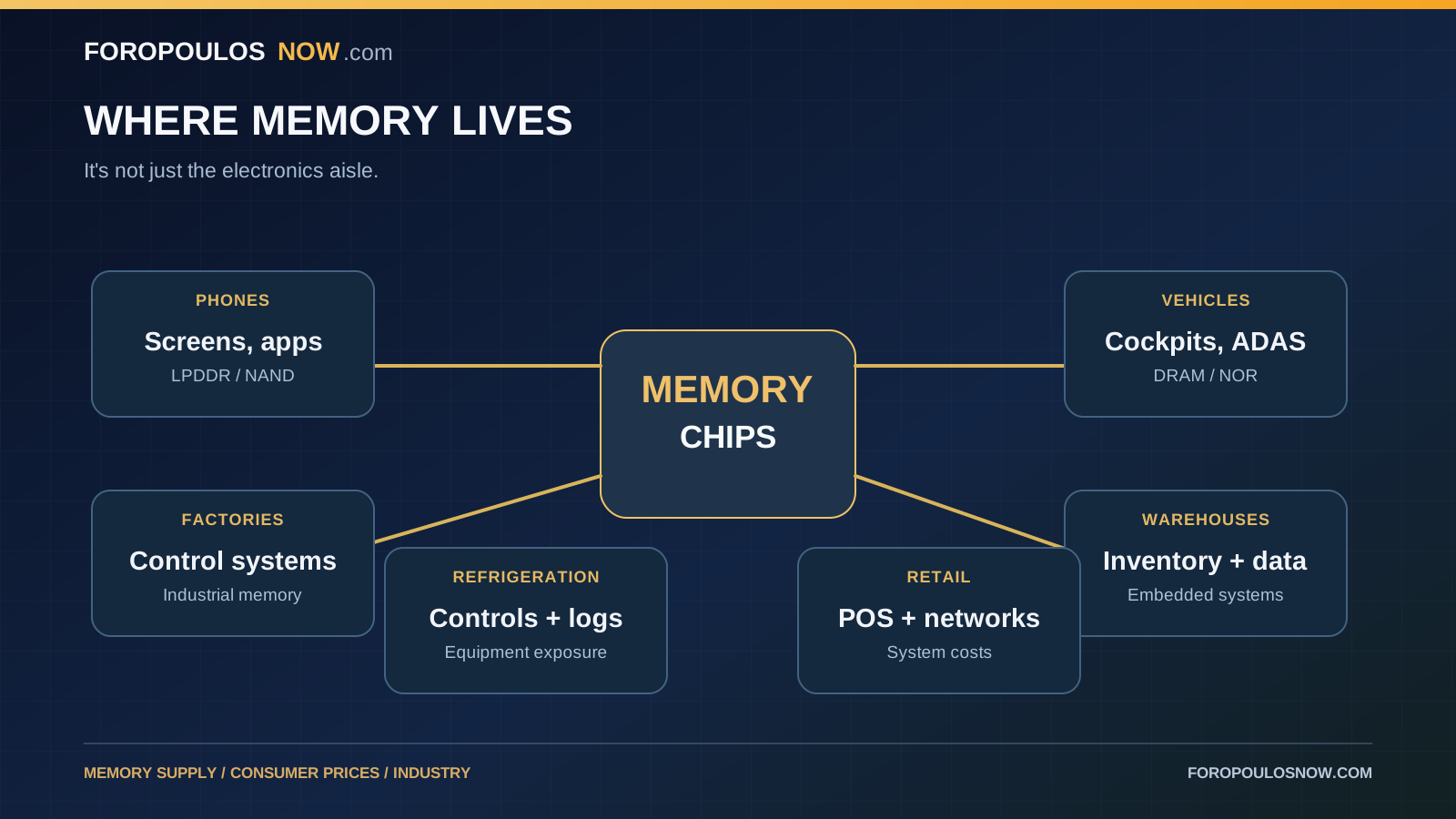
This isn't a story about how wonderful or terrible artificial intelligence is. It is a story about what happens to the rest of the economy when a foundational manufacturing component becomes more expensive, harder to source, or unavailable in the exact specification a product needs.
The Tiny Part Almost Nobody Thinks About
First, a quick distinction. Computer memory isn't one interchangeable product, and a shortage doesn't strike every kind of memory equally.
- DRAM (including DDR4, DDR5 and low-power LPDDR): temporary working memory. You'll find it in computers and phones, but also vehicle displays, industrial computers and many connected systems.
- NAND flash (including SSDs, eMMC and UFS): nonvolatile storage for operating systems, applications, logs and files. Used across phones, laptops and some embedded equipment.
- NOR flash and embedded memory: often stores firmware and boot instructions in controllers, automotive modules, network gear and industrial devices. Its supply chain and price behavior can differ substantially from DRAM and NAND.
- HBM (high-bandwidth memory): a specialized, stacked DRAM product. It is not the same chip you drop into a desktop PC, but it competes for manufacturing resources and investment.
The actual problem is product-specific supply, not a claim that every electronic component on Earth suddenly disappeared. Many microcontrollers already contain their own SRAM and flash; not every factory controller needs a separate commodity DRAM chip. The exposure depends on the design, model, supplier, approved substitutions, and current inventory.
That distinction matters. A laptop maker may accept a higher memory price or ship a smaller drive. An automobile supplier or regulated medical-equipment maker often cannot substitute an unapproved component and simply hope for the best. Qualification, safety, durability and support requirements make the workaround slower and more expensive.
The September 2026 analysis from the Center for Strategic and International Studies identifies consumer electronics, vehicles, telecommunications, industrial automation, and medical devices as exposed categories. It also describes why new fabrication capacity takes years rather than weeks to arrive.
So where did the imbalance come from? In brief: suppliers have shifted some capacity and investment toward higher-margin memory products while older product families are being reduced or phased out. Production is concentrated, manufacturing and qualification take time, and long-term allocations can leave buyers of everyday components with limited alternatives. The market also remains cyclical: some spot prices have flattened or softened even while many contract prices rise.
That's the background. The part consumers care about is what happens next.
Your Phone Is the First Receipt. It Won't Be the Last.
There is already measurable price pressure in the memory supply chain. On September 30, market research firm TrendForce projected that conventional DRAM contract prices would rise 10–15% quarter over quarter in Q4 2026, while overall NAND flash contract prices would rise 15–20%.
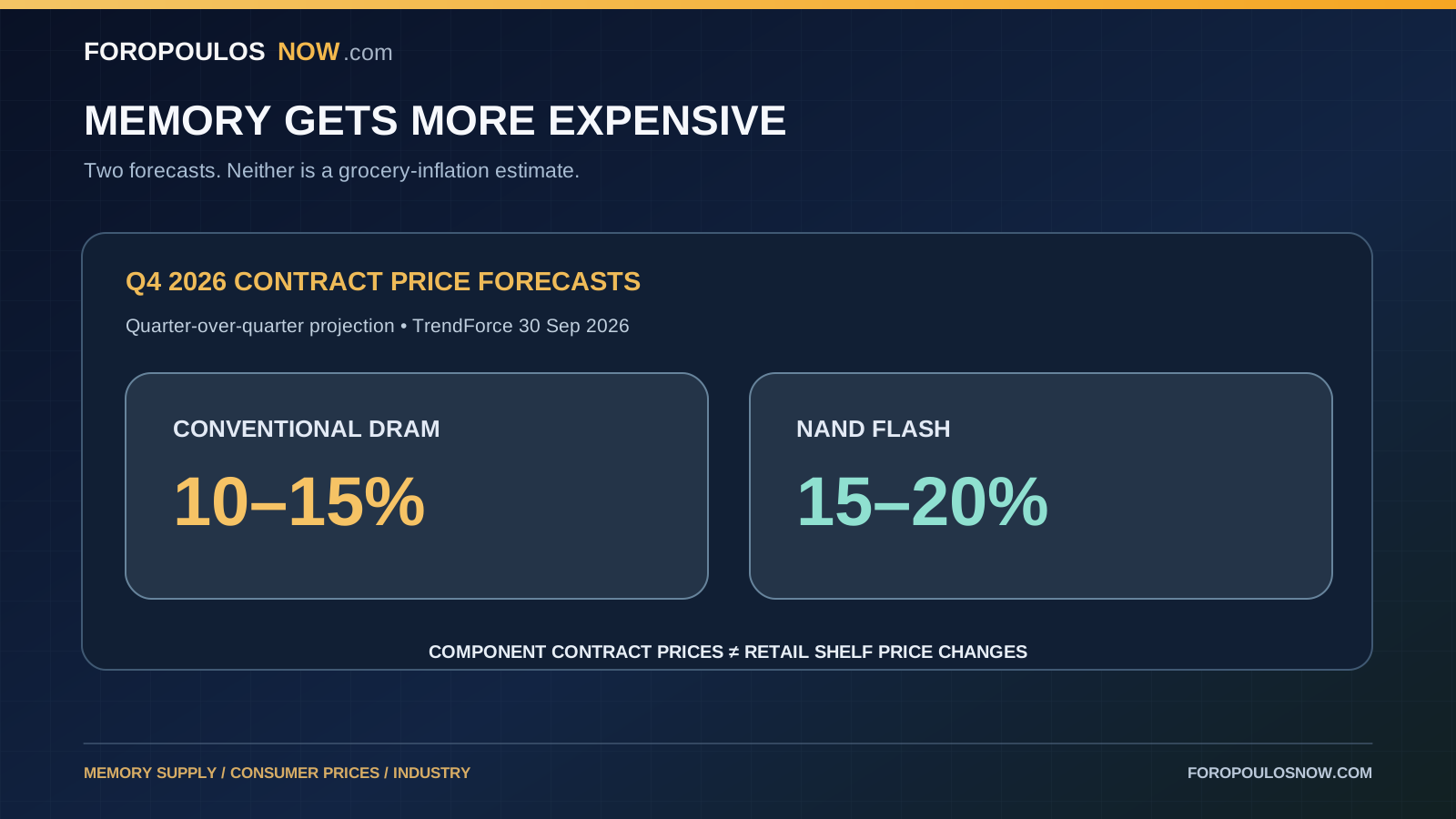
If a manufacturer buys memory today for a product that will arrive on store shelves months from now, higher input costs can work through old inventory, new procurement contracts, production planning, and retail pricing. That's why the timing of the retail effect may lag the semiconductor quotation.
The customer may see a higher price. Or fewer affordable configurations. Or a phone with less storage than the competing model offered last year. Or a longer wait for the replacement they actually want.
On October 21, TrendForce's spot-market update also showed the nuance: DDR5 availability remained tight, while some DDR4 trading was subdued and a NAND wafer price had slipped that week. Spot prices, contract prices, and store prices are not interchangeable numbers. Anyone waving a daily chip quote around as proof your television must cost 20% more is skipping several steps.
Smaller manufacturers can be squeezed harder than major brands because they lack the same purchasing power, advance allocations, or inventory cushion. In September, Reuters reported that independent phone and laptop makers were redesigning products and adapting to scarce supplies, sometimes finding that getting components at all was the bigger obstacle than price.
The distinction that keeps the numbers honest
A 15% increase in one component category is not a 15% increase in the finished product. A device's bill of materials includes many other components, and companies may absorb costs, reduce specifications, change models, negotiate contracts, or pass only part of the increase to consumers.
Cars Are Computers With Tires, and the Memory Bill Is Real
Consider the modern car. Even a model that doesn't advertise itself as futuristic may use memory in instrument clusters, infotainment units, cameras, connectivity and driver-assistance systems. These systems operate under automotive qualification and service-life requirements that are often far stricter than those for ordinary consumer devices.
This makes the automotive business vulnerable to two separate problems: paying more for qualified memory and not being able to secure enough of the right part on time.
In July 2026, General Motors and Ford each announced long-term memory and storage agreements with Micron. These arrangements were described as ways to secure reliable supply for future vehicle platforms; the GM announcement explicitly framed its move around supply predictability, not a claim that current plants had already stopped.
That is the meaningful signal. Carmakers don't negotiate specialized, multiyear semiconductor arrangements for entertainment. They do it because a missing qualified part can disrupt a production schedule that coordinates thousands of components from hundreds of suppliers.
S&P Global Mobility had warned in December 2025 that automotive DRAM contracts could rise substantially in 2026 as manufacturers competed for limited supply. Its automotive supply analysis forecast a 70–100% increase for new automotive DRAM contracts in some circumstances. That's a sector-specific prospective estimate. Not proof that every automotive chip doubled, or that every vehicle's purchase price rose accordingly.
The owner buying a delivery van or refrigerated truck may eventually face higher equipment costs, fewer available configurations, or a longer replacement cycle. That's a plausible downstream pressure on freight costs. The exact amount passed into freight rates, however, has to be measured; it cannot be assumed from semiconductor prices alone.
The Factory Problem: One Missing Part, a Whole Lot of Standing Around
Here is where the story goes beyond electronics shopping.
A modern factory may rely on industrial computers, human-machine interfaces, programmable logic controllers (PLCs), quality-inspection cameras, tracking systems, robots, network equipment, and data logging. Different machines use different kinds of memory: internal controller memory, external DRAM, industrial flash, or removable storage.
Not every machine is exposed to the current shortage in the same way. But if a plant depends on a specific industrial board that contains a scarce or discontinued memory device, the problem can extend far beyond the board's invoice price.
Suppose an older packaging line needs a replacement control module. The approved module is delayed because its supplier cannot source a qualified memory component. The plant might repair an older board, buy a higher-cost substitute, engineer and validate a redesign, hold more spare inventory, or schedule downtime.
All those choices have different economic consequences. What they share is that they consume money, time, or productive capacity.
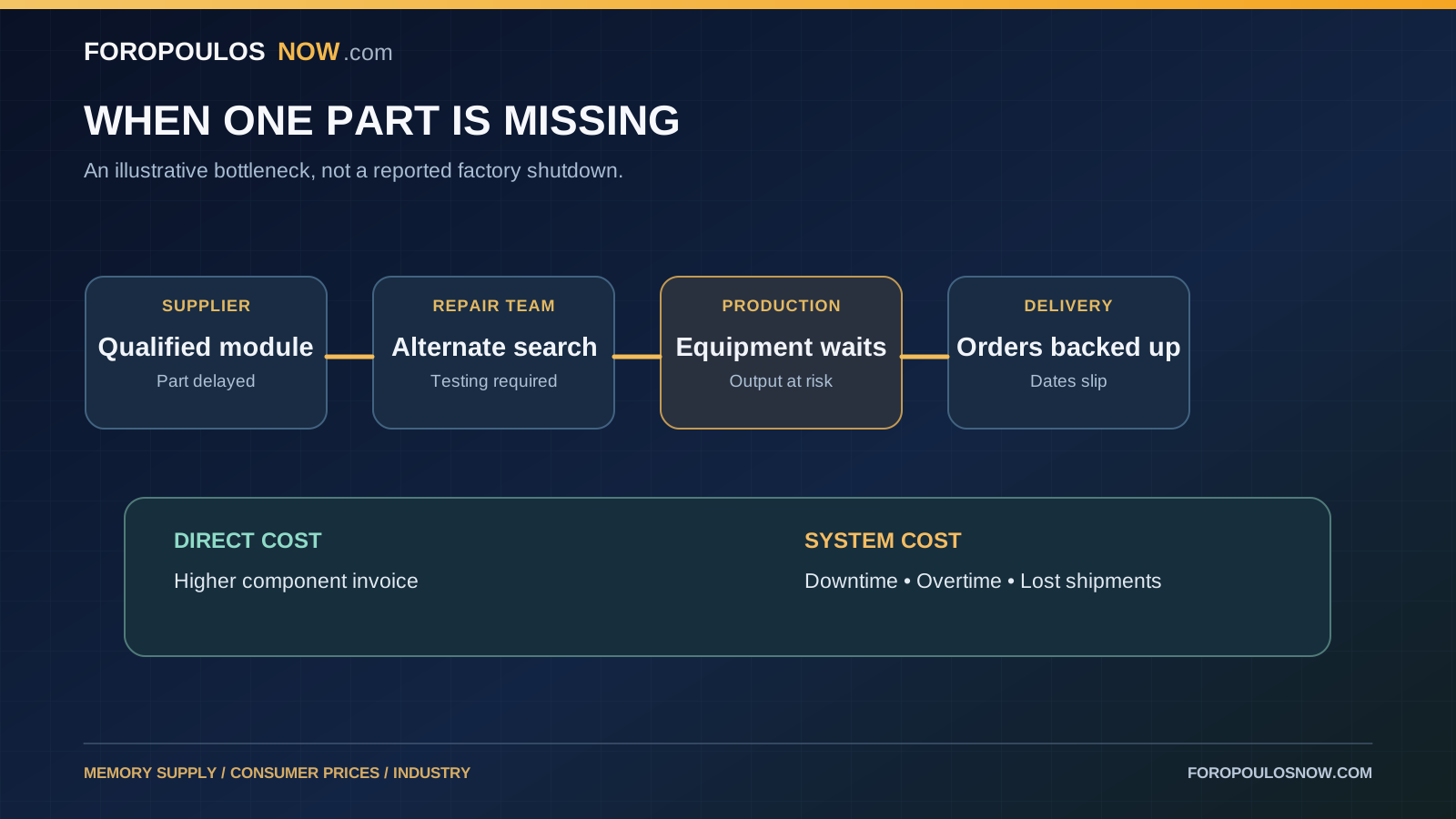
Consider a purely illustrative $100 component suddenly priced at $140. If the factory buys 100 per year, the direct purchasing increase is only $4,000 annually. That matters, but it's manageable in many plants.
Now consider the same part being unavailable for three weeks during a critical repair. The cost could include idle technicians, missed shipments, expedited freight, emergency engineering, overtime, and lost sales. Depending on the line, these may dwarf the increase in component cost.
This doesn't prove memory shortages have stopped every factory. It explains how a shortage of one qualified part can magnify cost far beyond that part's purchase price. CSIS specifically highlights memory in industrial controllers and supervisory systems, along with procurement and planning risks.
A useful test for any manufacturing claim
Ask whether a reported disruption is caused by DRAM, NAND, NOR, embedded flash, a different semiconductor, or some unrelated bottleneck. A generic claim that "the chip shortage closed the factory" is not evidence that memory supply was the cause.
So How Does This Reach the Grocery Store?
Let's follow one possible chain without pretending the silicon itself is a major ingredient in cereal.
A food business may need electronic controls for sorting, weighing, packaging, labeling, traceability and refrigeration. Distribution centers use scanners, routing and inventory systems. Refrigerated transportation and cold storage use control and monitoring equipment. Retailers operate point-of-sale devices, network equipment and temperature-monitored storage.
If memory-related shortages increase the cost or lead time to buy, repair or replace any of this equipment, businesses can face higher capital expenses, maintenance bills, financing costs, spoilage risk or downtime. Some of that may eventually be reflected in the cost of moving food through the system.
Notice the phrase "if memory-related shortages". A temperature sensor with built-in memory is not automatically affected because desktop DDR5 has become expensive. The exposure must be traced to the actual part and its supplier.
The reason this matters is what a grocery price represents.
According to the U.S. Department of Agriculture's revised Food Dollar data released in March 2026, U.S. farm establishments received 11.8 cents out of each dollar spent on domestically produced food in 2024. The other 88.2 cents was the post-farm marketing share: transporting, processing, storing, wholesaling, retailing and related activity. The share is a national accounting measure for domestically produced food across food-at-home and food-away-from-home spending; it varies significantly by product and outlet.
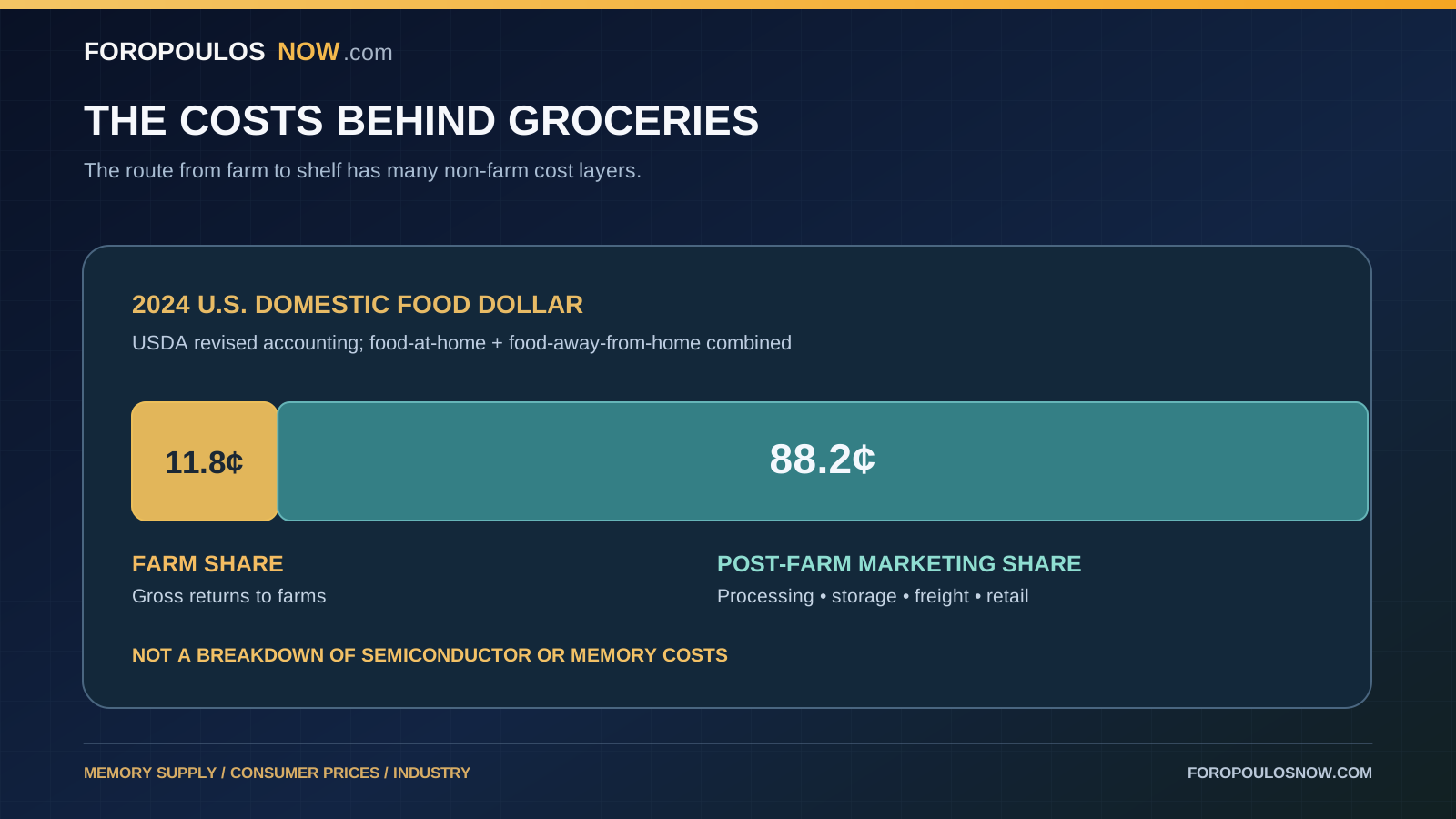
That is the economic doorway through which an equipment shortage could matter. Food prices are not determined only in the field. They reflect a long chain of labor, buildings, machinery, energy, transportation, compliance, retail operations, and financing.
But here is the line an accurate article cannot cross: there is no verified national estimate demonstrating how much of current grocery inflation is caused by memory-chip shortages.
In its October 23 update, USDA's Food Price Outlook reported that September 2026 food-at-home prices were 1.8% above September 2025, and overall food prices were 2.5% above a year earlier. Those numbers describe food inflation. They do not attribute it to memory chips.
Food-price movements also reflect weather, agricultural disease, crop supply, labor, energy, freight, competition and consumer demand, among other factors. A chip shortage might be a secondary contributor for a particular processor, distributor or retailer; it would be misleading to claim it explains the overall grocery bill without detailed evidence.
"The fact that electronics touch every supply chain does not mean electronics explain every price increase. It means every supply chain deserves to understand its exposure."
How an Expensive Chip Turns Into an Expensive Product
There's a useful business lesson here that owners and consumers should understand. Scarcity doesn't travel through the economy in one simple step.
First: component inflation. A manufacturer pays more for a memory part, or loses access to a previously affordable option.
Second: substitution and redesign. Procurement searches for alternates. Engineers may need to redesign boards, adjust firmware, or validate a different supplier. In vehicles and regulated products, testing and approval can be a significant barrier.
Third: operational disruption. A missing input can postpone output, strand work-in-progress inventory or delay replacement equipment. This is often more expensive than the direct parts premium.
Fourth: financial pressure. A business may carry more safety stock, extend supplier commitments, pay for expedited transportation, or tie up cash in parts that were once ordered just in time.
Fifth: price transmission. Or absorption. Depending on contracts and competitive pressure, the business may raise prices, reduce features, accept lower margins, delay investment, or cut other costs.
This is also why broad inflation claims need a denominator. If a memory component accounts for 0.5% of a product's manufacturing cost and its price doubles, the direct increase is approximately 0.5% of that manufacturing cost, not 100% of the retail price. That is illustrative arithmetic, not a measured average. If supply interruptions create downtime or force redesign, the resulting cost can be much higher. And requires its own evidence.
The reverse is true too. A big computer or smartphone brand with inventory and negotiating power may absorb costs for months. A smaller industrial supplier with no substitute part could experience immediate disruption. Exposure is uneven.
Nine Industries Raised the Alarm Together
On June 3, 2026, nine American trade associations sent a joint letter to the U.S. Treasury and Commerce departments. The signatories included groups representing automobile manufacturers, retailers, broadband and telecommunications companies, and medical-device makers.
The concerns weren't limited to computer parts or gaming systems. They cited higher costs for electronics and telecommunications infrastructure, along with risks to vehicle and medical-device production and delays for small-business federal contractors.
That is unusual cross-sector agreement on a common supply-chain risk. It doesn't prove that every predicted effect has materialized, but it does show that manufacturers across unrelated sectors are not treating the shortage as a hobbyist problem.
The groups called for expanded memory capacity, broader supply-chain resilience, support for consumer and industrial markets, and easier qualification of alternative parts where appropriate. Their appeal reflects a fundamental problem: a production system optimized around scarce components can be efficient right up until a critical item becomes unavailable.
What Business Owners Should Do Before Their Next Price Increase
This isn't an excuse to rush out and buy every memory module on the shelf. Hoarding can worsen shortages and lock up precious cash. It's a reason to examine where a small input could create an outsized operating problem.
The practical response isn't panic buying
Find the exact memory-dependent part numbers in critical equipment and products. Separate verified supplier notices from industry headlines. Identify qualified alternatives before a breakdown, but don't bypass required electrical, safety, automotive, food-safety or medical validation.
For business operators, the priorities are reasonably consistent across sectors:
- Map critical dependencies. Which systems stop production, shipment, cold storage, or revenue collection if they fail? What chips or replaceable modules do those systems actually require?
- Check supplier concentration and lead times. Are multiple vendors quoting the same upstream memory source? Are supply guarantees real allocations or merely estimates?
- Budget the full disruption, not just the part. Include spare inventory, repair labor, engineering changes, downtime, missed orders, inventory holding costs and warranty support.
- Stress-test the product margin. Model an increase in material cost separately from a delayed delivery or lost production week.
- Separate consumer price claims from proof. If a vendor attributes a price increase to "the memory shortage," request an itemized explanation where commercially practical.
The Uncomfortable Part: New Chip Factories Won't Save Next Month's Grocery Budget
There are efforts to expand production, but complex semiconductor manufacturing cannot be brought online overnight. CSIS's September 2026 assessment discusses pressure through 2027 and potentially into 2028 for some products, with new fabs requiring long build, qualification and ramp timelines.
In the meantime, the market will not move uniformly upward. Some products will remain scarce while others become easier to obtain; weak consumer demand may limit what sellers can charge. Inventory, contracting and product redesign can delay or cushion the effect. Today's forecast is not tomorrow's guaranteed retail price.
What is clear is that this shortage already reaches far beyond computer upgrades. Automakers are signing multiyear supply agreements. Phone and PC makers are reworking products and prices. Industrial operators have to assess the cost of maintaining and replacing electronics. And the sectors that handle everyday necessities contain equipment that depends on these same families of components.
The grocery connection is a warning about potential downstream cost pressure, not a measured explanation for today's food inflation. That distinction matters because serious supply-chain analysis is more useful than blaming every expensive item on the trend of the week.
What to watch next
Look for sustained increases in industrial- and automotive-grade memory quotes; evidence of delayed controls, repairs or deliveries; documented equipment-cost increases in food processing and cold logistics; and measured pass-through into food-industry operating costs. Those are the indicators that would turn a plausible spillover into a demonstrated one.
There's something almost comical about the modern economy. We built a world where a refrigerator can send notifications, a truck can update its software, and a grocery store can track inventory in real time. Then we discover that the cost and availability of the little pieces of silicon underneath those conveniences can become a constraint for everyone.
The memory shortage isn't only a technology story. It's a reminder that the price of an everyday product depends on a long chain of things we rarely see.
Research notes (October 28, 2026): Market projections are identified as forecasts, company announcements as supply agreements rather than evidence of shutdowns, and USDA food-price statistics are not attributed to memory-chip shortages. Illustrative calculations are examples rather than reported operational events. Additional background: TrendForce's October 28 DRAM bulletin; CSIS industry analysis, September 17, 2026; Reuters reporting on smaller manufacturers, September 16, 2026; USDA Food Dollar; USDA Food Price Outlook. The article is an educational supply-chain analysis, not a claim of quantified causal impact on grocery inflation.