
A colleague recently asked me to help review a small business's operational needs. The conversation started with staffing and management. It led straight back to a problem I've seen repeat across industries: people keep adding supervision to businesses that haven't established what they're supervising.
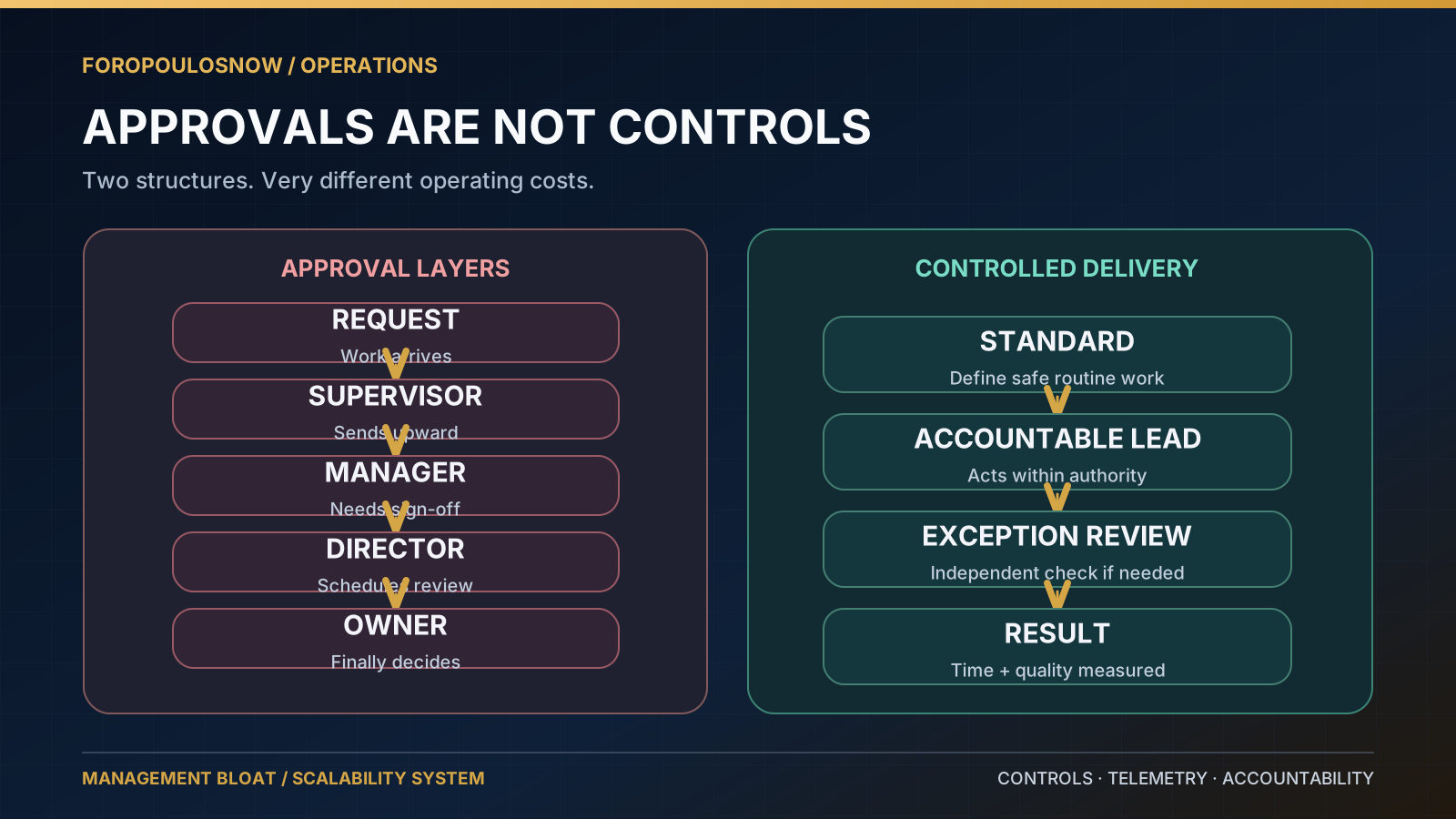
When you can't see the work, you hire someone to watch it. When that person can't explain the results, you hire someone to manage them. Congratulations: you've built an org chart with its own gravitational field.
The real question isn't how many managers a small business should have. It's whether each layer has a defined purpose, an affordable cost, the authority to act, and a measurable effect on performance.
I'm keeping the consultation itself private; this isn't a disguised client case study. The numbers below are clearly labeled examples, and the framework is intended for an owner, operator, or advisor to adapt to their own sector. The principle travels well: without operating standards, financial controls, and telemetry, you cannot manage scalability. You can only hope you're growing in the right direction.
The Promotion Trap: When Management Becomes the Work
Management isn't the enemy. Good management makes teams safer, sharper, more consistent, and less dependent on a founder solving everything at 11 p.m. A capable supervisor who coaches people, resolves exceptions, protects quality, and keeps delivery moving may be worth far more than their paycheck.
The trouble begins when management stops being a function and becomes a layer. A title appears because someone has been around a long time. Another appears because the owner is overwhelmed. A third appears because the first two disagree about who's allowed to approve a purchase order.
Somewhere in there, the customer is still waiting for someone to answer the phone.
How perfectly ordinary businesses get bloated
The patterns aren't unique to retail, contractors, hospitality, agencies, manufacturers, or professional services:
- Promoting to solve retention. A valuable employee deserves advancement. But creating an undefined manager position as a reward confuses compensation, career development, and the actual need for supervision.
- Hiring around an undocumented process. Nobody wrote down how scheduling, purchasing, quotes, inventory, complaints, or approvals work, so a new manager becomes the human instruction manual.
- Confusing activity with leadership. Meetings multiply, reports get longer, and everybody is busy. Meanwhile, cycle time, margin, service quality, and cash haven't improved.
- Building approval chains instead of controls. Three people say yes to the same routine decision, but nobody independently reconciles the transaction or investigates exceptions.
- Budgeting titles instead of workload. Staffing grows because revenue once grew, not because current demand, complexity, or risk justify the headcount.
- Making the owner the permanent escalation queue. Managers collect questions and pass them upstairs. The founder remains the only person with usable authority.
This isn't an argument for some magical manager-to-employee ratio. Work that is hazardous, highly variable, distributed across locations, or technically demanding may require more supervision. Routine, standardized work may require less. McKinsey's research on spans of control makes precisely that distinction: design spans around the complexity and nature of the work, not a universal headcount target.
A title is not an operating control
Don't ask only, "Who reports to this manager?" Ask: "What decisions does this person own? What can they resolve without escalation? What risk do they control? What customer or financial outcome should improve?" If those answers are vague, the position needs a role review before the next hiring decision.
"The purpose of management is to make the work more predictable, not to make the organization look more important."
There is another mistake hiding beneath the promotions: trying to cure a weak operating system with more payroll. That's a costly prescription when the underlying disease is missing data.
Before You Add a Layer, Show Me the Math
Here's where most growing businesses get the economics backward. They approve a salary, then hope the extra leadership somehow pays for itself. Upstream overhead is a recurring obligation. It needs a recurring economic justification.
Start with the entire cost of the role: wages or salary, employer payroll taxes, benefits, bonuses, insurance where applicable, training, software, equipment, and recruiting costs. Distinguish one-time setup costs from ongoing costs, but budget for both. If an owner is doing unpaid management work, normalize a reasonable replacement cost when assessing the model.
As a reality check, the U.S. Bureau of Labor Statistics reported that in June 2026 private-industry wages and salaries represented 70% of average employer compensation costs, with benefits making up 30%. That's a broad national average, not a recommended flat markup for a specific employee. Your actual burden depends on the role, region, employer, and benefits plan. Source: BLS Employer Costs for Employee Compensation.
The contribution-margin test
Before deciding whether a business can support a new layer, separate what comes in from what the work costs to deliver.
Contribution margin = revenue minus costs that vary with sales or service volume.
Operating headroom = contribution margin minus existing fixed operating costs.
The classifications matter. In one business, production labor may behave like a variable cost; in another, salaried service staff may be a fixed or mixed cost. Use one consistent classification and never count the same payroll expense twice. Gross profit and contribution margin are also not interchangeable; reconcile them to the chart of accounts.
Now consider an illustrative company, not the business from the consultation:
| Monthly operating picture | Amount |
|---|---|
| Sales | $200,000 |
| Variable costs | $140,000 |
| Contribution margin (30%) | $60,000 |
| Existing fixed operating costs | $54,000 |
| Operating headroom before a new hire | $6,000 |
| Proposed manager, fully loaded | $7,500 |
| Headroom after hire, absent improvement | -$1,500 |
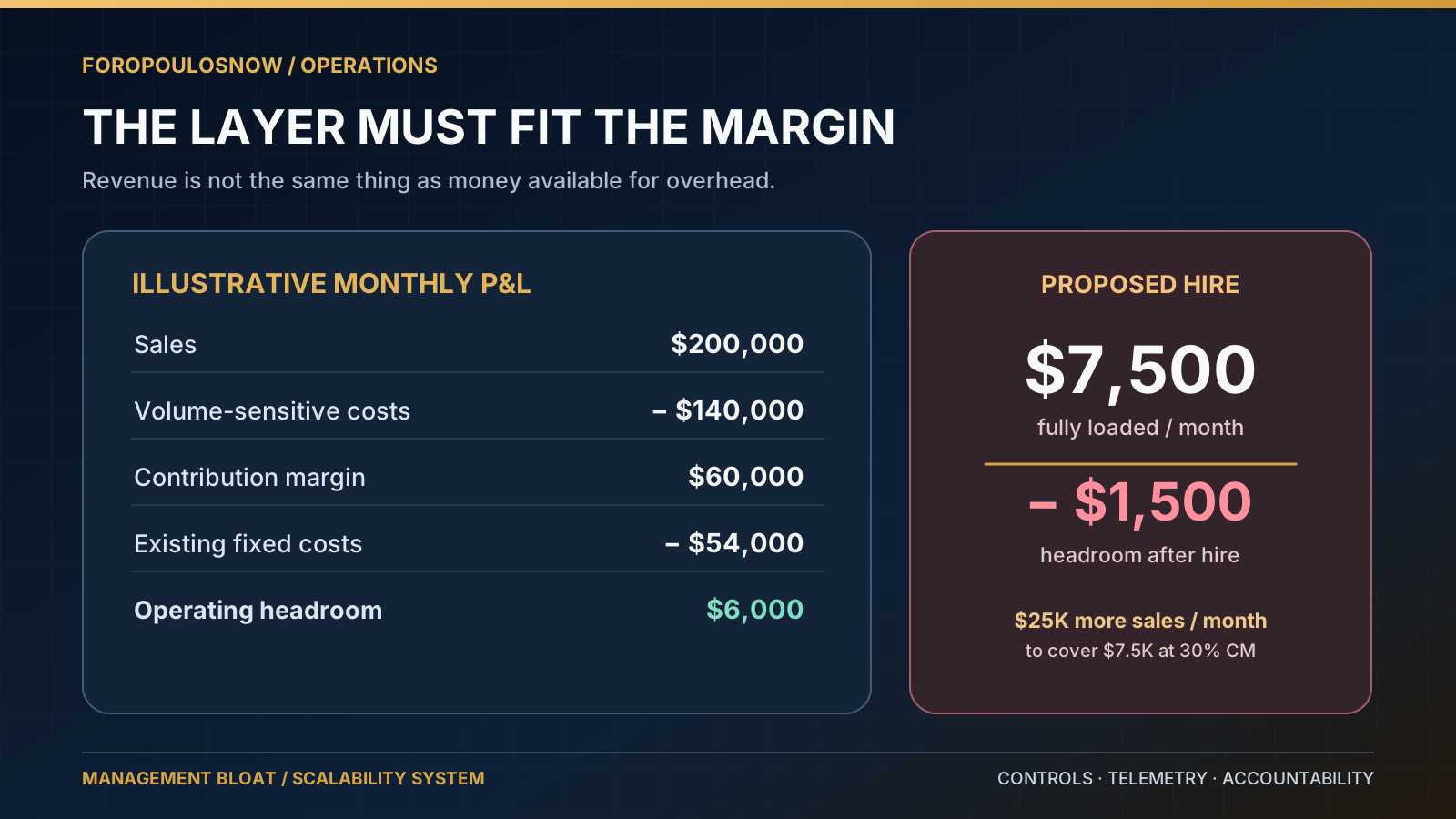
This hypothetical business would move from a $6,000 operating surplus to a $1,500 shortfall. To preserve its original surplus, the position would need to generate or protect another $7,500 in monthly contribution. At a stable 30% contribution margin, that is equivalent to $25,000 in additional monthly sales, assuming those sales require no unmodeled fixed capacity. Verified savings or avoided losses could also contribute to the justification.
But break-even is not a growth strategy either. A proper budget also needs an owner-approved profit target, debt service, cash reserves, seasonal stress testing, planned capital expenditure, and a reasonable margin for error. The SBA's business-finance guidance emphasizes proper bookkeeping, cash-flow visibility, and cost-benefit analysis for exactly this kind of decision.
The management-layer authorization test
Before funding a new position, document six things: (1) its unique purpose, (2) decisions and controls it owns, (3) workload or risk that requires it, (4) fully loaded annual cost, (5) expected measurable benefit or required compliance coverage, and (6) the budget and review date. A legal or safety-critical role may be necessary even without an immediate payback; its cost still has to be funded.
Benchmark your sector, not somebody else's spreadsheet
A convenience retailer, an accounting practice, and a fabrication shop should not share a labor-percentage target just because they're all called small businesses.
Start with a relevant NAICS industry classification and compare businesses with similar service models, geography, scale, hours, labor intensity, and regulatory obligations. U.S. Census Annual Integrated Economic Survey data includes industry-level revenue, payroll, expenses, and other operating measures; BLS compensation data adds another lens. Trade associations and credible sector surveys can refine the picture. Public datasets may lag and may not match a local operator, so use them as baselines to investigate, not as universal staffing decrees.
| Sector | Useful operating lenses |
|---|---|
| Retail / convenience | Gross profit per labor hour, inventory variance, shrink, stockouts, transaction mix |
| Home and field services | Jobs completed per crew-day, rework, utilization, quote-to-book cycle, contribution per job |
| Hospitality / food service | Labor hours per cover or occupied unit, waste, speed of service, guest recovery |
| Manufacturing | Throughput, scrap, downtime, schedule adherence, quality escapes |
| Professional services | Billable utilization, realization, delivery margin, turnaround, client retention |
The denominator matters. For a low-margin retailer, looking only at labor as a percentage of sales can hide how little gross profit remains. For a service firm, ignoring unbillable management hours can make an apparently busy team look far more profitable than it is.
Build the Operating System Before Building the Pyramid
Here's where the argument turns. If your organization needs three people to supervise a process nobody can describe, you don't necessarily have a staffing problem. You have an operating-system problem.
For this assessment, I use a five-part, sector-neutral framework: SCALE. It isn't an external certification or a claim that every industry runs identically. It's a practical model that makes the right industry-specific questions repeatable.
S. Sector economics
Define the unit that creates value: a completed job, guest, sale, order, service hour, subscription, or production run. Tie that unit to price, cost to deliver, contribution, capacity, cash cycle, and the applicable industry benchmark.
Require an operating budget at the business, site, team, and relevant service-line levels. Include managerial payroll separately enough that it can't quietly disappear into general labor. Build base, downside, and growth scenarios rather than treating last year's best month as this year's guaranteed future.
C. Controls
Document who can authorize purchases, schedule work, change prices, approve discounts, issue refunds, modify payroll, access financial systems, and reconcile cash, stock, or accounts. High-risk transactions need independent review or compensating controls where full separation of duties isn't possible.
The GAO's 2025 Green Book, while written as a federal internal-control framework, provides a useful cross-sector reference: a control environment, risk assessment, control activities, information and communication, and monitoring. These are design principles, not an assertion that a private business is required to follow federal agency standards.
A. Accountability
Give every recurring process an owner, an SOP, an outcome, and an escalation route. Use a simple responsibility matrix: who performs the work, who is accountable, who must be consulted, and who needs to be informed.
One person should be clearly accountable for a routine decision. Several people may perform checks when risk demands it. That is different from requiring four signatures because nobody knows who's in charge.
L. Live telemetry
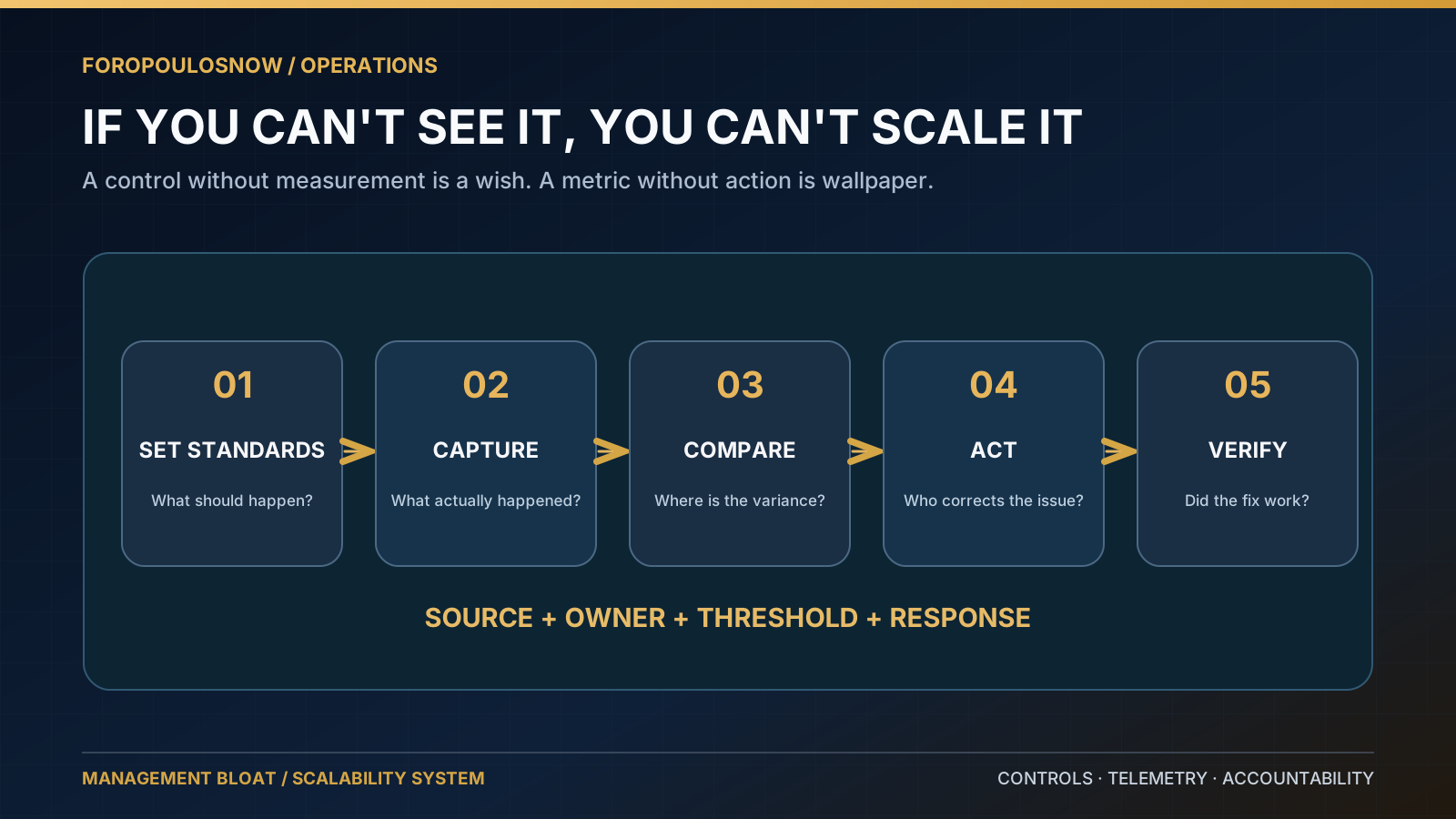
Telemetry is not a colorful dashboard that executives admire once a quarter. It's a repeatable signal from the actual operating process, captured with a definition, source, owner, cadence, decision threshold, and response.
You don't need fifty charts. You need a few measures that connect payroll and control activity to the customer experience and financial results:
| Measure | What it tells you | Source / review |
|---|---|---|
| Contribution per job, shift, or location | Whether output is economically worthwhile | Accounting + POS/job costing; weekly/monthly |
| Fully loaded supervisory cost / contribution | What portion of generated contribution is consumed by management | Payroll + finance; monthly |
| Productive output per paid labor hour | Whether staffing capacity matches actual work | Timekeeping + operations; weekly |
| Time from request to decision | Whether approvals are slowing the business | Tickets/approvals; weekly |
| Rework, returns, shrink, or exceptions | Where errors and missing controls consume margin | Quality, inventory, finance; weekly/monthly |
| On-time delivery, response time, retention | Whether efficiency is improving the customer result | CRM/POS/service logs; weekly/monthly |
| Overtime, vacancies, turnover, training completion | Whether cost cutting is overloading or underpreparing people | HR + scheduling; monthly |
For each measure, write down what triggers action. If average approval time breaches an owner-set service target, who removes the bottleneck? If rework rises while payroll falls, who stops the experiment? Without a decision rule, a dashboard is just expensive wallpaper.
E. Experiment, evaluate, evolve
Install a review rhythm: daily exceptions where necessary, weekly operational scorecards, monthly financial reconciliation and forecast updates, and quarterly role and capacity assessments. Preserve evidence of corrective actions and check whether they actually worked.
This is aligned with the process approach and continuous-improvement principles described by ISO 9001, which applies to quality-management systems across sectors. It doesn't mean your small business needs to pursue ISO certification. It means a company should be able to explain, operate, measure, and improve its processes.
The minimum viable business operating system
A usable system has a current budget; documented core processes; a decision and authorization matrix; named owners; trustworthy finance, staffing, and service data; a small KPI scorecard; and a calendar for reviewing exceptions and improvements. It should survive a manager's day off without turning the owner into emergency tech support.
The Management Bloat Audit: A 90-Day Reset
Now we can address organizational bloat without turning the exercise into a corporate version of musical chairs.
First, assess the structure, not the personalities. A good employee trapped inside a poorly designed role isn't evidence that the employee is the problem. The goal is to remove redundant work, unclear decisions, preventable risk, and overhead the business cannot support.
A reusable six-question screening scorecard
Score each domain 0, 1, or 2: 0 means no usable evidence; 1 means it is documented but inconsistently applied or measured; 2 means it is documented, actively measured, and demonstrated in operation.
| Domain | The evidence question |
|---|---|
| Economic coverage | Can the business fund each management role under base and downside forecasts? |
| Role clarity | Does each layer own distinct decisions, outcomes, and escalation authority? |
| Capacity and supervision | Is the span justified by complexity, workload, skills, geography, and risk? |
| Control coverage | Do the important financial, safety, quality, and access controls operate and get checked? |
| Telemetry | Do relevant KPIs have reliable sources, owners, thresholds, and corrective actions? |
| Customer and employee impact | Does the structure improve delivery and quality without creating unsafe workload or turnover? |
Maximum: 12 points. This is my proposed diagnostic screen, not a validated industry standard or compliance score. The useful output is the list of missing evidence and failing controls, not a trophy for getting a 10. One serious safety or fraud-control gap deserves immediate attention even if every other category earns full marks.
Run the correction in four stages
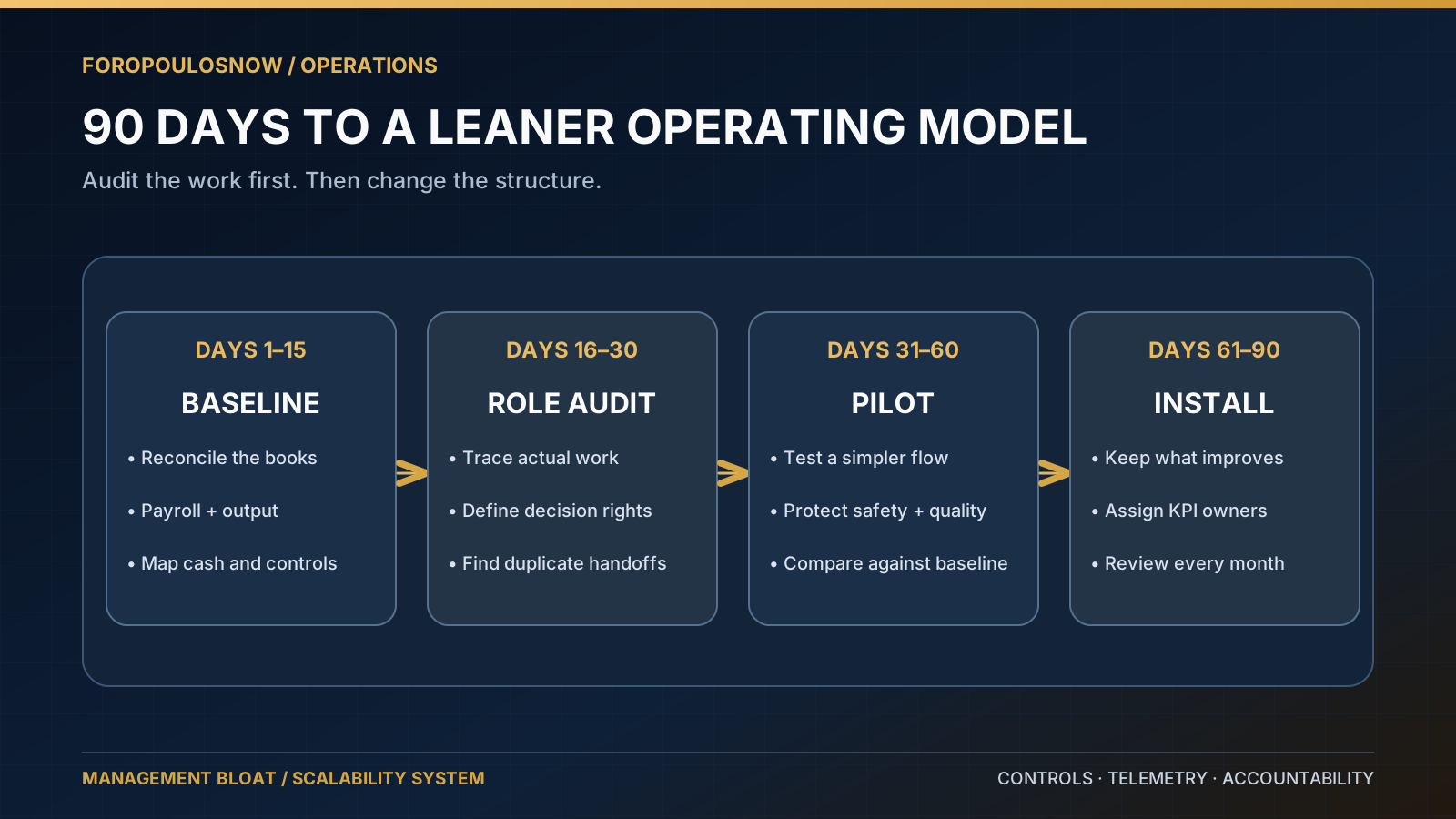
Days 1–15: Establish the truth. Reconcile the P&L, payroll, schedules, system permissions, purchasing rules, and operating output. Collect enough history to distinguish a slow Tuesday from a seasonal trend. Identify direct versus supervisory labor, fixed versus volume-sensitive costs, and unpriced owner labor. Interview frontline workers: they usually know exactly where the process stalls.
Days 16–30: Map work and ownership. For every manager, record the decisions they make, time spent coaching or producing, direct reports, approvals handled, issues resolved, and controls owned. Draw the real workflow rather than the version in the employee handbook. Look for duplicate approval steps, responsibilities that nobody owns, and expensive people doing clerical work because the process lacks structure.
Days 31–60: Redesign and test. Clarify or combine responsibilities where appropriate, simplify safe routine approvals, cross-train people, improve scheduling, document missing SOPs, or use shared/fractional specialist coverage. Pilot in one team or location where possible. Compare margin, turnaround, quality, control exceptions, overtime, and customer results against a baseline, accounting for demand and seasonality.
Days 61–90: Institutionalize what works. Keep effective changes, reverse harmful ones, and establish monthly owner-led reviews. Set budget triggers for hiring or adding another layer. Make each management position undergo periodic role and cost justification, not just an annual performance conversation.
The red flags, and what to do instead
| Symptom | Likely problem | Better correction |
|---|---|---|
| Managers spend their day forwarding approvals | Unclear authority | Define decision rights and exception thresholds |
| Sales are flat while supervisory payroll keeps rising | Layer cost grew without supporting economics | Run a fully loaded cost and downside budget review |
| Reports arrive, but nobody acts | Metrics lack thresholds and owners | Attach a decision and response to every KPI |
| Founder must approve routine issues | Escalation design failure | Delegate bounded authority and audit exceptions |
| Staff work overtime while managers debate schedules | Capacity not planned against demand | Forecast workload and build labor schedules from it |
| A manager is judged by number of reports | Headcount rewarded over outcomes | Evaluate delivered quality, margin, coaching, and control performance |
| A "lean" change causes more returns, incidents, or resignations | Cost reduction displaced risk | Restore coverage, investigate, and redesign the process |
There are important limits. Don't cut a required supervisor, remove an independent financial check, violate wage-and-hour or staffing requirements, or erase training and safety coverage in the name of efficiency. Use attrition, reassignment, cross-training, or role redesign where workable, and have qualified HR, legal, and financial advisors review decisions that affect employment obligations.
The Next Management Layer Might Not Be Human
Here's the progression worth talking about in a follow-up article. A few years ago, many small businesses needed humans to chase approvals, reconcile routine exceptions, compile weekly reports, monitor inboxes, route requests, and keep SOPs in front of a team. Traditional scripts could automate parts of that work, but unusual cases often broke the flow.
Modern agentic resources are changing the economics of coordination. Properly bounded software agents can gather information across approved systems, draft exception reports, flag discrepancies, prepare schedules, triage service requests, and propose next actions for a responsible human to approve. That may let a small business increase capacity without automatically installing another full-time coordination layer.
But don't confuse an agent with a licensed professional, a compliance officer, or an accountable manager. Agents can make mistakes, mishandle sensitive information, and follow malicious or misleading instructions. They need least-privilege access, human approval gates for consequential actions, audit logs, testing, monitoring, and a way to shut them off. The NIST AI Risk Management Framework gives organizations a useful foundation for governing, mapping, measuring, and managing those risks.
In Small Is the Unfair Advantage, I argued that a smaller organization can use agentic structure to make its agility count. This piece is the necessary prerequisite: if you automate a business that doesn't understand its own margins, controls, or decision rights, you've simply taught the mess to operate faster.
Coming next: the agentic coordination layer
Next we'll build on this operating model and ask a specific question: which management-adjacent workflows can now be delegated to narrowly scoped agents, which must remain human decisions, and how do we prove the system pays for itself without surrendering control?
The lesson from the consultation is a larger one about growth. Scalability is not how many people you can put underneath a title. It's how much reliable, profitable work your organization can deliver without losing its controls or its mind.
Before you build another management layer, build the instrumentation. Once you can see the machine, you can actually improve it.
Sources and methodology: BLS Employer Costs for Employee Compensation, June 2026; SBA guidance on managing business finances; Census Annual Integrated Economic Survey, 2024; McKinsey on spans of control; GAO 2025 Green Book; ISO 9001:2026 overview; NIST AI Risk Management Framework. The financial scenario, SCALE framework, scoring screen, and 90-day plan are illustrative editorial models, not sourced industry-average benchmarks or client-specific findings.