
Somewhere in the world, an engineer is staring at a circuit board that costs less than a decent dinner, trying to figure out why it could hold up a machine worth thousands of dollars.
The processor works. The software works. The product has been designed, tested, approved and lovingly placed into a production schedule that presumably looked beautiful in PowerPoint.
Unfortunately, somebody forgot that advanced electronics need more than expensive chips and a passionate belief in technology. They need copper, fiberglass, resin, capacitors, switches, and a collection of microscopic parts nobody thinks about until the purchasing department starts using phrases like "allocation" and "extended lead time."
Translation: We built an entire civilization around electronics. Now we're having trouble securing some of the boring parts.
And the boring parts have apparently decided they'd like a raise.
That sounds like a joke. The data does not.
On October 26, 2026, the Global Electronics Association reported that North American printed circuit board orders booked in September were 229.4% higher than a year earlier, while shipments that month were 6.4% lower. The association explicitly called out bottlenecks in copper foil, resin and electronic glass fabric, particularly the high-performance grades used in advanced boards.
That does not mean the planet has run out of circuit boards. It means demand, production and access to the right materials are moving out of step. And if you've ever tried to finish a project with every part except one, you know how expensive that last part can become.
The Most Important Green Thing You've Never Thought About
A printed circuit board, or PCB, is the physical foundation and electrical connection system inside an electronic product. Open a computer, television, garage-door opener, security camera or household appliance and you'll probably find one. Often several.
Think of the board as a city.
Copper pathways are the roads carrying electrical power and signals. The electronic components are the buildings where useful work happens. Small plated holes called vias connect roads on different floors. The insulating material keeps those roads from crashing into one another.
And the green color? Mostly marketing's gift to your mental picture. It's usually a protective coating called solder mask, and boards can come in other colors. The fiberglass-and-resin material beneath it is often a grade called FR-4.
The important distinction is between a bare PCB and a PCB assembly, or PCBA. The first is the board with its copper pathways, holes and protective coatings. The second is that board after the chips, capacitors, connectors and other parts have been attached and soldered in place.
A shortage can hit either stage. It can be difficult to obtain the bare board material, or the finished board can be sitting on a shelf waiting for one small electronic part.
Why does this matter to someone who has never used a soldering iron? Because the thermostat that tells your air conditioner when to run, the control panel on your washer, and the computer managing the engine in your vehicle all depend on some version of this infrastructure.
The board isn't the cleverest part. It's the part that makes all the clever parts work together.
Meet the Tiny Employees Keeping Your Appliances Alive
You don't need an electrical engineering degree to understand the main players. You just need to know what job each one performs.
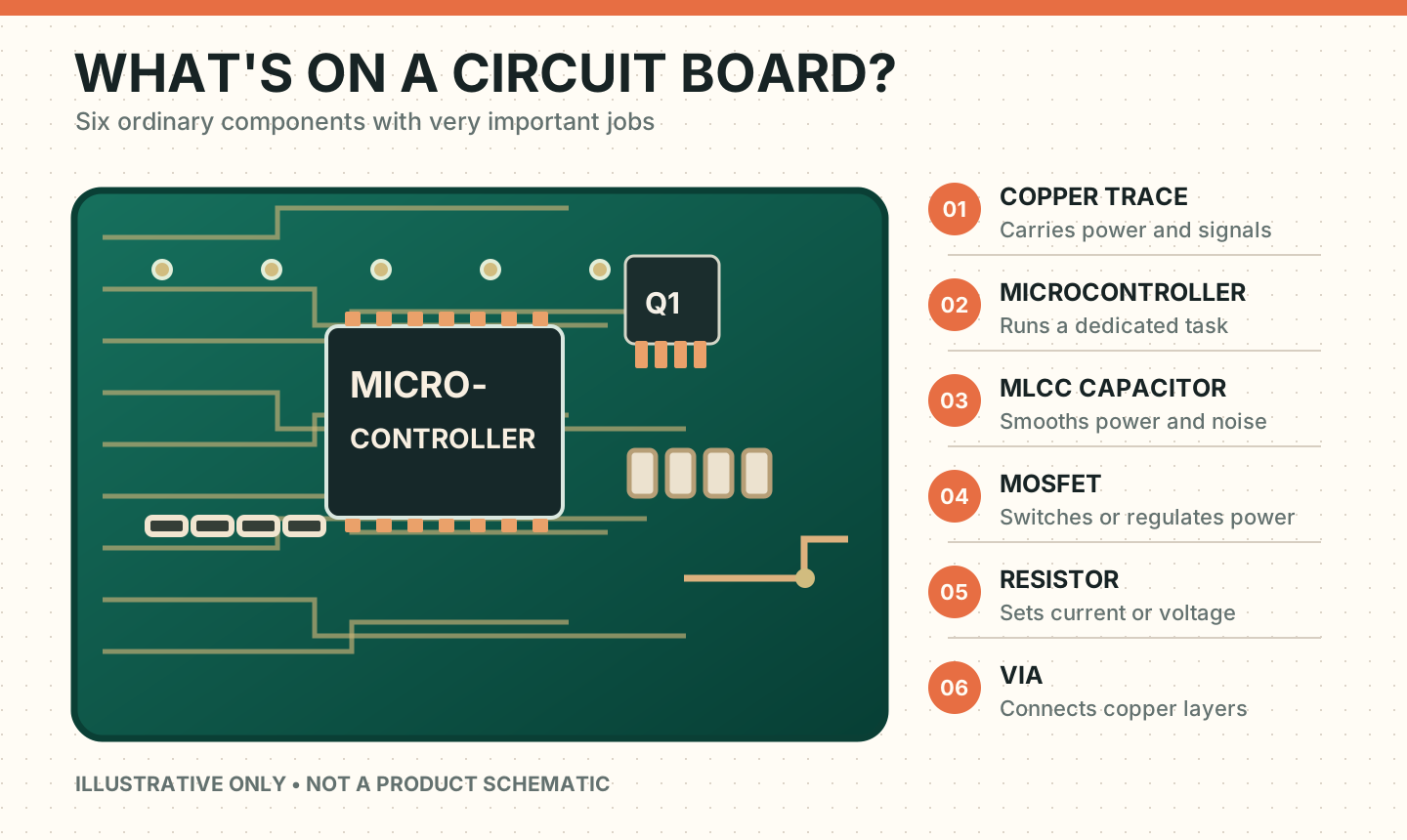
Copper traces connect components and move electrical signals or power. Remove the proper path and the circuit stops behaving like a circuit. It's less "wireless future" and more "where did the wire go?"
Resistors control current or, in combination with other components, establish voltages. They're the people directing traffic who never get thanked until a signal goes someplace it shouldn't.
Capacitors briefly store electrical charge, helping filter noise and stabilize power. One common variety is the multilayer ceramic capacitor, or MLCC. There can be hundreds or thousands on a complex board. They are tiny, not magic, and different capacitance, voltage and temperature ratings matter.
MOSFETs are semiconductor devices often used as electronic switches. They help control motors and efficiently regulate power. That makes them relevant to everything from chargers to industrial machinery. The initials stand for metal-oxide-semiconductor field-effect transistor, which is an excellent phrase to use if you want everyone to suddenly remember they have another meeting.
Microcontrollers are little computers that run specialized tasks. A control board may use one to read a sensor, watch a temperature and tell a compressor or pump what to do. Unlike the computer on your desk, it usually doesn't need a browser, a desktop wallpaper or forty-seven updates before it can start.
Connectors join the board to wires, displays, motors or other modules. Even an excellent control system is mostly a decorative object if it cannot connect to the thing it controls.
And memory chips, which we discussed in our previous article on everyday price pressure, hold instructions or data. Memory shortages and PCB shortages are linked supply-chain stories, but they are not the same shortage.
A quick correction to the apocalypse headlines
Not every capacitor, transistor, microcontroller or board is scarce. Availability varies by exact part number, performance rating, supplier, geography and approved substitutes. One model may be difficult to obtain while a superficially similar one remains available.
The engineer's least favorite phrase is "just use a different one." An automotive or industrial board may have to meet strict requirements for electrical behavior, temperature, vibration, reliability and long-term service support. A substitute that fits physically may still require engineering changes, testing and approval.
It's the hardware version of replacing a restaurant's chef with a person who owns a frying pan. Some of the qualifications may overlap. The food inspector will probably have follow-up questions.
Apparently, Even the Sandwich Ingredients Are on Backorder
How do you make a circuit board?
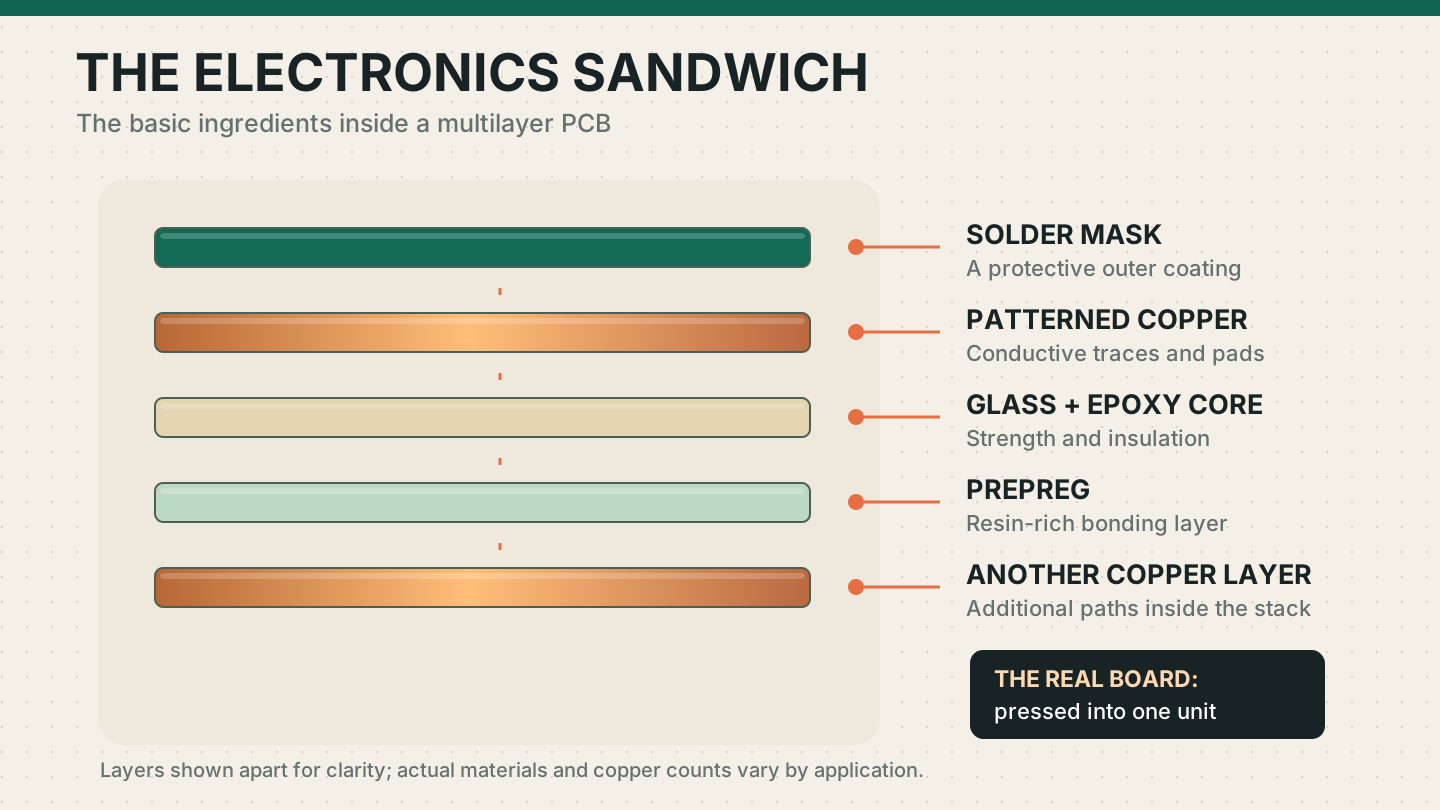
Start with fiberglass cloth for strength and stability. Saturate it with resin, commonly an epoxy system, to create insulating structural material. Add copper foil, which will be patterned into the circuit pathways. In multilayer boards, partially cured resin-and-glass sheets called prepreg are pressed between layers to bond them together.
Then manufacturers image and etch the copper, drill holes, plate connections, apply protective finishes, and inspect the result. The assembly stage adds and solders the electronic components.
This is not an afternoon arts-and-crafts project. Precise electrical behavior and consistency matter, particularly when signals run at high frequencies or the product must survive heat and vibration. PCBWay's materials guide provides a useful manufacturing explanation.
Now picture suppliers competing for the specialized glass cloth, copper, resin systems and production equipment behind that process.
In August, electronics publication Evertiq reported a warning from PCB supplier Confidee: supply pressure that began in advanced materials was reaching ordinary FR-4 and thicker copper-clad laminates. The underlying concern was not that every board had disappeared. It was that production priorities and material availability were shifting even for buyers of conventional products.
In October, laminate maker Kingboard announced a 15% price increase on specified laminates and prepreg made with style 2116 or thinner glass fabrics, as reported by DIGITIMES. It was the company's eighth price-increase notice in 2026.
A 15% increase in one material is not a 15% price increase on your next television. Other board materials, assembly, labor, software, distribution and retail margins all matter. The manufacturer may absorb some costs, redesign, find another supplier, or pass a portion through.
But it is a warning that a piece of the manufacturing foundation is becoming more expensive. And when several pieces rise at once, there are fewer places to hide the bill.
The Gold Rush Has a Shovel Problem
Advanced AI servers and networking equipment are important parts of this story. They use sophisticated boards, chip-package substrates, dense interconnections and demanding materials. Some require more layers and increasingly specialized electrical characteristics than an ordinary household appliance.
Demand for those products can make high-grade material production more profitable. Suppliers have an incentive to invest capacity where demand and margins justify it, even when conventional customers still need ordinary materials.
This doesn't mean a data center literally consumes the fiberglass intended for your washing machine. The relationship is more complicated: manufacturers can share upstream suppliers, equipment, processing capacity and investment budgets. A production line redirected toward premium materials may not be easily or quickly redirected back.
Other buyers matter too. The Global Electronics Association identifies data centers, networking, aerospace and defense among the drivers of strong PCB orders. Meanwhile, automotive and industrial manufacturers need their own qualified parts.
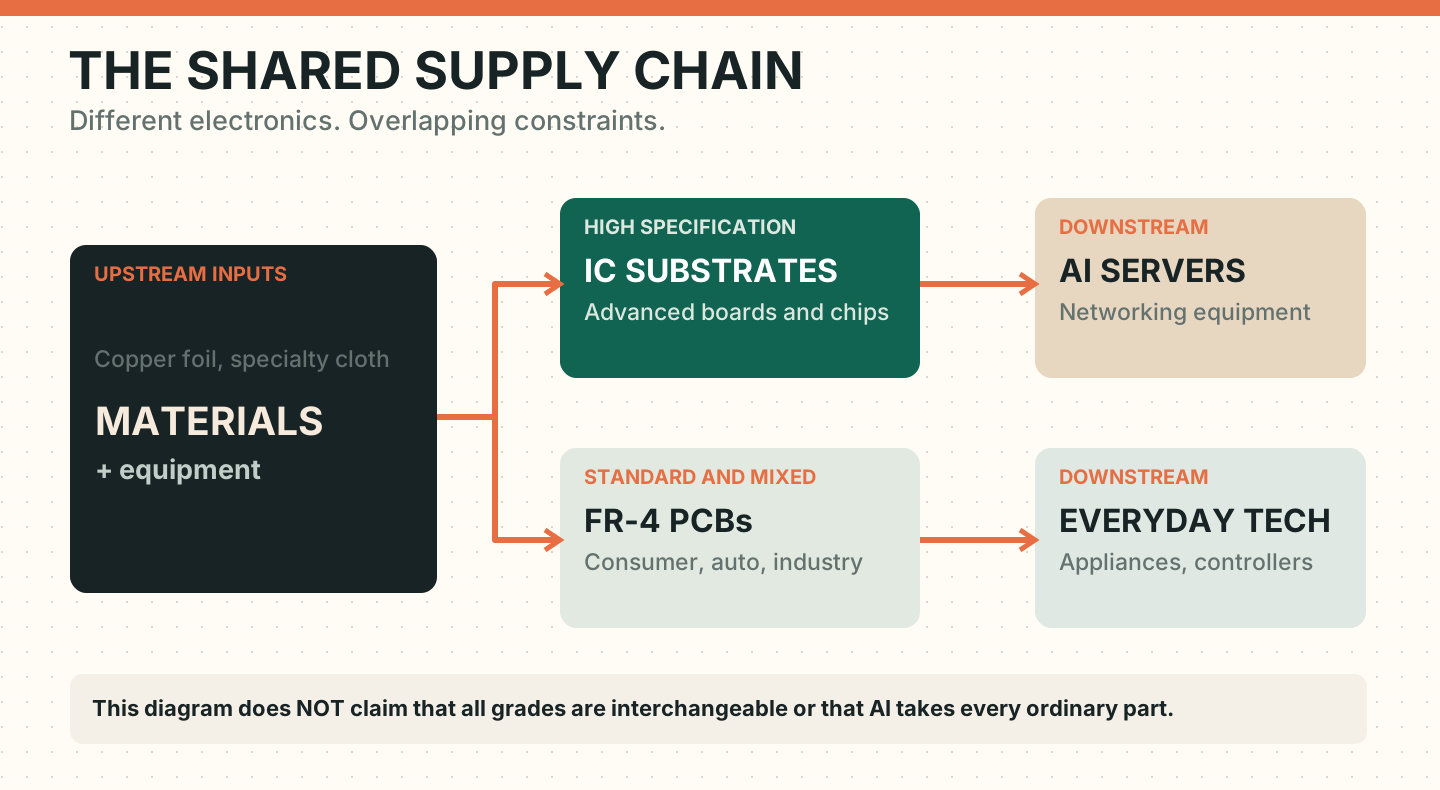
Here's another wrinkle. An IC package substrate is not the same as the big board you see inside a desktop computer. It's a very fine-pitch interconnection platform used inside or immediately beneath the chip package, bridging microscopic chip connections to the larger assembly. It can require exceptionally precise materials and manufacturing.
On October 20, TrendForce summarized remarks from Unimicron chairman S.C. Chien: some critical substrate materials could face a roughly 20% supply gap in 2027, and certain equipment lead times had stretched to 30 months.
That 20% is a forecast for some critical substrate materials, not a prediction that global PCB production will fall 20%. The distinction is important. We are trying to understand the supply chain, not enter a competition to see who can print the scariest percentage.
Even so, you cannot order a new factory machine on Monday and expect it to be weaving qualified electronic glass fabric by Friday. Capacity expansion takes equipment, installation, skilled labor, process validation, and customers willing to qualify the result.
Money can accelerate decisions. It cannot always accelerate chemistry.
And Now the Actual Numbers, Without the Dramatic Sound Effects
Let's revisit the September PCB data.
The Global Electronics Association reported a three-month book-to-bill ratio of 1.77. In plain English, the value of orders booked over its three-month survey period was 1.77 times the value of sales billed. That is a sign of strong ordering relative to billed output among participating North American manufacturers.
September bookings were up 229.4% year over year, while September shipments were down 6.4% year over year. But year-to-date shipments were up 13.3%. These numbers are not contradictory; they measure different time windows and different things.
A very large monthly bookings increase can reflect a low comparison base, concentrated large orders and changes in customer purchasing patterns. It is not a percentage shortage, a forecast for all markets, or proof that 229% more products will be delivered.
The same caution applies to components.
Future Electronics' October 19 market report described vendor allocation affecting categories including certain DRAM and storage products, MOSFETs, MLCCs, specialty resistors, aluminum capacitors and selected microcontrollers and analog products. Allocation means suppliers are controlling how scarce inventory is distributed. It does not mean every part in those categories is unavailable.
And the market is not moving in one direction. TrendForce's October 29 analysis expects shortages in high-end, high-capacitance MLCCs through the first half of 2027, yet it also reports that some lower- and mid-capacitance consumer-grade MLCC spot prices slipped about 5% in early October.
Yes, two things can be true
Some premium capacitors are in serious short supply while some cheaper consumer-grade capacitors have weakened in price. A component family is not one interchangeable commodity, and an AI-grade shortage does not automatically imply empty shelves at the neighborhood electronics store.
That is the real shape of the problem: pockets of tight supply, material inflation and constrained qualifications, not an evenly distributed electronics famine.
Congratulations. Your Washing Machine Has Joined the Global Supply Chain Crisis.
Let's leave the semiconductor conference and enter the kitchen.
Imagine your washing machine's mechanical parts are fine, but its control board fails. The board is specific to that model, and a repair company needs the right replacement. If the manufacturer cannot supply it promptly, the repair becomes a scheduling problem. If the delay is long, it can become a financial decision: wait, locate a compatible replacement, arrange a repair, or replace the machine.
This is an illustrative scenario, not proof of a nationwide appliance-board shortage. It shows how the cost of an unavailable part can be larger than its price.
Now take that same logic through the rest of everyday life.
Cars and trucks. Engine management, charging, displays, sensors, motor control and safety systems depend on electronic assemblies. Manufacturers need approved parts, and changing a board can require qualification. Production delays or more expensive parts are possible outcomes of shortages; we should not assume they are occurring in every vehicle line.
Home heating and cooling. Thermostats, fan controls, compressors and modern control modules use boards that are not easy to replace with whatever looks similar on a web search. The issue may be the component, the complete spare board, or the manufacturer's inventory policy.
Medical and accessibility equipment. Controls, sensing, displays and power systems can rely on exact, long-life components. Safety and regulatory requirements may make substitutions more involved. This is an especially good reason not to treat an unqualified part as an acceptable drop-in replacement.
Small businesses. Point-of-sale systems, security systems, routers, refrigeration, commercial ovens and industrial tools all contain electronic assemblies. A repair delay matters more when a business depends on the equipment to earn revenue.
Factories and distribution centers. Motor drives, conveyor controls, machine-vision systems and programmable controllers keep production lines working. If a qualified spare is unavailable, the operational impact may be more significant than the price of the board.
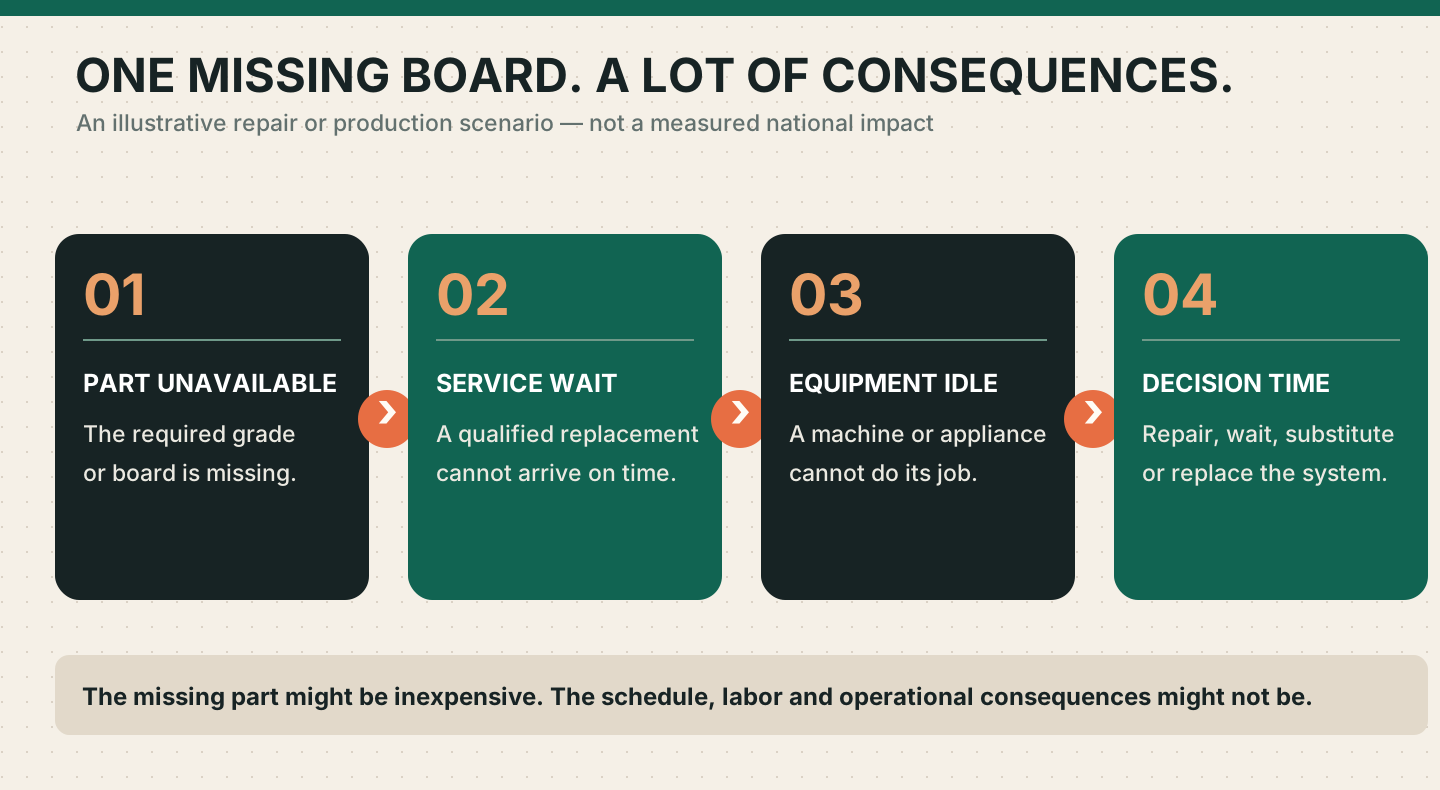
There's a familiar engineering truth hiding here: a part can cost very little and still be mission-critical.
Suppose a hypothetical $120 control module fails in a business where the affected equipment produces $8,000 of contribution in a day. If replacement is delayed and production cannot be shifted elsewhere, the financial exposure can dwarf the part price. But those are deliberately illustrative numbers, not a study of actual 2026 losses. Staffing, spare equipment, service contracts and inventory determine the real outcome.
Buying a thousand spare boards to avoid one delayed repair may also be a terrible use of cash. The sensible response depends on which parts are critical and what losing them actually costs.
Why Can't They Just Put a Different Chip on It?
Because engineering is not a game of Tetris.
Two components can have the same approximate size and still differ in pin assignments, operating voltage, heat behavior, timing, software requirements or approved service life. Two circuit-board laminates can look identical and behave differently when signal frequencies rise or temperatures change.
In a cheap consumer gadget, a manufacturer might redesign the board and move on. In an industrial system, regulated device or vehicle, design revisions can require additional engineering, requalification and documentation. The new part may even need to be tested over months of environmental or reliability conditions.
And there is the bill of materials, or BOM: the exact shopping list of everything needed to manufacture a product. A completed BOM is not a basket of suggestions. It is a controlled specification.
If someone says, "Well, it only needs one resistor," the next question should be, "Which resistance, tolerance, power rating, temperature behavior and package?"
That tends to end the conversation before somebody suggests borrowing one from a toaster.
Does This Mean Everything Is About to Get More Expensive?
No. It means there are credible pathways for higher costs and longer delivery times in certain products.
A retail price is the end of a chain: raw materials, fabricated boards, components, assembly, testing, shipping, inventories, manufacturer margins and retailer decisions. The price of one input can be absorbed, offset or amplified. It can also affect availability instead of price.
A manufacturer might negotiate a long-term contract, hold stock, redesign the product, substitute a qualified part, accept lower margin, raise prices or delay delivery. A company with purchasing power may reserve allocation that a smaller competitor cannot.
Nor is AI the single cause of every difficulty. Demand from networking, defense, automotive and industry matters. Material production is specialized. Supplier concentration and equipment lead times matter. And general consumer-electronics demand has been uneven.
The sensible warning is not "go buy three washing machines before midnight."
It is that the dependability of parts availability, which consumers rarely see and manufacturers sometimes take for granted, is becoming a more significant economic variable.
What has actually been demonstrated?
Documented: higher prices on certain laminate inputs; material bottlenecks; unusually strong North American PCB bookings; allocation in selected electronic components; and forecasts of tight supply in advanced capacitors and substrate materials. Not demonstrated: a uniform global shortage of every PCB, a universal consumer price increase, or a measured contribution from PCB shortages to national grocery inflation.
What Happens in 2027?
We have evidence of genuine stress, but the calendar matters.
At the end of October 2026, TrendForce expects high-end MLCC constraints to persist into the first half of 2027, while the Unimicron-related forecast points to potential shortages of certain IC substrate materials during 2027. Some new manufacturing capacity is planned, but expansions are neither immediate nor guaranteed to cure every grade-specific bottleneck.
The first things worth watching are not sensational headlines about computers disappearing. Watch supplier lead times, quote-validity periods, allocation notices, design substitutions, and whether manufacturers can turn booked orders into shipped products.
If a supplier says a component is "available," ask whether it is actually available at the required grade, quantity, price and delivery date. That is an entirely different sentence.
For manufacturers and repair organizations, a little disciplined procurement beats panic:
For consumers, it is simpler: maintain and repair equipment where practical, check parts availability before buying specialized used electronics, and avoid assuming every retailer price increase has been caused by a single global event.
The Boring Parts Are the Point
We spent decades celebrating smaller processors, faster networks, smarter software and the miracle of everything being connected to everything else.
We treated the boards, copper, resin, cloth and passive components underneath that miracle as if they would always be waiting in the warehouse.
They won't always be. At least not in the exact form, quantity and timing we demand.
This isn't the end of electronics. It isn't proof your refrigerator is about to become a luxury item. It is a lesson in how even extraordinarily advanced industries remain dependent on physical supply chains that cannot instantly expand on command.
The technology industry spent years promising us intelligence on demand.
Apparently, nobody thought to check whether intelligence came with enough fiberglass.
Reporting cutoff: November 1, 2026. All shortages, price changes and forecasts in this article are scoped to the product grades, markets and dates stated. This is an educational supply-chain analysis, not a price or investment forecast.
Sources and further reading
- Global Electronics Association — North American PCB results, September 2026 (released October 26)
- Future Electronics — Market Conditions Report (updated October 19, 2026)
- TrendForce — High-capacitance MLCC outlook (October 29, 2026)
- TrendForce — Unimicron substrate-material and equipment outlook (October 20, 2026)
- DIGITIMES — Kingboard laminate and prepreg price announcement (October 14, 2026)
- Evertiq — Conventional FR-4 supply pressure (August 19, 2026)
- PCBWay — What a PCB is made of (technical background)