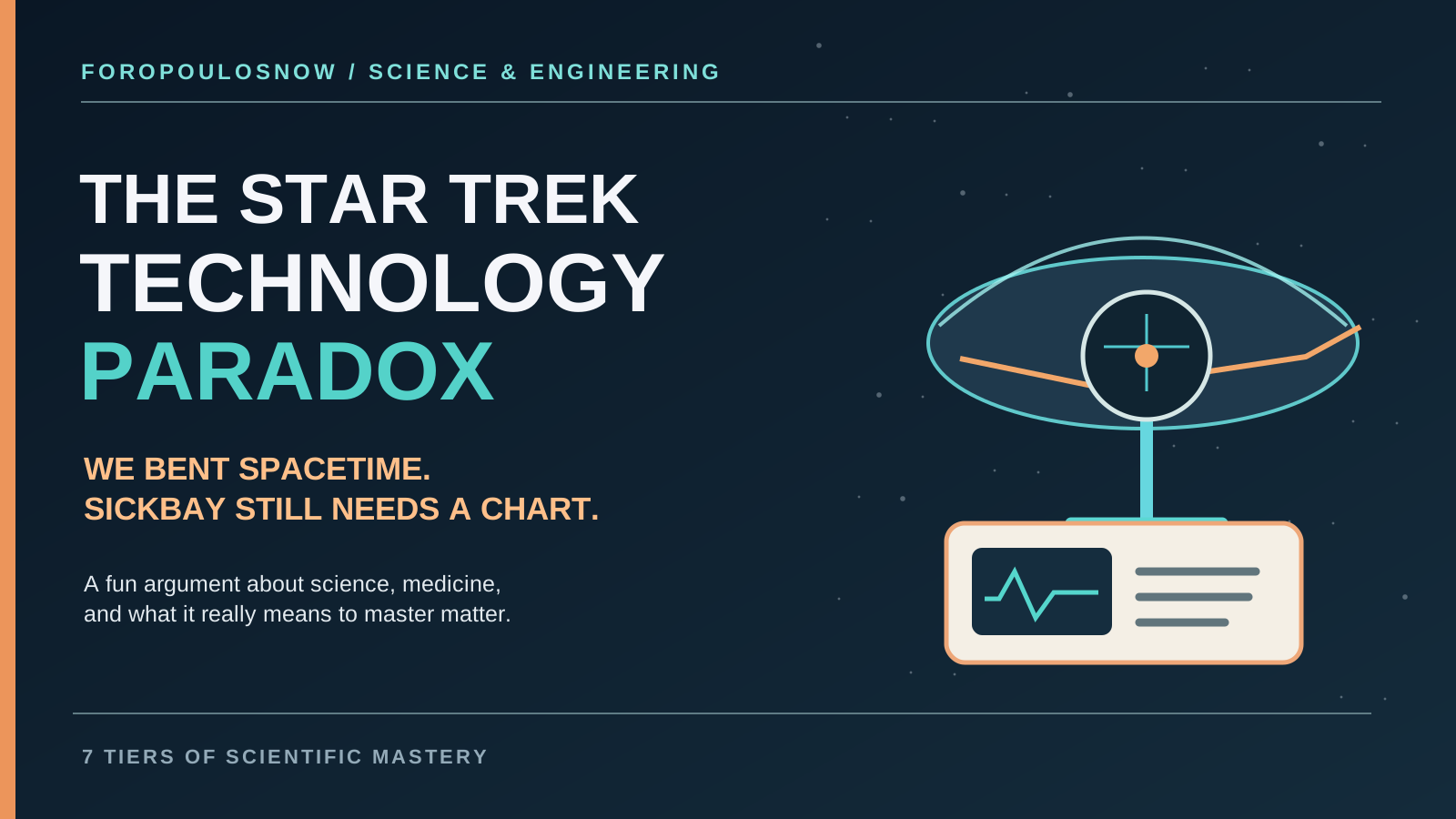

The Enterprise can transport a human being across space. Apparently, the medical department still has to check your chart.
I've been watching Star Trek: Strange New Worlds, and I have a complaint that may be more difficult to explain than warp drive: the medicine.
Captain Pike commands a vessel that can cross interstellar distances, scan objects from extraordinary ranges, project powerful fields and beam living people from one location to another. Then somebody gets hurt, and we return to a familiar scene: a worried doctor, an impressive scanner and a medical intervention that seems oddly ordinary next to the machinery flying around outside.
To be fair, the scanners are excellent. The lighting is fantastic. I'd probably go to sickbay just to look at the equipment.
But the more you think about the engineering implied by Star Trek's imaginary technologies, the stranger the gap becomes.
I'm not arguing that inventing a transporter automatically cures cancer. It doesn't. A machine that moves a complex system is not necessarily a machine that understands how to repair it. The distinction matters.
I'm asking something more useful: what scientific capabilities would have to exist around such an invention—and how many other fields should those capabilities influence?
That question gets us from a fun television inconsistency to a much more interesting subject: how to connect mathematical understanding, experimental proof and actual engineering across the domains of science.
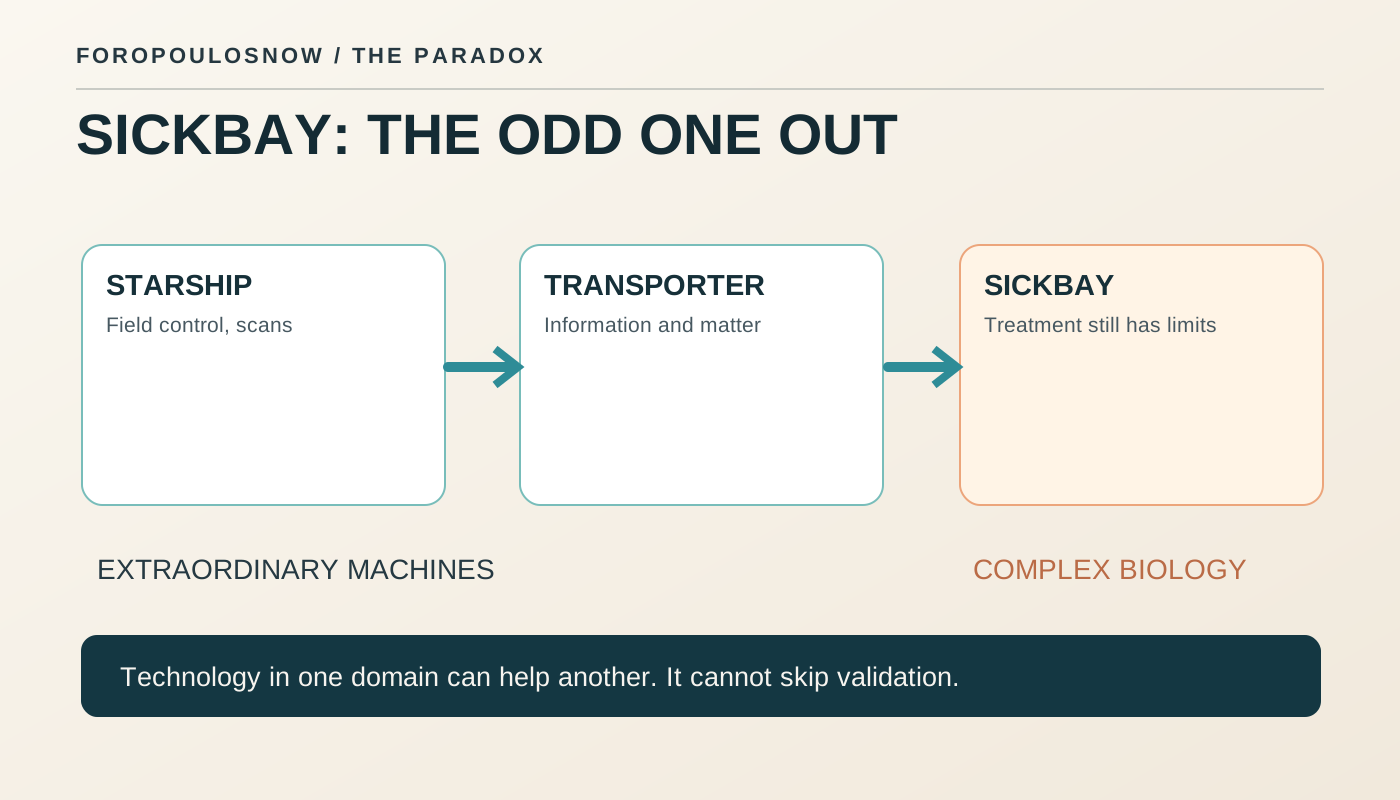
Sickbay: apparently the last department waiting on an upgrade
Let's start by correcting the easy criticism. Star Trek does imagine advanced medical technology, and Strange New Worlds gives us a particularly good example.
In Season 1, Episode 6, "Lift Us Where Suffering Cannot Reach," Dr. M'Benga and Nurse Chapel encounter a Majalan child with quantum bioimplants that automatically repair injuries. The technology is beyond Federation medicine, and the episode makes that difference part of the story. Star Trek's official recap confirms it.
That is a much more interesting answer than pretending every civilization has the same medical toolbox.
It tells us something crucial: technological knowledge is not the same thing as universal technological access. A culture can have a capability another lacks. Politics, law, ethics, resources and knowledge transfer all affect who benefits.
The Majalan story also contains a grim warning about assuming that technological sophistication implies ethical sophistication. Their spectacular achievements coexist with an arrangement the episode wants us to find horrifying.
So no, the show hasn't forgotten advanced medicine. But it has introduced a scientific discontinuity worth exploring.
How can civilizations develop one capability far beyond their neighbors without experiencing a corresponding revolution in related technologies? What discoveries are shared? What constraints are unique? And what happens when the mathematics behind one field turns out to be useful in another?
The important distinction
A spectacular technology can suggest useful knowledge in other fields without guaranteeing specific inventions, cures or social outcomes. Engineering depends on constraints, not just ambition.
Today's medicine already gives us a smaller, real-world illustration. Researchers study nanoparticles and molecular delivery systems to get therapies into particular tissues and cells. NIH-funded researchers have explored cell-targeting strategies using folate and engineered delivery carriers. That is genuine research, not microscopic robots performing surgery between commercial breaks. See the National Institute of Biomedical Imaging and Bioengineering.
What interests me is the potential direction: ever better measurements, models, materials and control systems could eventually enable kinds of intervention that make our current diagnostic-and-treatment routines look like early prototypes.
But "back-channel frequency interpolation through molecular syncing" is not an established medical technique. A phrase like that becomes science only when the physical mechanism, measurable quantities, predictions, tests and limits are defined.
Otherwise, it is excellent dialogue for a science-fiction medical officer.
The transporter problem is bigger than transportation
Now consider the transporter.
In the story, someone steps onto a platform, disappears and reappears somewhere else. Sometimes under enemy fire. Occasionally while an officer is shouting for more power, because apparently every sufficiently advanced machine still has a stressed-out operator.
Forget the special effects for a moment.
A living body contains enormous physical complexity: cells, molecules, tissue architecture, biochemical gradients, active electrical signaling, a nervous system and a lifetime of delicate structure. A hypothetical machine that transfers or reconstructs that organization would imply extraordinary information handling and physical control.
But we need to separate three ideas the fiction casually places side by side:
Measurement means determining properties of a system. Reconstruction means preparing a system in a desired physical arrangement. Understanding and repair means knowing which arrangement is healthy, why it matters and how to produce it safely.
They are related; they are not interchangeable.
A high-resolution map of a damaged bridge does not tell you how to repair the bridge. It does, however, give an engineer quite a head start.
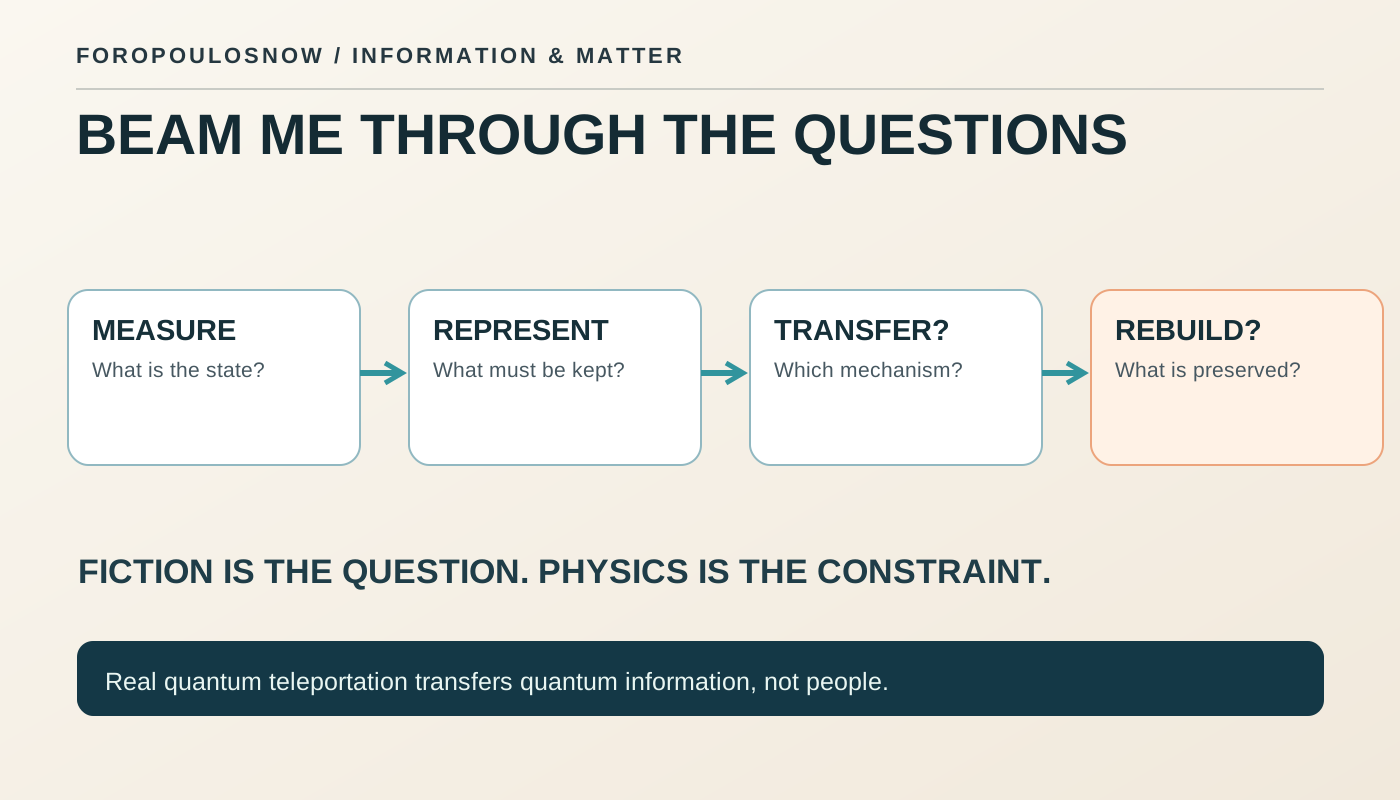
This is also where people misuse a real term: quantum teleportation.
Quantum teleportation in physics transfers quantum information, using entanglement and classical communication; it does not send a person, a molecule or a spaceship across the room. IBM Quantum Learning explains the distinction.
And quantum mechanics contains the no-cloning theorem, which prohibits perfect copying of an arbitrary unknown quantum state. That does not magically answer every question about fictional transporters. It does establish that any real mechanism would have to respect—or demonstrably revise—very serious constraints. IBM's discussion of the theorem is a good place to start.
Science-fiction vocabulary check
Human beaming is fictional. Quantum teleportation is real, but it transfers quantum state information—not matter—and requires ordinary classical communication. They share a word, not a demonstrated mechanism.
Here is the larger point. Even if the transporter never becomes possible, researching the imagined problem reveals interesting intersections between information theory, physics, sensing, materials and biological organization.
That's productive science fiction.
It asks what a capability would require, then pushes us to examine the consequences of those requirements.
The replicator: a civilization that makes tea out of the future
At this point someone usually brings up the replicator.
Fair enough. But a timeline correction first: the familiar food-and-object replicators are most prominent in later Star Trek, particularly The Next Generation, rather than standard everyday equipment aboard Pike's Strange New Worlds-era Enterprise. I'm using the broader franchise to explore the engineering implications, not claiming Pike's cook has Jean-Luc Picard's kitchen.
The replicator is wonderful. You request lunch. A machine produces lunch.
Hundreds of years of imagined advancements in molecular control, energy management and manufacturing, all culminating in the ability to avoid cooking.
Honestly, that's a pretty strong business case.
As Star Trek's own replicator explainer describes, the device is imagined as synthesizing objects at the molecular level. This is not what today's 3D printers do.
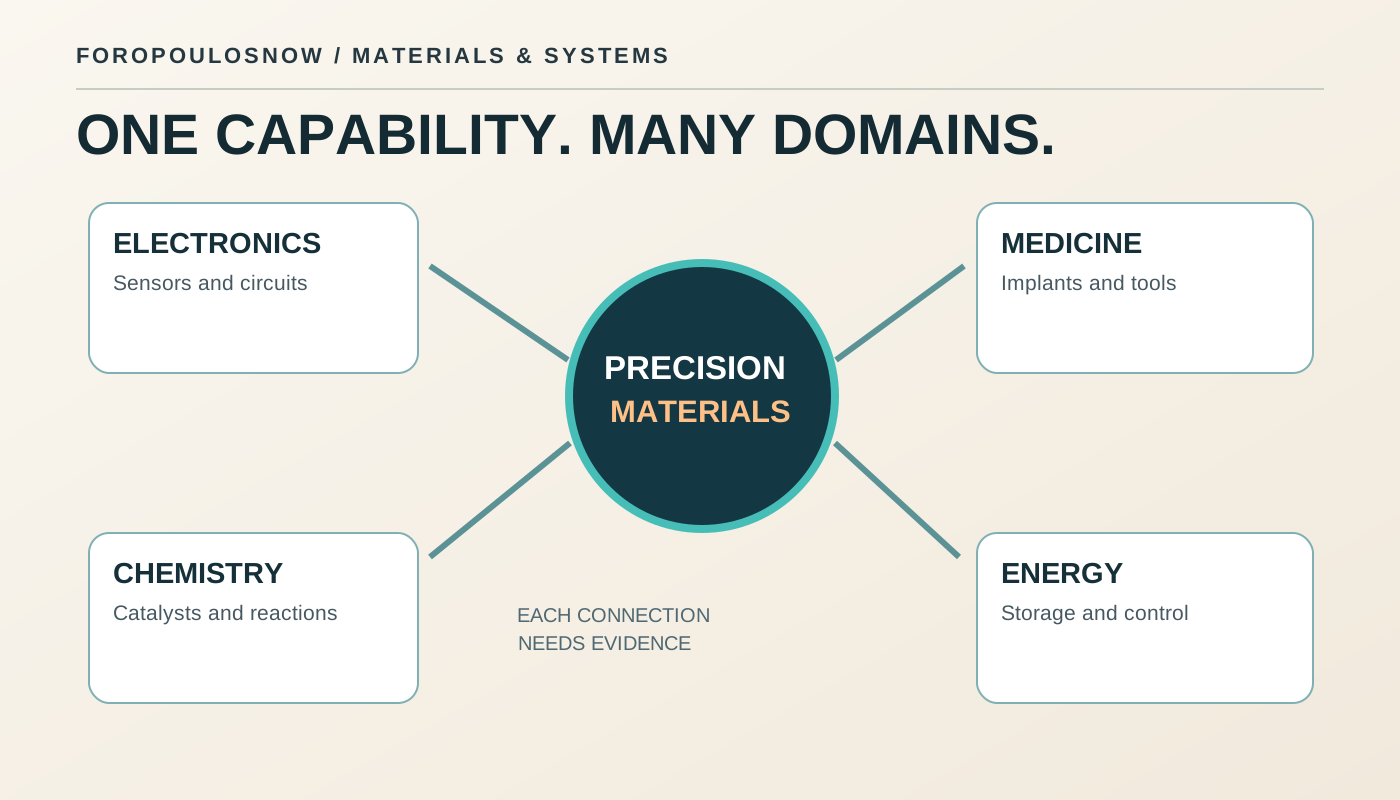
If a civilization could repeatedly manufacture complex materials with that precision, its scientific and industrial capabilities should look extraordinary. Imagine producing customized implants, specialized sensors, catalysts, electronic structures and replacement parts to verified specifications.
That doesn't eliminate the laws of thermodynamics, supply chains or quality control. You still need usable feedstock, energy, process constraints, defect detection and a reliable definition of the object you're making.
And molecular synthesis is not the same thing as perfect biological assembly. A living system is dynamically maintained, not merely shaped.
Still, this kind of manufacturing would connect chemistry, materials physics, metrology, computation and industrial engineering in a way that changes much more than dinner.
Warp drive should leave fingerprints everywhere
Now for warp drive.
The Enterprise supposedly manipulates spacetime to cross distances that make ordinary propulsion impractical. A practical faster-than-light warp system has not been demonstrated, and proposed mathematical spacetime geometries are not working engines.
But suppose a future civilization really had learned to build and control whatever physical system made this possible.
Its achievement would imply major advances in some combination of mathematics, field theory, energy handling, measurement, materials and control engineering. We cannot specify those breakthroughs in advance—especially when the premise itself may turn out to be impossible.
What we can do is ask whether the supporting knowledge would find use elsewhere.
Would new field-control techniques change precision instrumentation? Would new materials survive previously impractical conditions? Would new models enable better ways to investigate matter?
Maybe. Each is a research question, not a promise.
And even then, biological complexity might remain obstinate. The ability to manipulate an engine's operating environment does not automatically teach us everything about a brain, immune response or chronic disease.
The contradiction worth investigating isn't that all domains must advance at identical rates.
It's that a story's great inventions often arrive without the deep scientific and manufacturing ecosystem their existence would imply.
What warp drive does not prove
A fictional spacetime engine is not evidence for unlimited energy, medical cures or a new physical law. Conditional reasoning can still identify the scientific capabilities such an engine might require.
A galaxy of species, and everybody got the same instruction manual?
The alien civilizations deserve their own complaint.
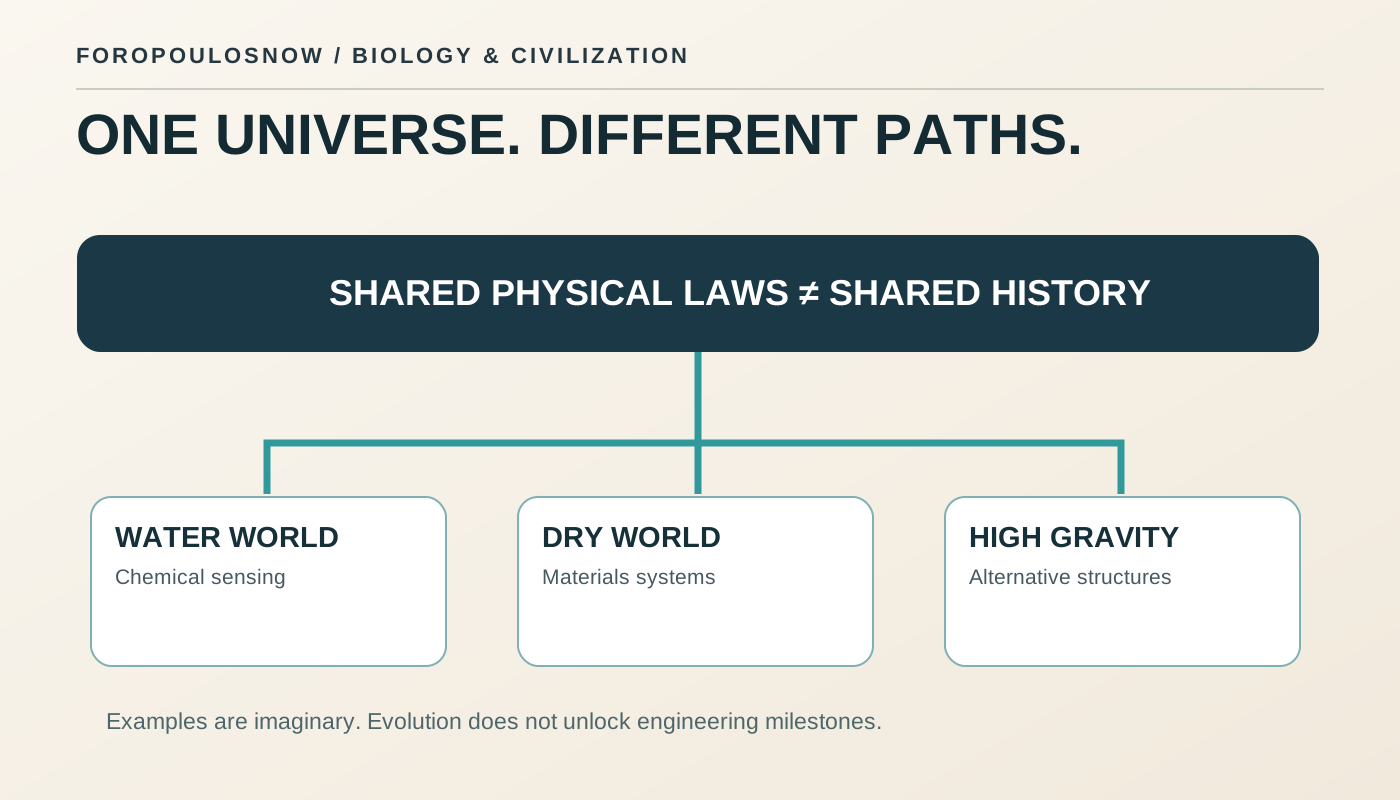
Different planets, environments, evolutionary histories and biological pressures. Yet many species end up with conveniently familiar social structures, engineering habits and technological problems.
Of course there are production reasons: a television drama needs characters audiences can understand. A negotiation scene is considerably harder when one participant is a distributed ocean intelligence that communicates by changing the chemistry of a moon.
There are scientific reasons to expect both similarities and differences.
Convergent evolution can generate similar solutions in unrelated lineages when similar environments create similar selective pressures. But evolution has no universal progress bar, and technological progress is not biological evolution.
A species with a very different body plan, sensory world or atmosphere could invent tools unlike ours. An advanced society might pursue biological engineering before spaceflight, or computation before heavy machinery. It might have excellent theoretical science and very limited resources to manufacture certain technologies.
The same physical reality does not dictate the same civilization.
And importantly, more technology does not automatically equal more wisdom. The Majalan episode makes that uncomfortable point better than almost any laboratory chart could.
So what would a serious way of comparing technological civilizations—or our own research programs—look like?
I'd stop counting impressive gadgets and start measuring verified capabilities.
The seven tiers of scientific mastery
Here is the part I care about more than the Star Trek jokes.
What if we evaluated technological progress by the capabilities a research program can actually demonstrate, then required each attempted cross-domain application to earn its own evidence?
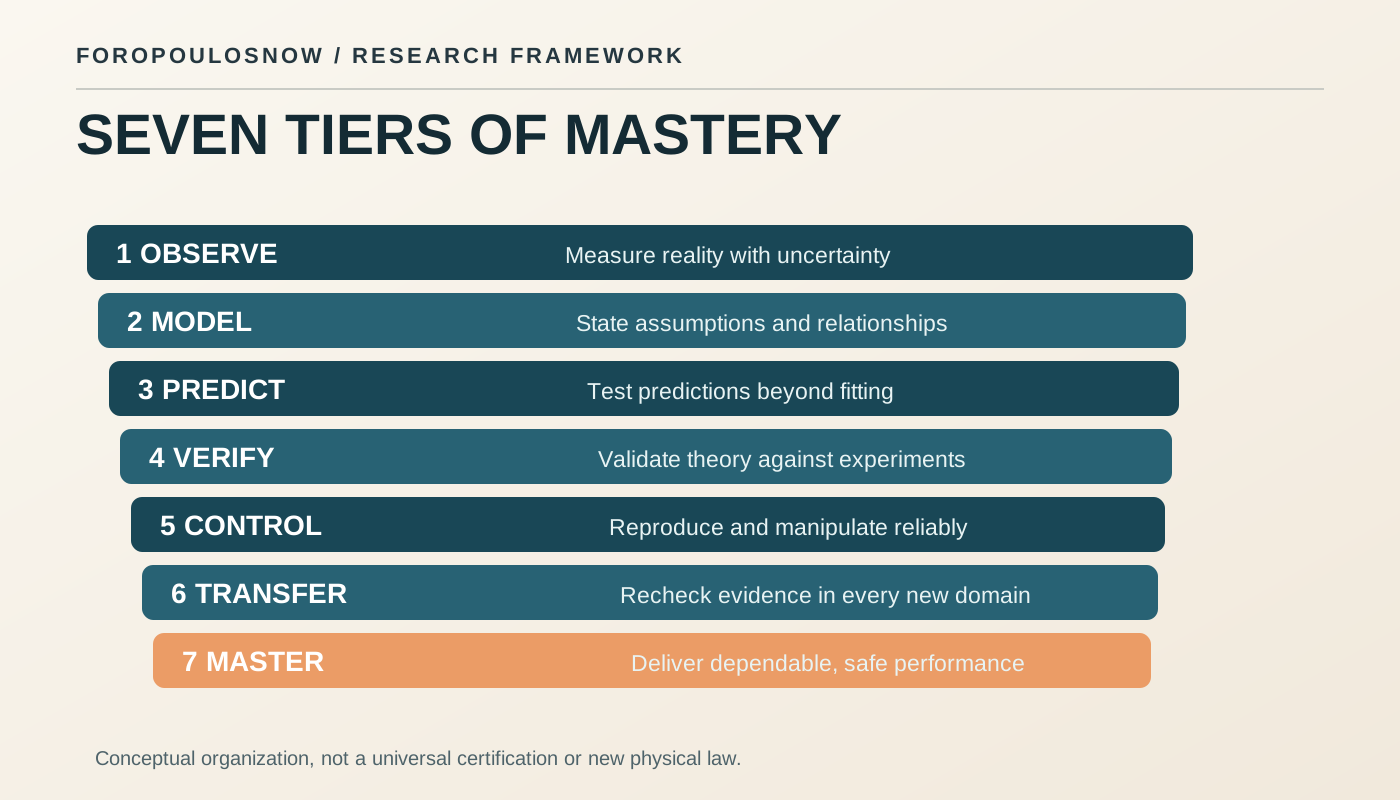
I'm proposing a practical seven-tier organizing framework for that discussion, not claiming that it is a new physical law, a finished universal mathematical system or a proof that one discovery produces another.
The tiers are intentionally recognizable: good science already relies on measurement, modeling, prediction, validation and engineering. The value is forcing the relationships to remain explicit instead of allowing impressive demonstrations to substitute for understanding.
Tier 1 — Observe
What happened? What was measured? With which instrument, calibration, error margin and boundary conditions?
A dramatic result that cannot be measured reliably is an interesting story, not an established capability.
Tier 2 — Model
Describe the observations mathematically. State assumptions, variables, domains, constraints and relationships.
An equation is not more convincing because it is longer. Sometimes the most useful thing mathematics can do is tell us exactly where an idea stops making sense.
Tier 3 — Predict
Use the model to forecast observations not already built into its assumptions or fitting process.
What outcome would count against the model? If there is no answer, we haven't designed a very informative test.
Tier 4 — Verify and validate
Check that the mathematics or computation behaves as specified, and separately test whether the model represents reality.
A formal proof can establish a conclusion from chosen axioms. It cannot, by itself, establish that those axioms accurately describe nature. Experiments, independent replication and quantified uncertainty remain essential.
This is familiar territory to researchers and engineers working on digital twins. NIST describes verification, validation and uncertainty quantification as central to credibility.
Tier 5 — Control
Can we intentionally reproduce or manipulate the phenomenon inside defined operating limits?
Predicting how something behaves is different from controlling it on demand. Ask anyone who has ever written a beautiful simulation and then connected it to actual hardware.
The hardware generally has notes.
Tier 6 — Transfer
Can a capability be applied in another domain without quietly importing assumptions that don't hold there?
A sensor proven in a factory isn't automatically proven in a bloodstream. A material safe in a turbine isn't automatically safe in a human implant.
Cross-domain integration has to earn the word validated.
Tier 7 — Master
Can the resulting technology operate reproducibly, reliably, safely and at the scale and cost required for its purpose?
One extraordinary laboratory success is valuable. A dependable manufacturing process is a different achievement.
This is not a universal ranking of science
The seven tiers are a proposed editorial and research-management lens, not a certified maturity index. Many research programs work across several tiers simultaneously, and foundational science can be immensely valuable without any immediate path to a product.
A real engineering thought experiment: build the medical sensor, not the transporter
Let's use a more achievable example than beaming somebody onto a planet.
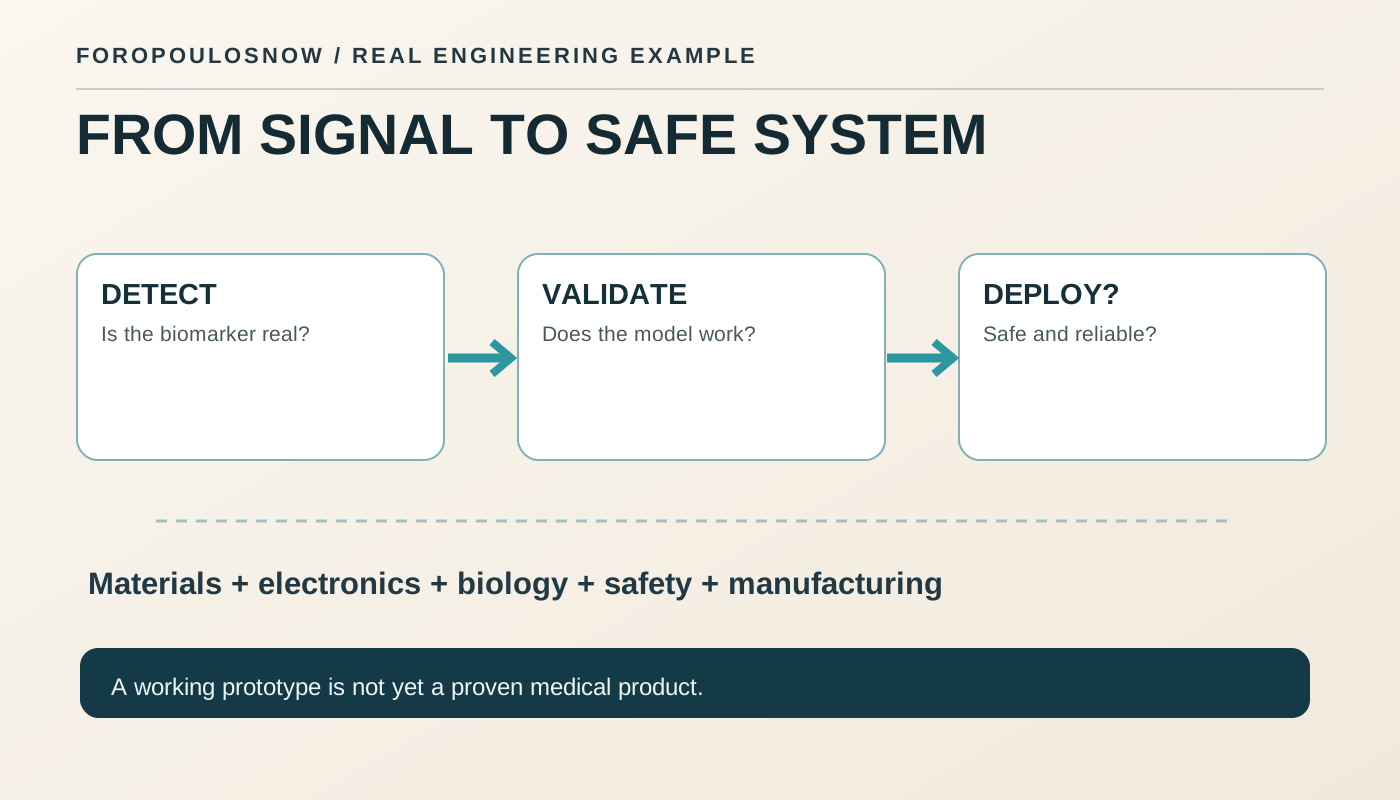
Imagine developing an implantable sensor that continuously tracks a medically meaningful biological signal and helps clinicians recognize deterioration sooner.
First, researchers must define the signal and demonstrate it can be measured. That's Tier 1.
They develop a model connecting the signal to the relevant biological process: Tier 2.
They test whether it predicts a meaningful outcome in independent data: Tier 3.
Then come laboratory studies, uncertainty analysis, biological validation and appropriate clinical evaluation: Tier 4.
Next, an engineered device must measure reliably inside a difficult, changing biological environment, while minimizing harm: Tier 5.
Materials researchers, electrical engineers, biologists, clinicians and manufacturers then integrate their separate contributions, checking that none of the assumptions silently broke during integration: Tier 6.
Finally, any actual product must satisfy manufacturing, reliability, safety, regulatory and real-world performance requirements: Tier 7.
That is an example of interdisciplinary engineering, not a claim that any particular proposed sensor has cleared those gates.
This is where the science-fiction comparison becomes useful. Instead of saying, "Well, if we can do X, surely we can do Y," we ask:
Which transferable capability does X establish, and what evidence would Y still require?
That question connects science without pretending one discipline automatically solves another.
The only part of science fiction I'd really like us to steal
I don't want to remove the drama from Star Trek. I enjoy watching the Enterprise solve an impossible problem with thirty seconds remaining as much as anyone else.
And, yes, it's fun to imagine a doctor explaining that your injury has been repaired by microscopic machines before you even realized you needed an appointment.
But as engineers and researchers, we get something better out of the fiction than an argument over whether a prop is believable.
We get an opportunity to examine the systems of knowledge behind the invention.
A transporter is not just a transporter. It raises questions about information and physical structure.
A replicator isn't just a kitchen appliance. It raises questions about molecular synthesis and manufacturing.
A warp drive isn't just a faster engine. It raises questions about spacetime, energy and the limits of our models.
And an advanced medical system isn't just a scanner with impressive lighting. It is biology, chemistry, materials, electronics, computation and years of experimental validation working together.
The Enterprise can keep its transporter. For now, I'd settle for fewer scientific ideas that work only in one PowerPoint presentation.
There is only the Work.
— Thesecretchief
Sources and further reading
- Star Trek, official recap: "Lift Us Where Suffering Cannot Reach" — the Majalan quantum-bioimplant story and its social context.
- Star Trek: "Inventing the Replicator" — fictional molecular manufacturing as imagined in the later franchise.
- IBM Quantum Learning: Quantum Teleportation — transfer of quantum information, not matter.
- IBM Quantum Learning: Limitations on Quantum Information — the no-cloning theorem.
- NIH NIBIB: Researchers Renew Obsolete Concept Using Folate for Cancer Drug Delivery — real nanomedicine research, distinct from autonomous medical nanobots.
- NIST: Credibility Consideration for Digital Twins in Manufacturing — verification, validation and uncertainty in engineering models.
Editorial note: Star Trek is discussed as cultural criticism and a scientific thought experiment. The original illustrations are conceptual, contain no official franchise imagery, and are not technical blueprints. This article does not assert the existence of working human teleportation, warp engines, autonomous medical nanobots or a new validated mathematical law.