

Inside the Prometheus Engine Core: Formal Mathematics, Deterministic Computing, and the Future of Agentic Research
By Lyko Research Labs | A Greek-Fire Corporation Research Initiative
What if artificial intelligence didn't just give you an answer, but could prove that answer was mathematically correct?
That question is becoming increasingly important as artificial intelligence moves beyond generating text and begins participating in scientific research, engineering, mathematical discovery, and autonomous decision-making.
Modern AI systems can write sophisticated software, analyze enormous datasets, develop mathematical hypotheses, and produce compelling explanations. But one fundamental problem remains:
A convincing answer is not necessarily a correct answer.
Even the most advanced language models can make mathematical mistakes, misunderstand assumptions, or produce results that appear logical but fail under rigorous examination.
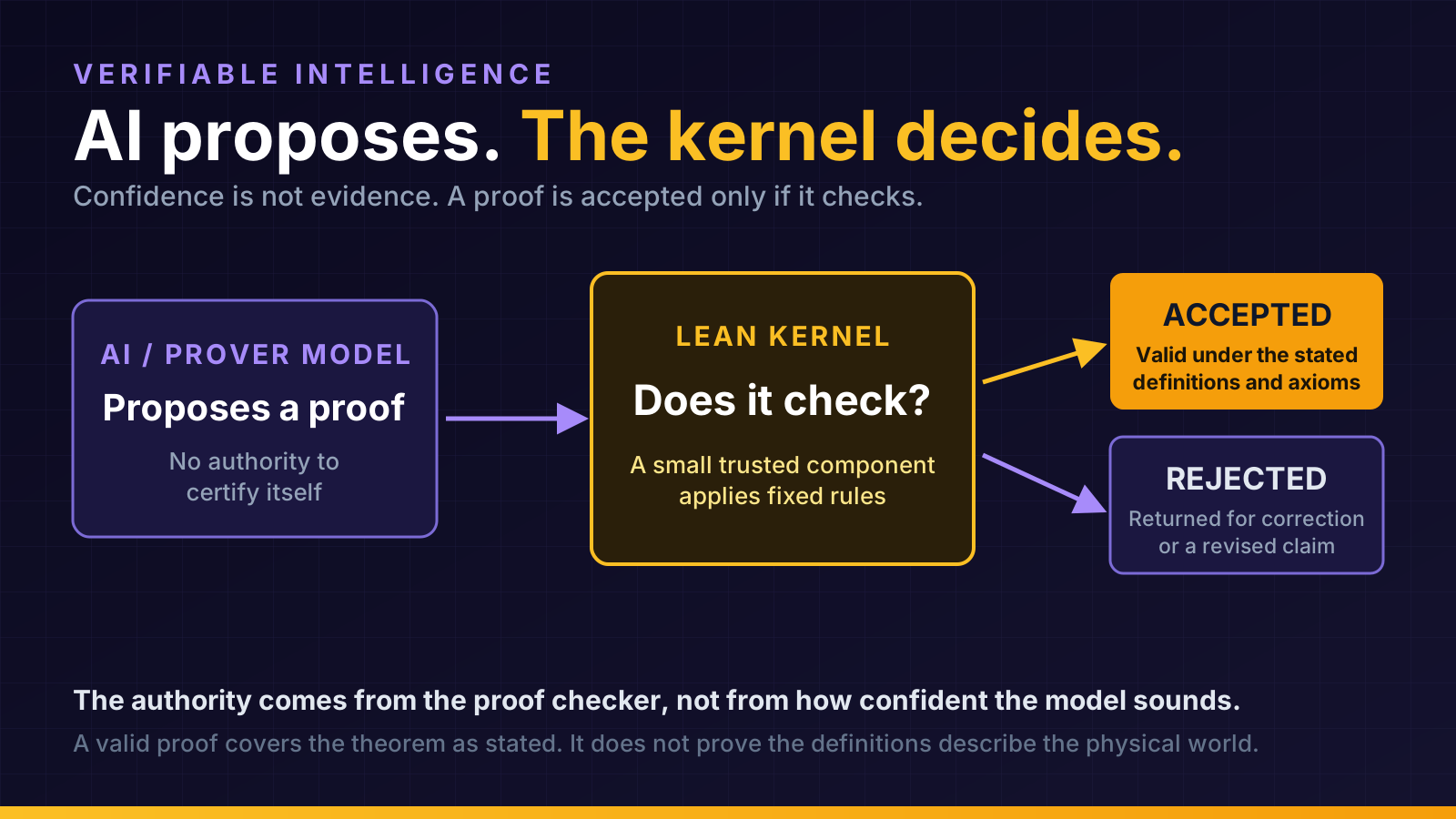
At Lyko Research Labs, our work on the Prometheus Engine Core approaches this problem from a different direction.
Rather than relying exclusively on probabilistic AI outputs, we are developing deterministic computational systems supported by formal mathematical verification, reproducible experiments, and structured certification records.
One of the technologies helping make that possible is Lean 4, a programming language and interactive theorem prover.
To understand why that matters, we first need to understand what a Lean proof actually is.
What Is a Lean Proof?
A mathematical proof is a logical demonstration that a statement follows from established assumptions and accepted rules of reasoning.
Traditionally, mathematicians write proofs for other mathematicians to evaluate. Those proofs may span pages of calculations, definitions, and logical arguments.
A Lean proof takes a different approach.
Instead of relying entirely on human interpretation, Lean allows mathematical statements and their supporting arguments to be expressed in a formal language that a computer can verify.
For example, imagine we wanted to prove that adding zero to a natural number leaves that number unchanged.
In Lean, we could express this as:
1theorem add_zero_example (n : Nat) :
2    n + 0 = n := by
3  simp
The important part is not the syntax.
It is what happens when the proof is checked.
Lean processes the theorem and the proof, translates them into a precise internal representation, and uses a small trusted component called the kernel to check whether the proof is valid under the system's rules.
If the argument cannot be justified, it will not be accepted as a completed proof.
This introduces an important distinction between traditional AI-generated reasoning and formally verified reasoning.
An AI model can propose a proof. Lean determines whether that proof is mathematically valid.
One Important Qualification
A valid Lean proof establishes the theorem as formally stated, relative to its definitions and axioms. It does not automatically establish that those definitions accurately describe a real-world physical system. That distinction is essential to responsible scientific research.
Why Formal Verification Matters to the Prometheus Engine
The Prometheus Engine Core is being developed as a deterministic mathematical and computational foundation within our broader research and agentic engineering environment.
Deterministic computation means that, given the same defined inputs, state, and computational rules, the system follows the same mathematical behavior.
This creates an opportunity to study properties that are difficult to establish in systems that rely entirely on probabilistic generation.
For example, we can investigate whether a transformation preserves a defined quantity, whether a scheduling change affects a final result, whether an operation remains within a mathematical boundary, or whether two independent implementations produce identical outputs.
These are not merely questions of whether software appears to work.
They are questions about the mathematical rules governing the software itself.
That is where Lean becomes valuable.
By translating selected properties of the Prometheus Engine into formal mathematical statements, we can develop machine-checked proofs that establish those properties under explicitly defined conditions.
Instead of simply saying that a particular operation should always behave a certain way, we can attempt to prove exactly when and why that behavior must hold.
And when a proof cannot be established, that failure matters too.
It may reveal an incomplete assumption, a limitation in the model, or a mathematical claim that should never have been made.
How We Generate and Verify Lean Proofs
The formal verification environment in our PrometheusEngine repository includes a Lean 4 project, mathematical dependencies, machine-checked theorem files, and a proof-generation harness.
The underlying process begins with a research question.
Suppose an experiment suggests that a particular mathematical transformation preserves an invariant regardless of the order in which certain operations are performed.
That observation becomes a candidate theorem.
First, the relevant mathematical objects must be defined precisely. The theorem must then state exactly what property is being claimed and under which assumptions.
A researcher or specialized AI agent can construct a candidate proof using Lean's formal language and available mathematical libraries.
Our proof-generation tooling also includes a workflow for passing an unfinished theorem to a specialized prover model, collecting a candidate proof, and rebuilding the Lean project to determine whether that candidate is accepted.
The model is not granted authority to certify itself.
Its proposed mathematical argument must survive the independent checking process.
A successful verification establishes a formal result for the stated theorem. A failed verification returns the work for correction, further investigation, or revision of the underlying claim.
The core sequence is straightforward:
Research question → Formal theorem → Candidate proof → Lean kernel verification → Recorded evidence
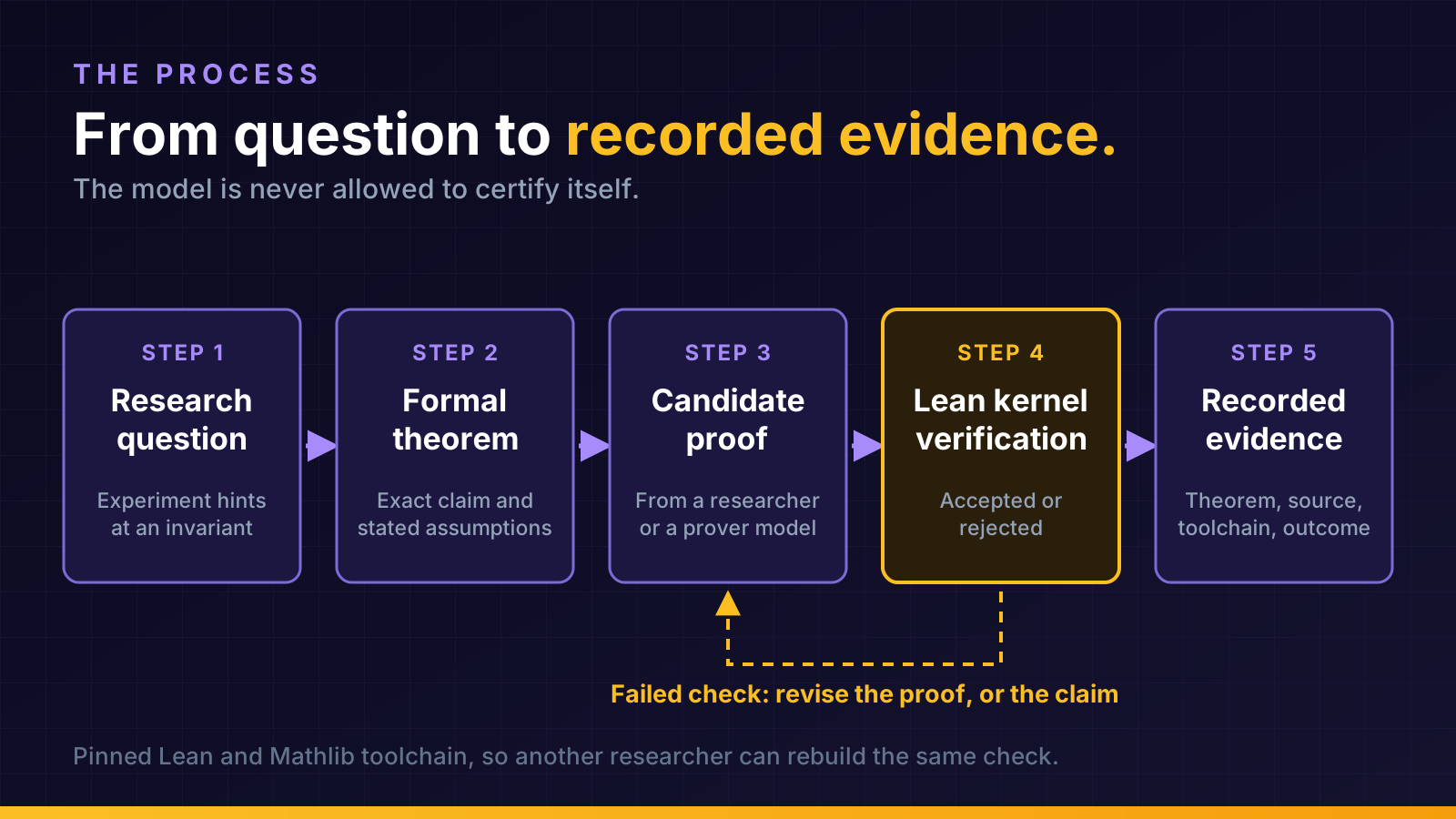
This process allows AI to assist with mathematical discovery while retaining a formal boundary between generating an argument and accepting it as proven.
Our repository includes a locally served prover harness using a Goedel-Prover model through Ollama, alongside manually completed Lean proofs. The formal project uses a pinned Lean and Mathlib toolchain so proof verification can be reproduced against defined dependencies.
That last point is particularly important.
A scientific result should not depend on the original researcher being present to explain why it worked.
Where source code and dependencies are available, another researcher should be able to examine the assumptions, rebuild the proof, and independently evaluate the conclusion.
Real Examples From Our Prometheus Engine Research
Formal verification is already represented in the PrometheusEngine research codebase.
One example concerns a mathematical topology represented by an adjacency matrix.
The Lean formalization establishes a trace-zero property for the specified structure. This is a concrete mathematical statement about the matrix and its construction.
It does not claim that every physical phenomenon associated with the structure has been proven. It establishes a particular mathematical foundation that subsequent analysis can reference.
Another research area concerns invariance, computational state, and the behavior of deterministic wave-register operations.
The formal library includes work addressing scheduling invariance, finite bounds, step confinement, and mathematical conservation relationships within defined computational models.
Why Invariants Matter
These are useful properties because deterministic systems depend on knowing which transformations preserve mathematical meaning and which operations may alter state.
An especially instructive example comes from our work on the mathematical relationship between an exact algebraic wave substrate and the Born probability rule associated with quantum mechanics.
Rather than simply asserting that our mathematical substrate derives quantum probabilities, the Lean formalization demonstrates an important limitation.
Under the stated algebraic symmetries, multiple probability-weighting functions are admissible. Those symmetries alone do not uniquely determine the Born rule.
This is precisely the kind of result rigorous research should produce.
The formal proof helps identify what the mathematics supports and what would require additional assumptions.
That principle becomes increasingly important as computational research enters areas involving physics, complex systems, and autonomous intelligence.
How This Connects to Our Deterministic Agentic Kubernetes Hive
The next challenge is scale.
A single researcher can conduct experiments, write mathematical arguments, and review results. But a modern research program may involve thousands of computational tasks, numerous independent verification procedures, and multiple specialized AI agents working across different environments.
Our broader architecture brings together PrometheusEngine, AgentFoundry, AgentOrchestra, and Kubernetes-based orchestration capabilities.
Kubernetes provides the infrastructure for organizing and executing containerized workloads. Agentic orchestration provides the mechanisms for assigning specialized computational responsibilities.
The Prometheus Engine Core supplies deterministic computational capabilities that those workflows can consume.
Within this architecture, different agents can contribute different forms of work.
A research agent may explore a mathematical hypothesis. A development agent may translate it into executable code. A formalization agent may construct a Lean theorem. A prover may propose an argument. Testing and verification workers may run independent checks.
The objective is not to make every AI agent individually infallible.
It is to build an environment in which the work of different agents can be evaluated against independently defined mathematical and engineering requirements.
Kubernetes can distribute the computational workload, but distribution alone does not create mathematical certainty.
Lean provides a formal verification mechanism for the mathematical properties we choose to encode, while executable tests, independent implementations, and evidence records cover other engineering and experimental obligations.
This separation is fundamental to the architecture.
The result is an approach to agentic intelligence in which confidence is supported by evidence rather than generated by language alone.
From Mathematical Proofs to Research Certifications
A Lean proof and a research certification are related, but they are not identical.
A Lean proof establishes that a formally expressed theorem follows from its assumptions.
A computational certification may additionally record the specific input, algorithm, result, numerical precision, implementation version, and evidence used to evaluate an operation.
Our PrometheusEngine codebase contains mechanisms for deterministic serialization, content-addressed records, cryptographic digests, and computational certificates.
For example, the interval-real computation layer can produce enclosure certificates that record an operation, its input digest, the resulting numerical enclosure, a referenced mathematical theorem, the computational precision budget, and the certificate's own SHA-256 digest.
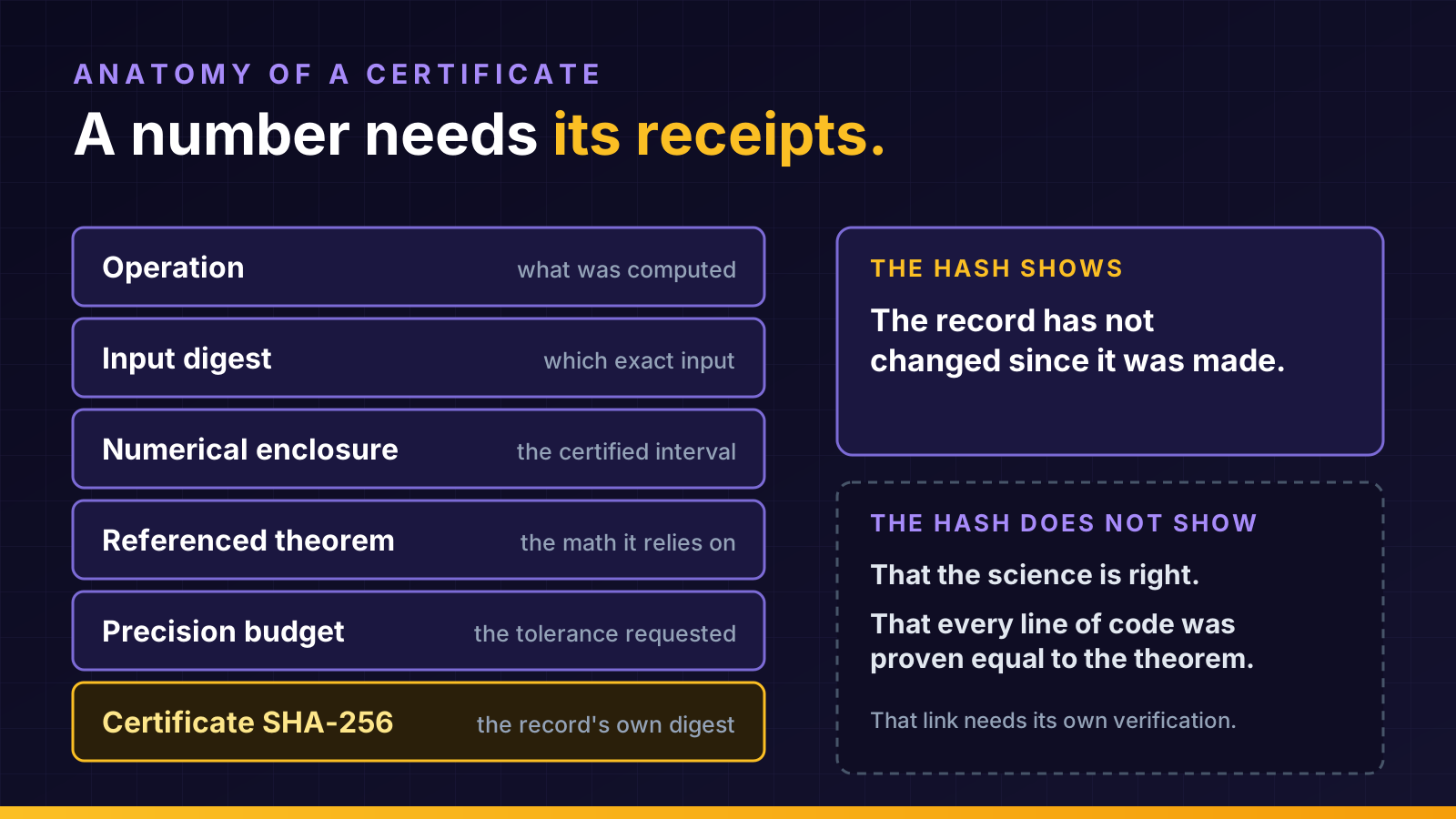
This matters because approximate numerical answers require more than a displayed decimal value.
A scientifically meaningful numerical result may need an explicit bound on its uncertainty.
If a system reports that a calculated value lies within a certified interval, the evidence must explain how the interval was constructed and why its width satisfies the requested tolerance.
The certificate records that computational claim and the conditions under which the result was produced.
A Hash Is Not a Proof
A cryptographic hash helps establish whether the underlying record has changed. It does not, by itself, prove the underlying scientific conclusion. Likewise, referencing a theorem in a certificate does not automatically mean that every line of the implementation has been formally proven equivalent to that theorem. That connection requires additional verification.
Our certification methodology therefore uses complementary forms of evidence: formal mathematical proofs where available, executable test suites, independent computational comparisons, reproducible reference outputs, and cryptographically identified records.
These layers serve different purposes, but together they provide a much stronger foundation for research than an unsupported claim of correctness.
Why Determinism and Reproducibility Matter
Consider two AI agents analyzing the same mathematical model.
They may use different reasoning methods or produce different explanations. Their language can vary even when their conclusions are similar.
For deterministic computation, however, we want a much more precise standard.
When the same canonical inputs are processed under the same defined computational rules, the resulting state should be reproducible wherever the implementation's determinism guarantees apply.
That is valuable for scientific research, distributed computing, engineering validation, and eventually hardware implementations.
Our ongoing Prometheus Engine work includes comparisons between TypeScript and Rust implementations, exact arithmetic and numerical-boundary checks, and hardware-oriented validation workflows.
The purpose is to identify where the same mathematical rules can be represented consistently across implementations.
A formal proof can establish a mathematical invariant. A software test can detect whether an implementation violates an expected behavior on tested inputs. A hardware simulation can compare generated circuit behavior against a software reference.
Each addresses a different potential source of error.
The distinction becomes especially valuable when moving research from software models toward physical computing infrastructure.
If the same core is expected to operate across multiple environments, we need evidence that its defined behavior survives those transitions.
How Lean Proofs Support Our Research Publications
One of our objectives at Lyko Research Labs is to ensure that research findings can be supported by inspectable technical evidence as they move toward publication.
Scientific publications traditionally communicate methodology, observations, mathematical derivations, experimental results, and conclusions.
Formal verification allows us to add another important element: executable mathematical evidence.
Where a paper relies on a theorem formalized in Lean, its supporting materials can identify the exact theorem, the formal assumptions, the source file, the toolchain version, and the verification procedure.
Readers with access to the required materials can rebuild the formalization rather than relying solely on the written explanation.
The same principle extends to experimental work.
A publication can identify the input datasets, preprocessing steps, computational implementation, test environment, source revision, numerical tolerances, and resulting evidence records.
A properly documented research result should allow reviewers to distinguish between four very different categories:
- Formally proven: A mathematical statement accepted by the Lean kernel under identified assumptions.
- Computationally validated: A software or hardware behavior supported by tests, reference implementations, and reproducible comparisons.
- Experimentally supported: A scientific hypothesis evaluated against observations, measurements, uncertainty, and empirical analysis.
- Unresolved or falsified: A proposed claim that remains unproven, has insufficient evidence, or has failed its defined tests.
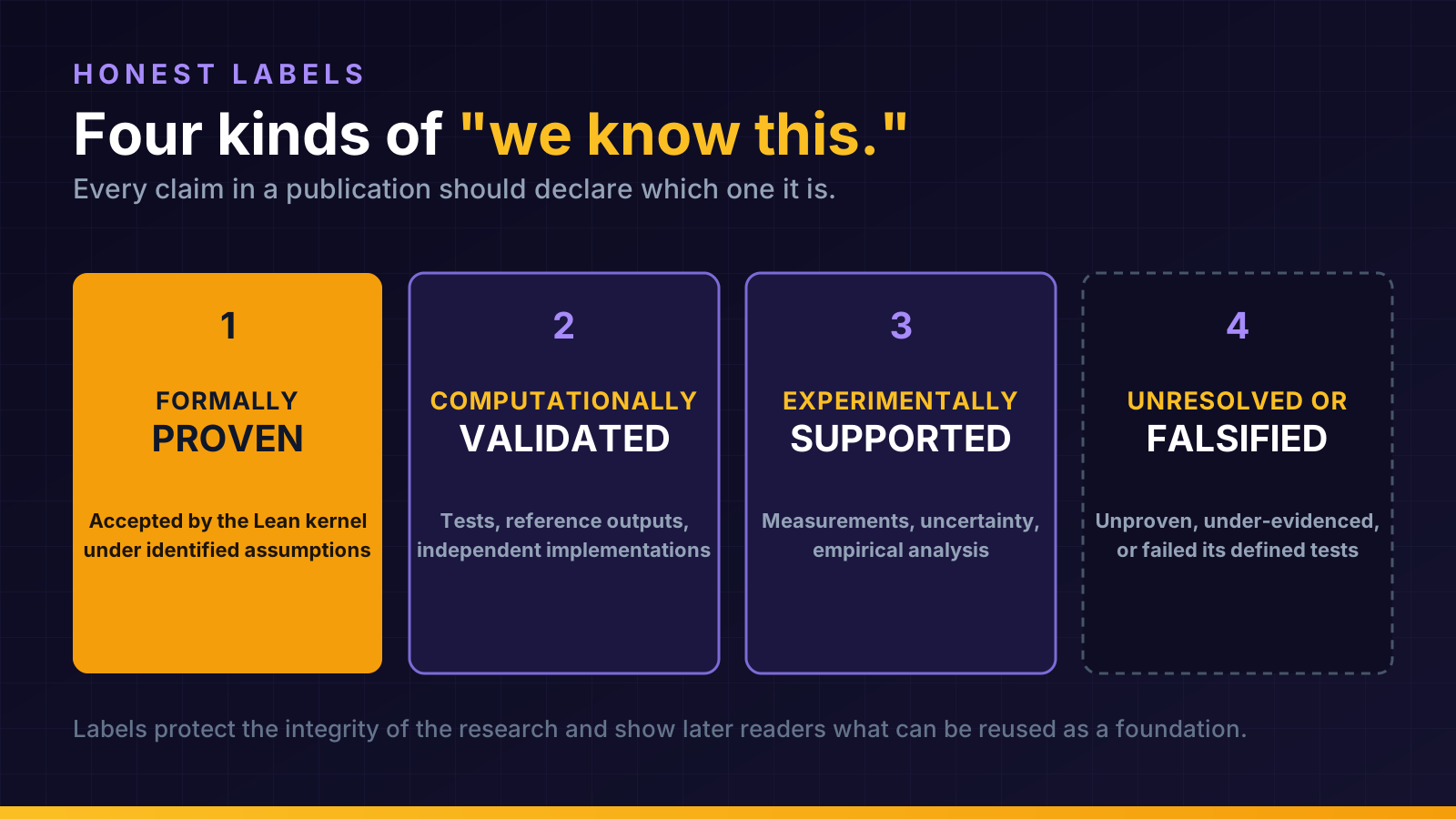
These distinctions protect the integrity of the research.
They also make publications more useful because future researchers can identify exactly which parts of a result may be reused as mathematical foundations and which require further experimental investigation.
The goal is not to publish conclusions that cannot be challenged.
The goal is to publish research whose assumptions, evidence, limitations, and methods can withstand meaningful scrutiny.
The Importance of Proving What Does Not Work
There is a tendency in emerging technology to measure progress only by successful demonstrations.
That approach can produce impressive presentations while hiding fundamental weaknesses.
Formal research requires a different attitude.
If a proof reveals that a desired mathematical property cannot be derived from the available assumptions, that is valuable information.
If an experiment produces a contradiction, that contradiction must be preserved and investigated.
If a computational certificate fails its precision requirement, the result must not be upgraded to certified simply because it appears close to the expected answer.
Our PrometheusEngine research already includes documented boundaries between exact computation, deterministic but mathematically lossy operations, and approximate numerical methods.
It also maintains records of claims that are not established or have been refuted.
Failures Are Findings
These distinctions are not obstacles to progress. They are part of how progress becomes trustworthy. In advanced research, discovering that a hypothesis is wrong can prevent enormous amounts of wasted development and reveal a more productive mathematical direction.
The ability to preserve both successful proofs and falsified claims is therefore an important part of a reliable research environment.
The Future: Intelligence That Can Explain, Reproduce, and Verify Its Work
As AI systems become increasingly capable of performing independent research and engineering, we believe the distinction between generating answers and establishing correctness will become more important.
A system that can generate a thousand mathematical hypotheses is useful.
A system that can reproduce its calculations, test its assumptions, formalize selected claims, independently check proofs, and preserve the evidence behind its conclusions is considerably more valuable.
This is the direction informing our work with the Prometheus Engine Core and the surrounding agentic orchestration infrastructure.
Lean 4 represents one important component of that direction.
It does not eliminate the need for scientific experiments, sound modeling, independent review, or responsible interpretation.
What it provides is a powerful mechanism for moving certain mathematical claims out of the realm of persuasive explanation and into the realm of machine-checkable evidence.
Combined with deterministic computation, distributed agentic engineering, and reproducible experimental records, it creates a foundation for more accountable computational research.
At Lyko Research Labs, that is what we want our research and publications to represent.
Not simply what our technology can produce.
But what we can demonstrate, reproduce, and justify.
Because the future of advanced intelligence should not depend on how confidently a machine can tell us it is right. It should depend on how rigorously we can establish when it is right, why it is right, and where its conclusions stop being justified.
That is the value of a Lean proof.
And that is the standard we are working to bring into the Prometheus Engine Core.
Lyko Research Labs
Where Theory Becomes Discovery.
A research initiative of Greek-Fire Corporation. lykoresearchlabs.com
Technical references: The engineering described here is supported by the PrometheusEngine formal proof project, its Lean proof-generation harness, the LYKO Core Map and certification inventory, and AgentOrchestra. The formal verification methodology is grounded in the Lean 4 language documentation.


