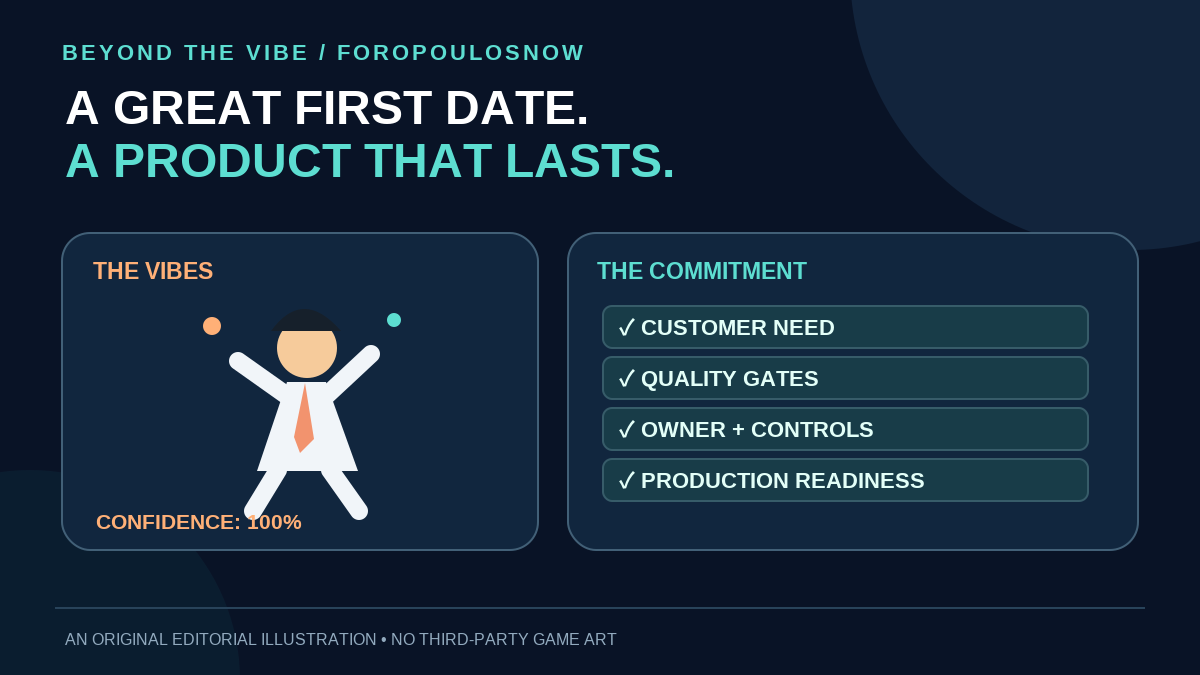

Every time somebody mentions vibe coding, my brain immediately goes to Leisure Suit Larry.
Some of you are old enough to remember him. For the rest of you, imagine a guy in a white polyester suit, a gold chain, and a level of confidence absolutely unsupported by the available evidence.
There he is. Wandering around. Throwing out pickup lines. Trying to get laid.
Larry has ambition. Larry has enthusiasm. Larry has absolutely no plan for tomorrow morning.
But he's having a fantastic time trying.
And somewhere between that ridiculous outfit and his unwavering belief that everything will work out, I see a remarkably accurate illustration of the modern software-development conversation.
Because there is a difference between getting something to work for one exciting evening and building something that can survive a long-term relationship.
That's what this article is about.
Not whether artificial intelligence can generate software. It absolutely can.
It's whether the person steering it understands how to turn that software into a product somebody can depend on.
And believe me, Monday morning has a way of separating the two.
Vibe Coding Is a Real Thing. So Is Knowing What You're Doing.
Let's be fair to the technology.
AI coding tools are extraordinary. Someone who couldn't have built a website a few years ago can now describe an application, generate a working interface, connect services, and have a prototype on the screen in an afternoon.
I love that.
Anything that makes experimentation more accessible and gives a small team more leverage is worth paying attention to.
But we ought to use the terminology correctly.
Andrej Karpathy popularized vibe coding in February 2025 as a deliberately casual approach: ask an AI to generate the code, run it, feed problems back, and largely stop worrying about the implementation itself. Martin Fowler later drew a useful distinction: that is not the same as experienced people using AI while reviewing the design, understanding the code, and retaining responsibility for its behavior.
I think that distinction matters considerably more than which model you're prompting.
Two Different Approaches
Vibe coding: ask for the result, try it, keep prompting, and often accept code you do not really inspect.
Disciplined AI-assisted engineering: establish requirements, design constraints, tests, review and operational ownership—then use AI to accelerate the work.
Neither approach requires you to hate the other one. A throwaway personal tool is a perfectly good place to experiment.
The mistake is treating a disposable experiment like it has already met the obligations of a business.
Larry can have a great night out.
That doesn't make him ready to share a mortgage.
Congratulations. Your Demo Works. Now Introduce It to Customers.
Let's say my old buddy calls.
"Man, you're not going to believe it. I just built an entire marketplace with AI."
Terrific.
"Users can sign up, message each other, book services, and pay."
Even better.
"And it's basically done."
There's the sentence that makes me put down my coffee.
Because I've seen the difference between what works in a demonstration and what happens when real people get involved.
The login screen looks wonderful—until somebody forgets a password.
The payment button works—until a transaction retries and produces an unexpected result.
The booking system looks elegant—until two customers try to reserve the same resource at once.
And the dashboard that looked terrific with six carefully chosen records begins behaving a little differently when it has to support actual business operations.
None of that proves a particular AI-built application will fail. These are illustrative problems that real product teams plan and test for.
The point is that a successful demo does not establish production readiness.
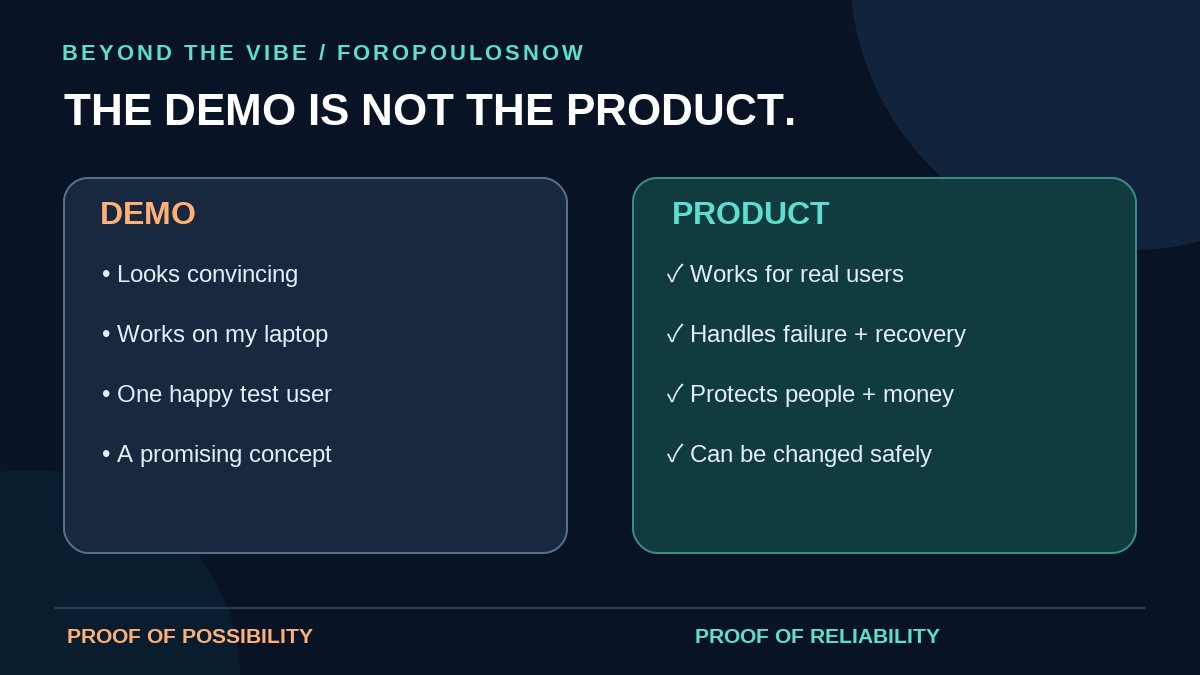
A prototype answers: "Can I make this work?"
A product has to answer: "Can the customer use it, can the business support it, and can we change it without breaking everything around it?"
That gap between appearance and dependable operation is where product experience starts paying for itself.
Product Management: Somebody Has to Know What We're Building.
Here's a misconception I run into all the time: product management is the person who makes everyone write status updates.
No.
Good product management is the discipline of deciding what should be built, for whom, why, in what order, and how we'll know it worked.
Before developers start generating features, someone needs to understand the customer, the economics, and the operational requirements.
What actual problem are we solving?
Who will pay for the solution?
What's essential to the minimum viable product, and what's just somebody's shiny idea from Tuesday?
Which features depend on other features?
Which risks could hurt a customer—or put the business in an uncomfortable position with a payment processor, regulator, or attorney?
What does success look like after launch?
Those questions aren't a bureaucratic obstacle to engineering. They're how we prevent engineering effort from going in ten different directions.
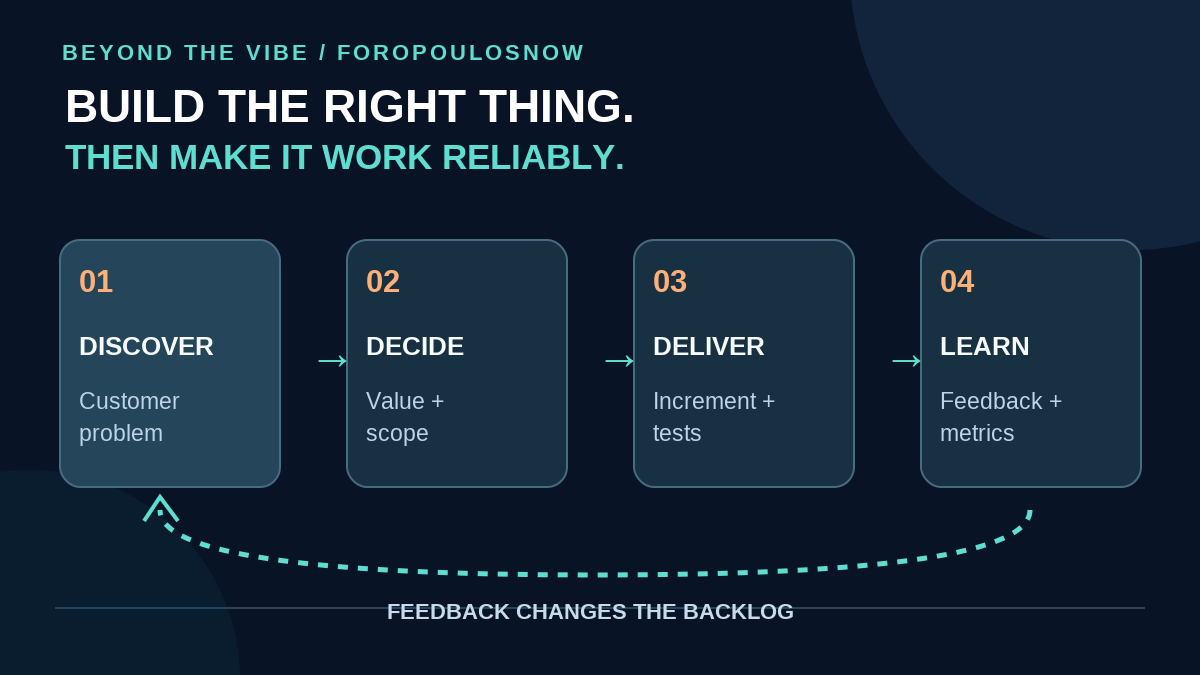
You can build the wrong thing beautifully. You can even build the wrong thing exceptionally fast.
Artificial intelligence has made that second option easier than ever.
A capable product leader helps make sure speed is being spent on something that matters.
Scrum Isn't a Board Full of Colorful Little Tickets.
Now we get to the stuff that doesn't make for a very sexy social media demonstration.
Product backlogs. Sprint Goals. Milestones. Dependencies. Acceptance criteria. Reviews.
Yes, all the things people discover immediately after their application starts attracting actual customers.
Scrum is a lightweight framework for managing complex work through short cycles of delivery, inspection, and adaptation. The official Scrum Guide defines accountabilities, events, artifacts, and commitments. It does not require Jira, a particular ticket board, mandatory story points, or a corporate circus.
The Product Owner is accountable for maximizing value and effectively managing the Product Backlog.
The Developers are accountable for creating usable increments of work.
The Scrum Master is accountable for establishing Scrum and helping the team improve its effectiveness.
These are accountabilities, not necessarily three separate people drawing three separate salaries at a startup.
A Sprint contains planning, regular inspection, review of the result, and a retrospective for improving the way work gets done.
Outside a formal Scrum framework, other teams may use Kanban or a simpler delivery cadence. That's fine, too.
What matters is making the work visible, knowing who is responsible, and learning from the result.
And yes, businesses still need delivery dates and milestones. Those are commitments to coordinate intelligently—not excuses to pretend that uncertainty disappears because somebody put Friday in a spreadsheet.
A deadline without an agreed deliverable is just a date.
And a Scrum board without a product strategy?
It's an expensive to-do list with better colors.
The Most Expensive Word in Software Engineering Is "DONE."
Let's take something simple.
"Allow customers to reset their passwords."
AI may generate the interface and backend code in a few minutes. Wonderful.
Now tell me what happens when the reset token expires.
Can someone reuse it?
Can one customer reset another customer's account?
Do failures expose whether an email address is registered?
Are the security checks, tests, and operational logs good enough to understand what happened if a problem occurs?
Has it been reviewed, integrated, and tested in an environment that resembles the one customers will actually use?
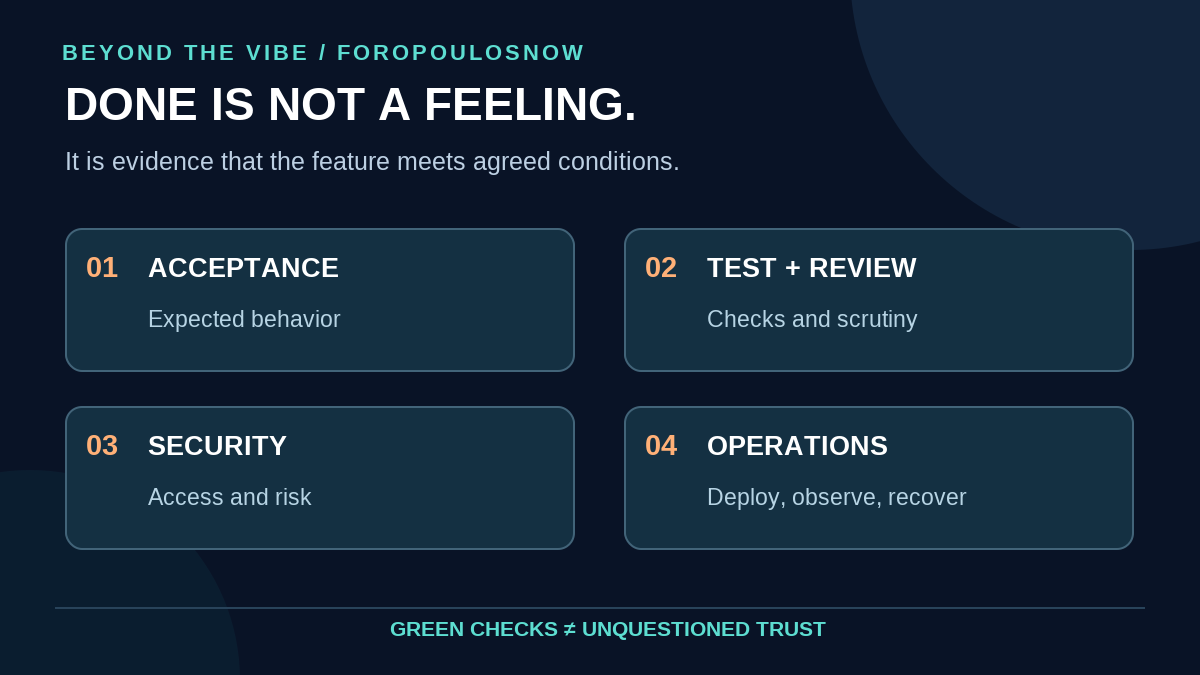
That is why experienced teams establish acceptance criteria and a Definition of Done.
In Scrum, the Definition of Done is a formal description of the quality measures required for an Increment to meet the product's standards. It isn't a developer checking a box because the screen looks right.
Acceptance criteria describe the expected behavior of particular work. The Definition of Done supplies a shared standard for the resulting Increment.
The Five-Minute Feature
The code may take five minutes to generate. The engineering obligation doesn't have a five-minute expiration date. Test, review and operational checks still matter when the feature handles real accounts or transactions.
And if you don't know how to evaluate what AI produced, you may not even know which questions to ask.
That's not an insult to beginners.
It's the reason experience has value.
Corporate-Level Controls: Who Gave Larry Access to Production?
Now let's make everybody slightly uncomfortable.
Corporate controls.
I can hear the objections already.
"Come on, man. I'm building a startup. I don't need a compliance department."
Maybe you don't.
But if your application handles customer identities, private messages, financial transactions, or important business records, you do need to understand who can do what—and how you'll prove it afterward.
Who has production access?
Who can modify the database?
Who can approve a release?
Where are credentials stored?
Can a deployment be traced to an authorized change?
Are important actions logged?
What happens to customer balances if a payment fails halfway through?
Can the business recover from a failed deployment or data loss?
And when somebody asks what happened last Tuesday at 2:17 in the afternoon, do you have an answer better than "the AI said it was fine"?
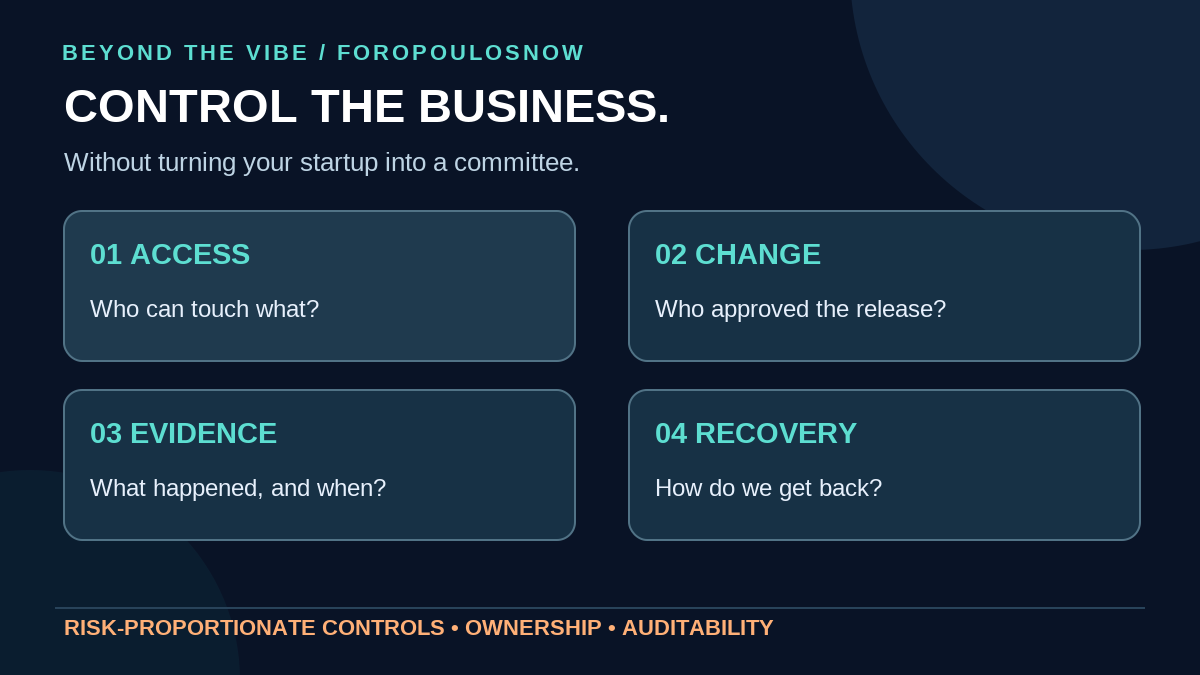
The NIST Secure Software Development Framework offers useful guidance here. Its practices are organized into four broad groups.
That's a secure-development framework—not a magic compliance certificate. Corporate governance can additionally involve privacy practices, financial reconciliation, vendor oversight, audit evidence, and whatever legal or contractual responsibilities apply to your business.
A tiny startup doesn't need the same approval structure as a multinational corporation. Controls should match the risks.
Maybe your team needs a clear owner for production changes, protected credentials, code review, automated tests, backups, and a reliable way to restore service.
As the business grows, you may need stronger segregation of duties, documented approvals, independent review, and more formal evidence.
The objective is control, not theater.
A Policy Is Not a Control
A policy that nobody follows is decoration. A control that cannot be demonstrated is an assumption. Put the checks into the actual operating workflow, and retain evidence that they happened.
Because eventually customers, partners, auditors, insurers, or investors may ask questions.
At that point, "we vibed it" is a fascinating answer.
Just probably not the one they wanted.
When Code Gets Cheaper, Bad Decisions Get More Expensive.
Here's where I think the conversation gets really interesting.
Software generation is becoming cheaper and faster.
But the cost of solving the wrong problem hasn't magically gone away.
Neither has the cost of poor architecture, security mistakes, unmaintainable dependencies, support issues, or decisions nobody documented.
Imagine two teams using the same AI coding assistant.
Team One asks it to build features as quickly as possible. If something looks wrong, they prompt again. They accumulate functionality without a clear product backlog, tests, or reliable ownership.
Team Two uses AI just as aggressively, but it operates against an agreed product goal, documented requirements, sound engineering constraints, test evidence, and a controlled release process.
Both teams may produce impressive code.
One is also making disciplined decisions about whether the code belongs in the product and how the business will operate it.
That's the advantage.
Google's 2025 DORA research describes AI as an amplifier of an organization's existing capabilities. The report emphasizes foundations such as user focus, platforms, and team practices, rather than treating the tool itself as a guarantee of better results.
That's research about observed organizational patterns, not a promise that every experienced team wins or every beginner fails.
But it lines up with a principle I've learned working across technology and business operations:
Speed is valuable only when you understand what it's accelerating.
And that's why I think experienced product managers, architects, developers, and operations leaders may become more valuable as these tools mature.
They can use the same acceleration without handing over their judgment.
You Don't Need Seventeen Managers and a Ceremonial Stand-Up.
Now, before somebody buys a giant enterprise-management subscription for their weekend app, let's clear something up.
I am not proposing more bureaucracy.
I've spent enough time in business operations to know exactly how ridiculous management overhead can get.
You do not need a twelve-person steering committee to change a button label.
You don't need a meeting to decide whether to hold a meeting about your next meeting.
And if your Scrum process is producing more status reports than working software, we should probably have a different conversation.
A solo founder can practice legitimate product management.
A two-person team can maintain a meaningful backlog, define acceptance criteria, review changes, manage credentials, and establish a release process.
You don't need to imitate a Fortune 500 organizational chart.
You need enough structure to know what you're building, why you're building it, whether it's complete, and what happens when it breaks.
Here's a practical place to start.
Good process removes uncertainty you can control. Bad process manufactures work to justify its own existence.
That's the balance I'm interested in: capable people, assisted by powerful technology, operating with just enough discipline to deliver something durable.
Larry, We Need to Talk About the Relationship.
Look, I genuinely want people to experiment with AI.
Build that app. Test that idea. Show your friends. See whether anybody actually wants to use it.
There has never been a better time to try.
But don't confuse the excitement of building something with the experience required to run it.
When you move from a prototype to a product, you inherit new responsibilities. When that product becomes a business, those responsibilities expand.
And that's exactly what we're going to explore in Beyond the Vibe: Building Software That Lasts.
In the installments ahead, we'll get practical about product discovery and roadmaps, Scrum without the theater, definitions of done and quality gates, corporate controls, production operations, and the modern AI-assisted team.
Not because everybody needs a title.
Because knowing how professional product delivery works gives you an advantage when almost anybody can generate code.
Now, back to Larry.
There he is in that white suit, out on the dance floor, confident that everything is going according to plan.
He may even get lucky.
Good for Larry.
But Monday morning is still coming.
And if you're planning to build a business together, you might want to have that conversation while everyone still has their clothes on.
— Thesecretchief
Sources & Further Reading
- Martin Fowler — Vibe Coding (May 2026). Distinguishing uninspected prompt-driven experimentation from professional AI-assisted engineering.
- The Scrum Guide — Schwaber and Sutherland (November 2020). Scrum accountabilities, events, artifacts and Definition of Done.
- NIST — Secure Software Development Framework, SP 800-218. Secure-development practice groups and risk management.
- Google Cloud — 2025 DORA AI Capabilities Model. The role of organizational capabilities and AI in software development.