
How nearly three decades of controversy, technological innovation, cultural satire, and digital ambition transformed GTA from a chaotic video game into one of the most influential entertainment franchises in history.
Six Business Days in Vice City
There I am.
Robe on. Controller in hand. Responsibilities temporarily reassigned to somebody who isn't me.
GTA VI has arrived, and I've apparently decided Vice City is a perfectly reasonable place to spend the next six business days.
Across the couch, Veronica is sitting with Zero, our Siberian Husky. Neither looks particularly impressed with my sudden commitment to a fictional criminal enterprise.
Veronica has that familiar expression. The one that says she already knows how this is going to end.
Zero is probably wondering whether anyone intends to honor his walking schedule.
And I'm sitting there thinking about how far we've come.
Because somewhere between the stolen cars, police chases, ridiculous radio advertisements, and questionable decisions that would get a normal person locked up for decades, Grand Theft Auto became something much bigger than a video game.
It became a cultural institution.
I Remember It Like It Was Yesterday
I remember it like it was yesterday.
I was over at Kevin's house, and my buddy Jason had Grand Theft Auto for the original PlayStation.
We must have sat there for hours.
And I mean hours.
Taking turns with the controller, stealing cars, running from the police, laughing at the absolute insanity of what we were getting away with.
You have to understand something about gaming back then.
This was the original PlayStation era. We weren't accustomed to games that handed you an entire city and essentially said, "Here you go. Try not to get arrested."
And GTA wasn't exactly trying to win any parenting awards.
It was controversial. It was outrageous. And that was part of what made it so damn entertaining.
The graphics were nothing like what we have today. Everything was viewed from above. The cars were tiny, the streets were simple, and the action was downright primitive by modern standards.
But none of that mattered.
We were having a blast.
There was something hilarious about a game that let you do practically everything you were told not to do, with absolutely none of the real-world consequences.
And the more outrageous things got, the harder we laughed.
Looking back, what sticks with me isn't some particular mission or high score.
It's sitting there at Kevin's house with Jason, discovering a completely different kind of video game.
We didn't know we were playing the beginning of one of the biggest franchises in entertainment history.
We were just three guys having a hell of a good time.
And nearly thirty years later, here I am, still playing Grand Theft Auto.
Only now the graphics are practically cinematic, the cities are enormous, the technology is extraordinary, and the woman sitting beside me has legitimate concerns about how much time I'm about to spend playing.
Some things change.
Some things really don't.
1997: The Little Game That Let You Be the Criminal
The original Grand Theft Auto arrived in 1997, developed by DMA Design and published by BMG Interactive.
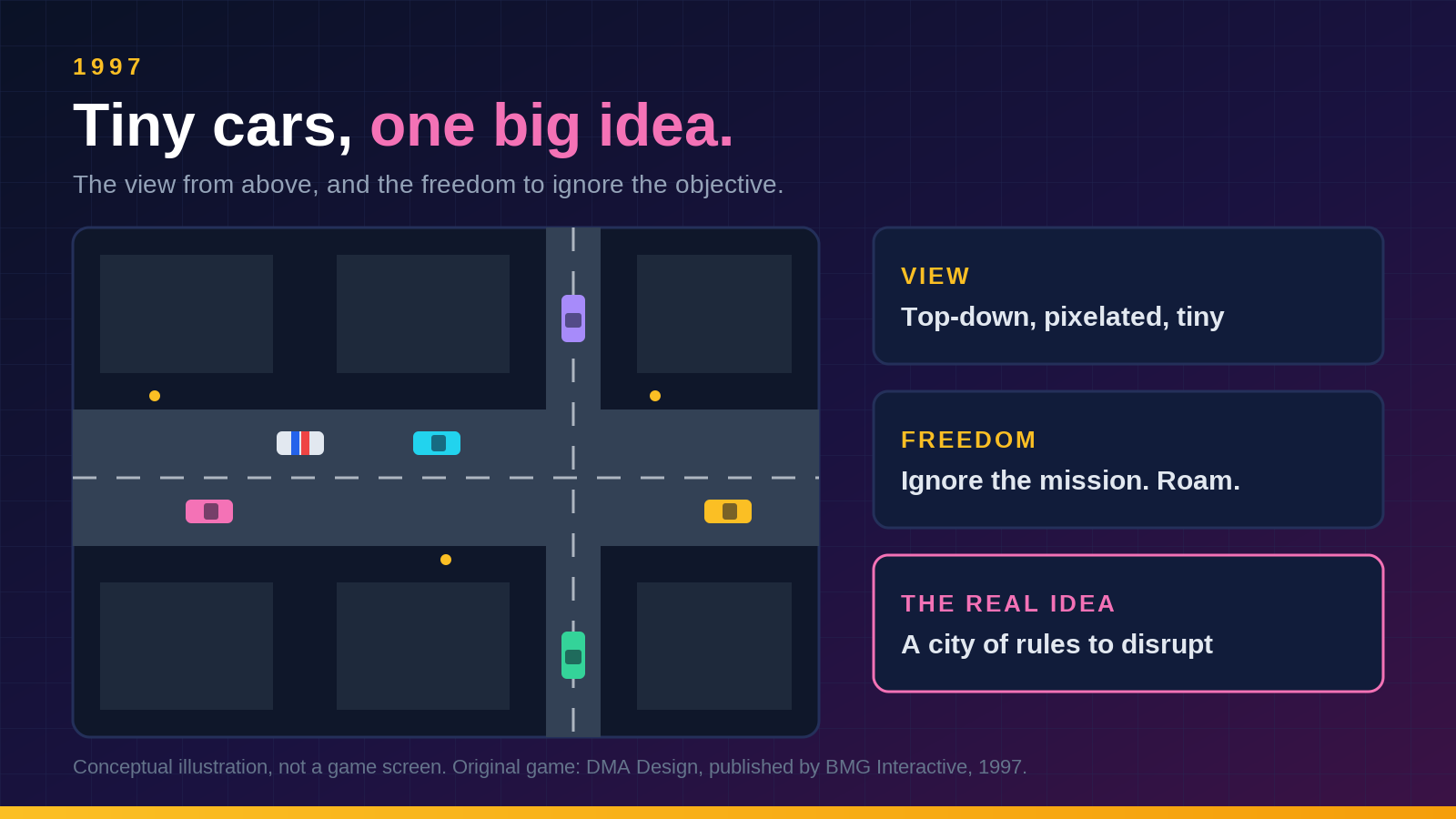
Top-down graphics. Tiny cars. Pixelated pedestrians. A city viewed from above.
You committed crimes, completed missions, stole vehicles, and attempted to avoid law enforcement.
But it had something more valuable than elaborate graphics: freedom.
The player wasn't simply following a sequence of levels. You could travel through the city, ignore objectives, experiment with systems, and create your own entertainment.
What began during development as Race'n'Chase became a criminal sandbox built around experimentation. The 1999 sequel added competing gangs and reputation systems.
The city wasn't just scenery. It was a collection of rules players could disrupt.
2001: GTA III Changes Everything
Released for PlayStation 2 in 2001, GTA III brought the formula into a three-dimensional Liberty City.
Buildings surrounded you. Traffic moved through intersections. Pedestrians occupied sidewalks. Radio stations filled the streets with sound.
Other developers had explored open worlds before GTA III. Rockstar didn't invent them. But it demonstrated how a convincing 3D city, cinematic storytelling, and player-directed chaos could operate together.
Rockstar Didn't Invent the Open World
Open worlds existed before GTA III. What Rockstar showed was how a convincing 3D city, cinematic storytelling and player-directed chaos could work together in a single game.
You might intend to complete a mission. Forty-five minutes later, you're driving a stolen police cruiser on the opposite side of town.
The game had authored missions, but it also produced unscripted stories. It helped reset expectations for interactive freedom.
2002: Vice City Gives the World a Personality
Vice City transformed the formula into a vivid parody of 1980s Miami: neon lights, pastel suits, nightclubs, expensive cars, and dubious business arrangements.
Then there was the music.
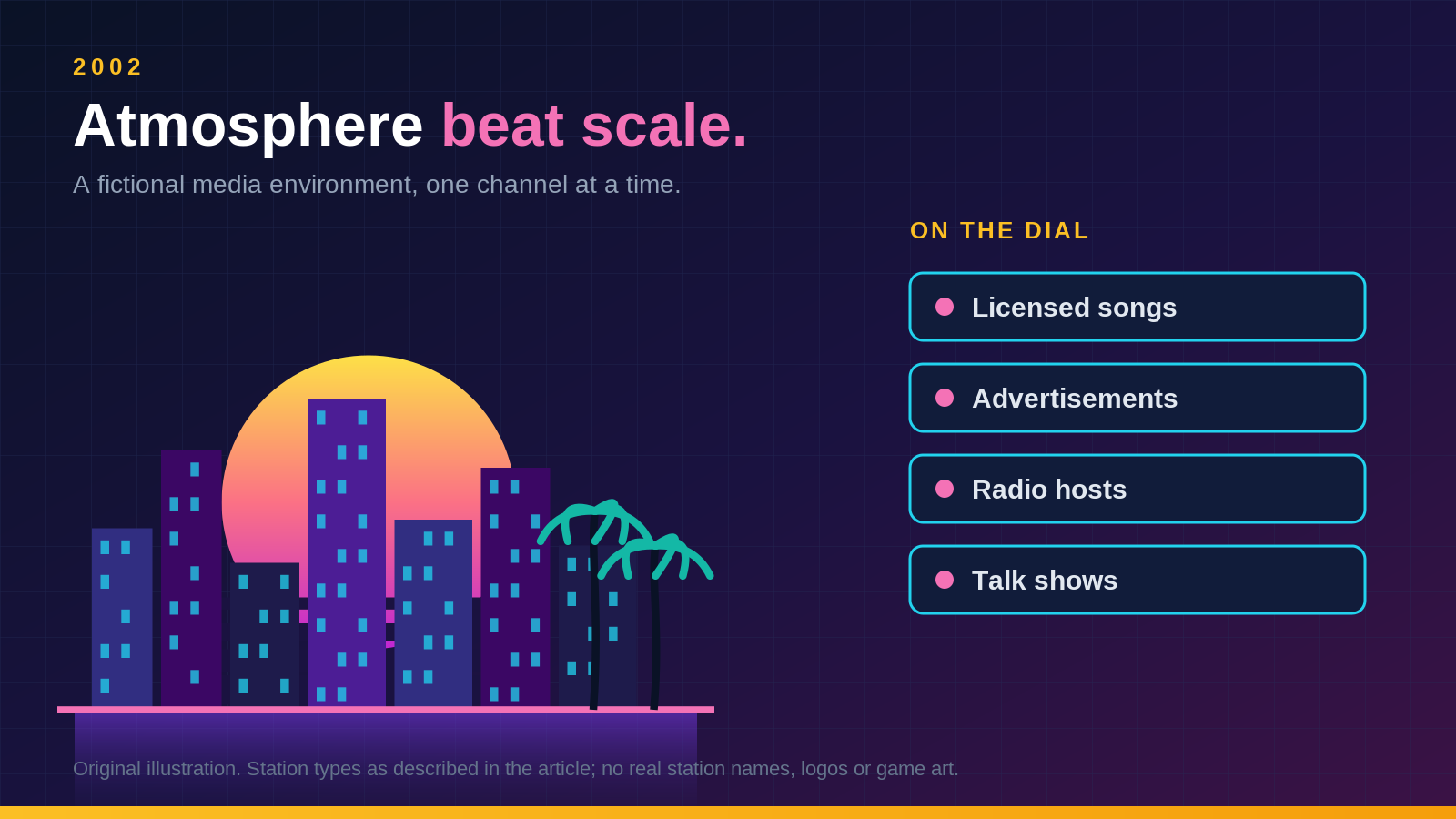
The radio stations weren't just background sound. Licensed songs, advertisements, hosts, and talk shows created an entire fictional media environment.
Tommy Vercetti, voiced by Ray Liotta, anchored the experience in gangster-movie storytelling.
Vice City proved that atmosphere could be as important as scale. The city didn't need to be the biggest. It needed to be unforgettable.
2004: San Andreas Turns a Sandbox Into a Lifestyle
San Andreas expanded the world into Los Santos, San Fierro, Las Venturas, countryside, deserts, and highways.
CJ's physical condition, appearance, and skills could change. Players customized vehicles, exercised, ate, flew aircraft, and pursued countless side activities.
Rockstar wasn't merely enlarging a map. It was expanding the number of lives players could imagine living inside it.
The game also became the center of the 2005 Hot Coffee controversy, when hidden sexual content activated by modifications led to a temporary Adults Only rating and subsequent regulatory scrutiny.
As GTA became culturally influential, its controversies traveled well beyond gaming.
2008: GTA IV Discovers That Reality Has Consequences
GTA IV returned to Liberty City with Niko Bellic, an immigrant confronting the darker side of the American Dream.
Rockstar's RAGE technology and NaturalMotion's Euphoria animation system enabled more dynamic physical reactions, movement, and collisions.
Vehicle handling had greater weight. Characters reacted more believably to impacts.
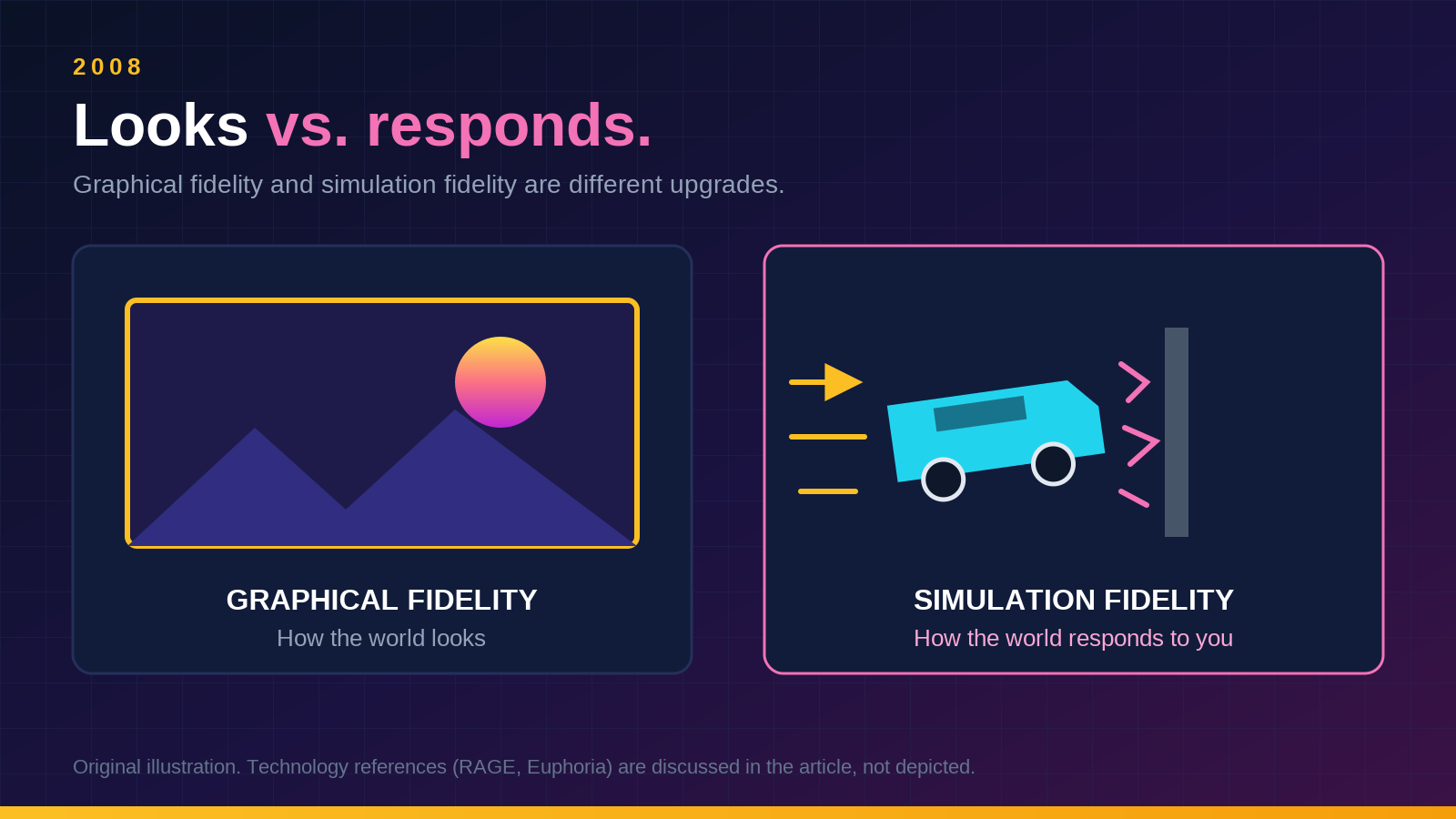
From an engineering perspective, the difference matters: graphical fidelity improves how a world looks; simulation fidelity improves how that world responds to you.
Looks Versus Responds
Graphical fidelity changes how a world looks. Simulation fidelity changes how that world responds to you. GTA IV's physics and animation work is a case of the second.
Rockstar was learning to balance computational complexity, cinematic storytelling, and player freedom.
2013: GTA V Becomes an Empire
GTA V introduced three playable protagonists—Michael, Franklin, and Trevor—whose intersecting lives provided different perspectives on wealth, ambition, crime, and excess.
Its version of Los Santos was enormous, detailed, and relentlessly satirical.
Take-Two announced more than $1 billion in estimated worldwide retail sales in GTA V's first three days. The milestone demonstrated the extraordinary commercial power of interactive entertainment.
But the franchise's next transformation would be even more consequential.
GTA Online: From Selling a Product to Operating a World
Launched in October 2013, GTA Online turned Los Santos into a persistent commercial and social platform.
New heists, vehicles, businesses, properties, and events encouraged players to return. Optional virtual-currency purchases introduced recurring revenue opportunities.
The traditional model sells a product. The live-service model attempts to maintain a relationship.
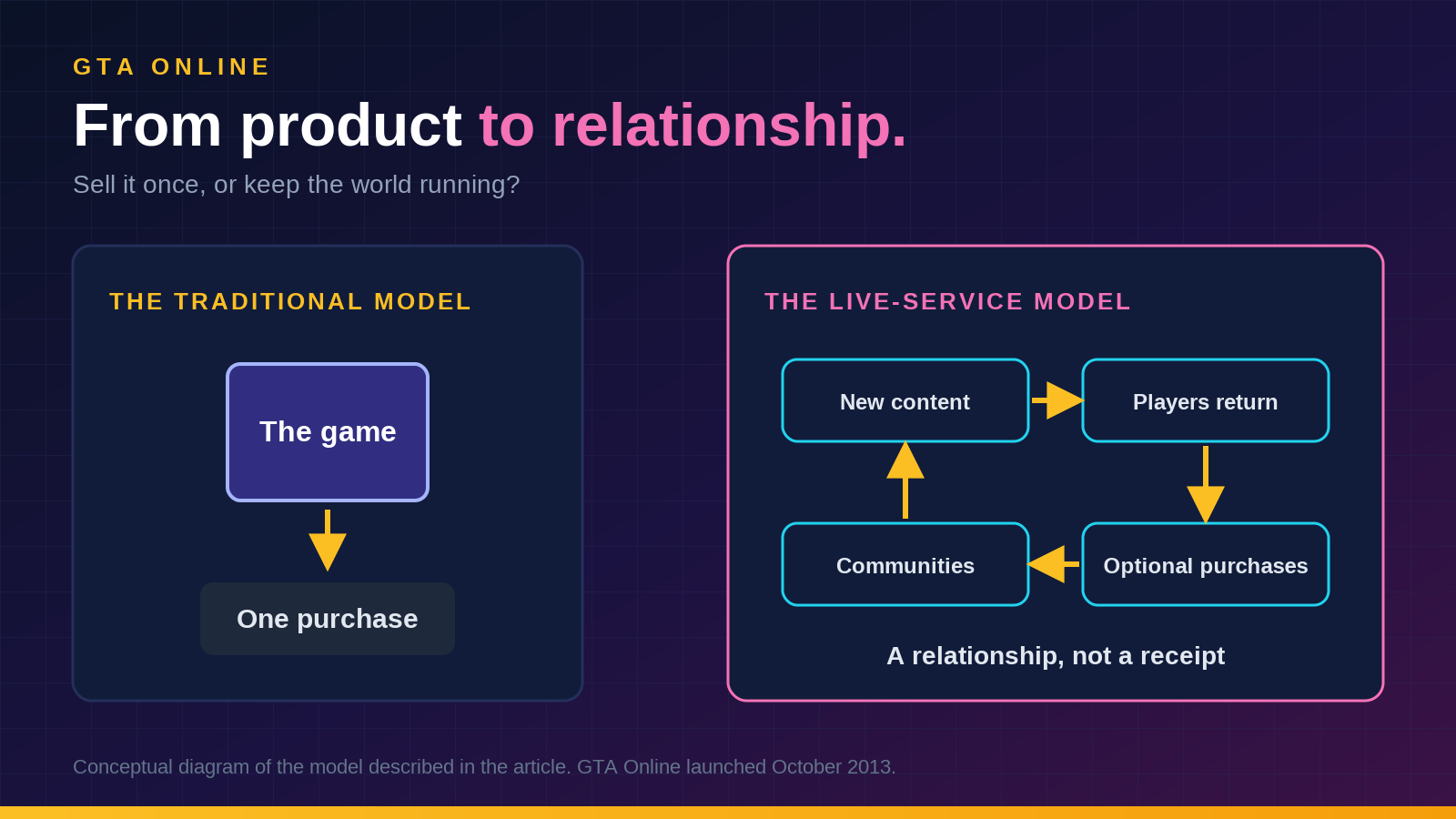
Role-playing communities created virtual police departments, businesses, careers, and improvised stories. Rockstar's 2023 acquisition of the Cfx.re team behind FiveM and RedM acknowledged the importance of these communities.
The model also raised difficult questions about monetization, player autonomy, and the future of digital ownership.
The Trade-Off
The loop that keeps a world alive also raises questions this article can't settle: how much monetization is too much, how much autonomy players keep, and what owning a digital game really means.
Every GTA Is a Time Capsule of America
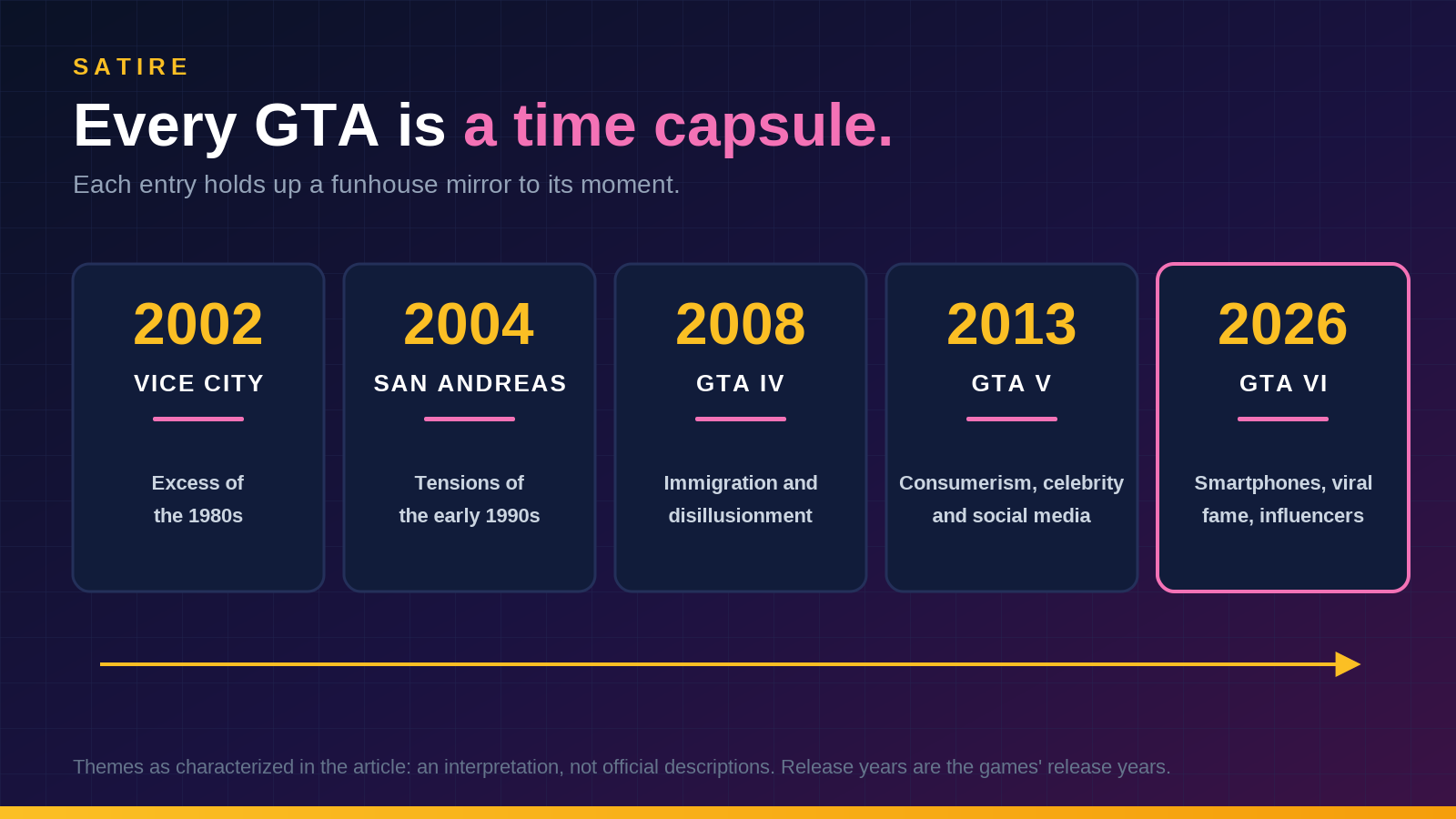
Each major GTA preserves a particular cultural moment.
Vice City evokes the excess of the 1980s. San Andreas explores the tensions of the early 1990s. GTA IV examines immigration and disillusionment. GTA V lampoons consumerism, celebrity, and social media.
Its fictional corporations, absurd advertisements, corrupt institutions, and technology parodies work because they resemble our world just enough to be uncomfortable.
GTA V's Lifeinvader satire feels less exaggerated in an era of invasive data collection and attention-driven platforms.
Not every joke lands. Not every controversy is a creative triumph. But the series has spent decades reflecting society through a funhouse mirror.
GTA VI: The Next Chapter
GTA VI returns to Vice City and the fictional state of Leonida, with Lucia Caminos and Jason Duval at the center of its story.
The surrounding world is different from the Vice City of 2002.
Smartphones are ubiquitous. Viral videos create instant celebrities. Influencers operate businesses. Attention is currency.
Rockstar now has an almost unfair amount of material for satire.
The engineering challenge is equally formidable: rendering, physics, animation, audio, asset streaming, traffic, and player behavior must coexist in a responsive real-time world.
The most meaningful advance won't be polygon count alone. It will be how convincingly—and enjoyably—the city responds to players.
Launch excitement is real, but the game's enduring impact and commercial performance must be assessed with evidence over time, not assumed on day one.
Hype Isn't a Result
Day-one excitement tells you about anticipation, not lasting impact. Sales, staying power and cultural influence only show up in evidence over time.
The Business Lesson: GTA Sells More Than Entertainment
Rockstar has built recognizable intellectual property, culturally distinctive settings, technological expectations, memorable music and characters, and a recurring online ecosystem.
Each generation inherits the memories of the last.
People who played Vice City in 2002 bring that nostalgia into GTA VI. Those who discovered San Andreas remember an entirely different world. GTA Online players have spent years creating their own stories in Los Santos.
The opportunity is immense, but so is the pressure. As development budgets and expectations rise, creative risk becomes harder to justify.
Technology and capital can help build a bigger world. Neither guarantees a better one.
Why GTA Matters Beyond Gaming
Modern games are sophisticated software systems: real-time graphics, simulation, animation, network services, economies, audio, storytelling, and human-computer interaction.
GTA helped establish expectations around player agency, world design, and cinematic presentation.
It didn't invent every mechanic it popularized. Innovation is cumulative. But Rockstar repeatedly demonstrated what could happen when existing technologies were assembled into a coherent, compelling experience.
Sometimes industries change because someone invents a new technology.
Other times they change because someone figures out what to do with technologies already available.
GTA has been especially influential at the second.
Back to the Couch
Which brings me back to where this started.
Me. In a robe. Holding a controller.
Veronica is still on the couch with Zero, watching me spend an impressive amount of time pursuing a career that would be deeply concerning if it appeared on my actual résumé.
But I'm experiencing more than another release.
I'm watching the latest chapter in a nearly thirty-year experiment—one that started, for me, at Kevin's house with Jason and an original PlayStation.
Every generation brought new technology, new mechanics, and a different reflection of the world outside the screen.
That's why GTA VI matters.
Not merely because it's bigger or more detailed.
It matters because the franchise has spent decades demonstrating how entertainment, technology, business, and culture evolve together.
Veronica may disagree with my research schedule. Zero almost certainly does.
But I've got an entire state to explore, a criminal enterprise to investigate, and a suspicious number of traffic laws to misunderstand.
So yeah. I'm playing GTA VI.
But I'm also studying the empire.
And if you need me over the next six business days, I'll be conducting very important research.
— Thesecretchief
Sources & Further Reading
- The Guardian: how Grand Theft Auto was made, DMA Design development history (2015).
- Take-Two Interactive: GTA V first-three-day sales announcement (2013).
- Rockstar Games: Cfx.re community joins Rockstar (2023).
- Federal Trade Commission: GTA San Andreas makers settle charges over Hot Coffee content (2006).